Yādavābhyudaya
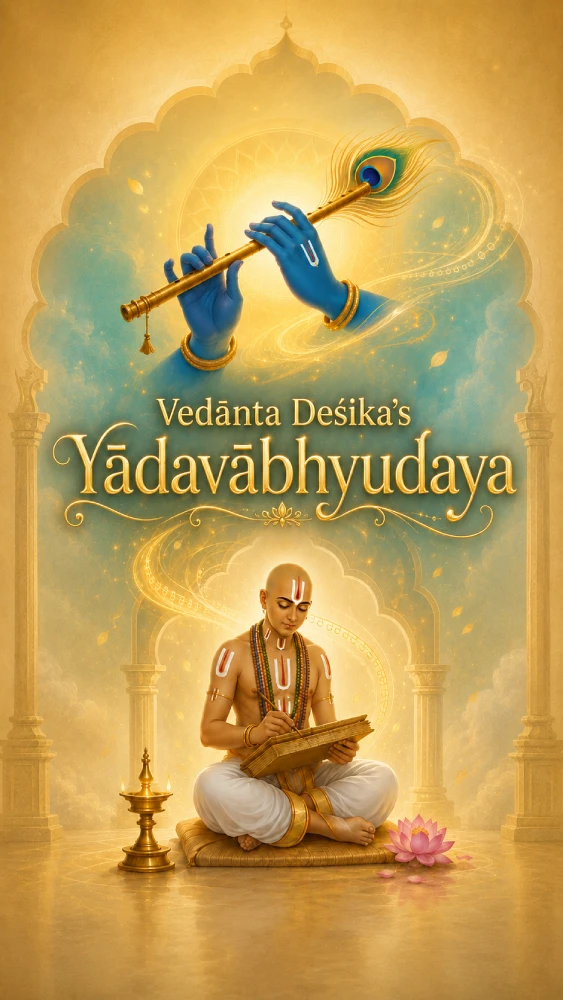
Yādavābhyudayam is a celebrated Sanskrit mahākāvya composed by Śrī Vedānta Deśika, the revered Śrī Vaiṣṇava ācārya and philosopher-poet. It recounts the divine exploits of Lord Śrī Kṛṣṇa's incarnation, weaving together the story of His birth among the Yādavas, His manifold līlās, and His triumphant deeds. Written in elegant classical Sanskrit with a rich variety of metres, alaṅkāras, and rasa, the work showcases Deśika's extraordinary poetic brilliance, intellectual depth, and devotional fervour. Its greatness is further attested by the fact that it was chosen for commentary by Appayya Dīkṣita, the renowned exponent of Advaita Vedānta, underscoring its stature as a masterpiece that transcends sectarian boundaries. As an elongated poetic elaboration of the subtle references found in Deśika's own Gopālavimśati, Yādavābhyudayam stands as one of the crowning jewels of Vaiṣṇava kāvya literature, relished equally as a work of art and as a meditation on the Lord.
Contents56 sections
Introduction - Svāmī Deśika’s Yādavābhyudayam
श्रीमते निगमान्त महादेशिकाय नमः
स्वामि देशिकैः अनुगृहीतम्
यादवाभ्युदयम्
śrīḥ
śrīmate rāmānujāya namaḥ
śrīmate nigamānta mahādeśikāya namaḥ
svāmi deśikaiḥ anugṛhītam
yādavābhyudayam
Yādavābhyudaya is the story of Kṛṣṇāvatāra retold by Vedānta Deśika with a beautiful poetic flavor steeped in bhakti.
Deśika has written devotional hymns on all the arcāvatāras - the deities of all the Vaishnavite shrines - but none of the forms of Lord Nārāyaṇa seems to be so dear to him as His incarnation as Kṛṣṇa. Gopālavimśati, twenty verses in praise of Kṛṣṇa is the most exquisite work exuding charm and beauty. Yādavābhyudaya is an epic which seems to be an elongated version of Gopālavimśati as it elaborates on the subtle references to the exploits of Kṛṣṇa therein but it is rich in poetic skill and intellectual excellence. The most significant fact which points out to the link between the two works is that the opening verse of both the works is the same. The greatness of Yādavābhyudaya can be understood by the fact that the commentator of the work is none other than Appayya Dīkṣita, the well known exponent of Advaita Vedānta. In this page an endeavor will be made to present this great work in such a way that all can enjoy its richness and beauty, which has been made known only to Sanskrit scholars so far.
— Dr. Saroja Ramanujam, M.A, Ph.D, Siromani in Sanskrit
Story of Śrī Kṛṣṇa
Salutations to Śrī Vedānta Deśika
श्रीमान् वेङ्कटनाथार्यः कवितार्किककेसरी
वेदान्ताचार्यवर्यो मे सन्निधत्ताम् सदा हृदि
śrīmān veṅkaṭanāthāryaḥ kavitārkikakesarī
vedāntācāryavaryo me sannidhattām sadā hṛdi
May the revered Veṅkaṭanātha Ārya (Vedānta Deśika) — the lion among poets and logicians, the foremost teacher of Vedānta — ever abide in my heart.
कवितार्किकसिंहाय कल्याणगुणशालिने ।
श्रीमते वेङ्कटेशाय वेदान्तगुरवे नमः ॥
kavitārkikasiṃhāya kalyāṇaguṇaśāline
śrīmate veṅkaṭeśāya vedāntaguruve namaḥ
Salutations to the glorious Veṅkaṭeśa, the lion among poets and logicians, the repository of auspicious virtues, the preceptor of Vedānta.
CHAPTER 1
PROLOGUE
Vedānta Deśika starts his epic with the mangalasloka:
vande bṛndāvanacaraṃ vallavījanavallabham
jayantīsambhavam dhāma vyajayantīvibhūṣaṇam
This verse is rich in meaning and brings out fully the glory of Kṛṣṇa. It means, Salutations to Him, who was born on Kṛṣṇāṣṭamī, who used to inhabit the Brindavan, adorned with the garland of forest flowers, self effulgent and loved by gopis. The four adjectives given to the Lord, namely,
- bṛndāvanacaram, the one who roams around in Brindavan,
- vallavījanavallabham, the beloved of the gopis,
- jayantīsambhavam, born on the day of His avatar,
- vyajayantīvibhūṣaṇam, adorned by the forest flowers are rich in meaning as they denote His vātsalya, sauśīlya, saulabhya and svāmitva.
His Vātsalya, love towards His dependents is indicated by bṛndāvanacaram, which is like that of a cow towards its calf. Bṛndā denotes His devotees, for whose protection, avanāya, He moves about, carati. This dispels the fear in the heart of His punishment for the wrong deeds one has committed, svāparādha bhaya nivartakam. Appayya Dīkṣita, in his commentary says that He, who was daṇḍakāraṇyacara, walked in the daṇḍaka forest for the protection of the rishis became bṛndāvanacara, for the protection of the cows, in Kṛṣṇāvatāra true to His promise later,
paritrāṇāya sādhūnāṃ vināśāya ca duṣkṛtām
dharma saṃsthāpanārthāya saṃbhavāmi yuge yuge
“I manifest myself in each epoch in order to protect the good and to punish the wicked.”
The cows represent the good who resort to the Lord for their welfare. Sentiment, rasa, exhibited by this epithet is adbhuta, wonder that the lord assumes the form of a cowherd and showers His love to one and all, man, bird and beast. The same vātsalya as He has shown towards Prahlāda so that Hiraṇyakaśipu could not harm even a hair on his body, towards Jaṭāyu in Rāmāvatāra and towards all His dependents in Kṛṣṇāvatāra which made Him even to wash and feed the horses during the Mahābhārata war.
vallavī janavallabham, the beloved of the gopis, is the epithet chosen for the purpose of indicating His Sauśīlyam, benevolence. Sauśīlyam is defined as “mahatāṃ mandaiḥ saha nīrandhra saṃśleṣa svabhāvaḥ”, the close friendship shown by the great towards the humble folk. This quality of the Lord dispels the fear that He is beyond comprehension. Appayya Dīkṣita says that the fact that He who enjoys the uninterrupted union with Mahalakshmi was also able to enjoy the company of the simple cowherd girls is the proof of His sauśīlya. The term Vallavījana is used to denote their nomad existence as valla means movement. The sentiment expressed here is śṛṅgāra.
Deśika uses the epithet jayantīsambhavam to denote the saulabhya of the Lord, in taking birth in the yādavakula, which removes the fear that the Lord is unapproachable. Saulabhyam is labdhuṃ susakatvam, easy accessibility. The significance of the word jayantīsambhava instead of Devakīsambhava implies that the Lord manifested Himself as Kṛṣṇa and was not born, according to His words “saṃbhavāmi yuge yuge” and “yadā yadā hi dharmasya glānirbhavati ------- tadātmānaṃ sṛjāmyaham.” Jayanthi also means jayam tanoti, victorious in the vināśa of duṣkṛta, indicative of vīrarasa. It is interesting to observe here that the words jayantī and janmāṣṭamī are used only to mark Kṛṣṇajayantī, janmāṣṭamī avatāra dhinasya jayantīti vyavahāraḥ and all the others are mentioned as Rāmanavamī, Nṛsiṃhajayantī and so on.
dhāma vyajayantī vibhūṣaṇam relates to the svāmitva, overlordship. Dhāma means the self effulgent nature and vyajayantī which normally means garland of forest flowers also implies bhūta tanmātra adhiṣṭhāna devatā the divinity behind the elements. The vanamālā here is the māyā of the Lord which He wears like a garland in His manifestations this indicates that Kṛṣṇa is the Parabrahman who is the cause of this universe created out of His own Māyā. The Paravāsudeva is referred to by this epithet.
For a literary work there are four aspects that have to be specified at the outset.
- the grantha - the mention of the work itself.
- the viṣaya - the subject matter,
- the adhikārī - to whom the work is intended, and
- the phala or prayojana - the benefit that will accrue by the study of the grantha.
Here by the four adjectives given to the Lord in the sloka refer to the above mentioned four requisites of a kāvya.
- The grantha is Yādavābhyudaya, the glory of Yādhava, Kṛṣṇa. This is indicated by bṛndāvanacaram, the inhabitant of bṛndāvan, Kṛṣṇa.
- The viṣaya is the story of Kṛṣṇa denoted by jayantīsambhavam, born on Janmāṣṭamī.
- Adhikārī is the one who has love for the Lord. This is shown by the word vallavī janavallabham.
- Lastly the phala, fruit of hearing the story of the Lord is Mokṣa, salvation which is implied by dhāma vyajayantī vibhūṣaṇam. Knowing Him as Dhāma the Parabrahman manifest in the garb of a cowherd through His māyā, vyajayantī vibhūṣaṇam, and one gets emancipated.
The glory of the Lord is such that even the Vedas, which are the primary source of knowledge about Him, are not able to do full justice to His description. Deśika portrays the Vedas as the bards trying to sing about His merits and he says that when they start extolling even one of His infinite auspicious attributes, they become tired.
“ekaika guṇaprānte śrāntāḥ nigamavandinaḥ”
Then Deśika expresses his humility by saying that under such circumstances what those with limited intellect can expect to accomplish, meaning himself! He goes on to reassure himself that the subject is saurīkathā, story of Kṛṣṇa, which is like nectar that will be relished even if it is told by a dull witted person. He reaffirms his position by claiming that there could be nothing wrong in following the footsteps of the great poets like Vālmīki and Vyāsa.
Then Deśika extols the kavitva saying that a kavi, poet, whose creation is full of merits such as rasa, bhāva and alaṃkāra is akin to the creator, Brahmā, in whom Sarasvatī revels.
- Rasa is the nine kinds of sentiment, śṛṅgāra etc.
- bhāva here means the accompanying moods that go with each sentiment, called vibhāva, anubhāva and sañcārībhāva and
- alaṃkāra is the figure of speech.
Such poetry is like goddess Sarasvatī, expressive, beautiful and well adorned with ornaments. The poet who is endowed with all these skills is like Brahmā associated with Sarasvatī.
But should perfection be an essential characteristic in composing poetry? No, says Deśika. If a talented dancer makes a slip in her performance a connoisseur will ignore it and will appreciate only the overall effect. Similarly considering the viṣayagaurava, the merit of the subject matter which is Bhāgavataviṣaya, story of the Lord, even if there may be any fault, it can be excused.
So, says Deśika, “I will now speak of the story of Kṛṣṇa, which is the nectar emerging out of the ocean of Vyāsaveda, the Mahābhārata, without any hesitancy.” What is implied here is that the most enjoyable part of Mahābhārata is the story of Kṛṣṇa. Vyāsaveda may also mean the Vedas, the essence of which is the Lord, as Rāmānuja says in the mangala sloka of Śrībhāṣya, śruti śirasi vidīpte brahmaṇi śrīnivāse, the Lord forms the crown of the Vedas. So the story of Kṛṣṇa is the sārabhūta, essence of Vedas as well as Mahābhārata which is later given by Vyāsa as Bhāgavatapurāṇa like extracting the butter out of the milk of Mahābhārata.
Deśika calls the story of Kṛṣṇa vibhudhajīvātu, the elixir for vibudha, devas, as the incarnation took place on being entreated by devas and the Bhūdevī. The word vibudha also means men of wisdom of whom the story of Kṛṣṇa is the paramauṣadham greatest antidote for the ills of the saṃsāra.
In this context it would be interesting to note the peculiar circumstances which made Vyāsa write the Bhāgavata purāṇa. The Dasamaskandha, tenth section of Bhāgavatapurāṇa contains the story of Kṛṣṇa, the subject matter of Yādavābhyudaya.
It seemed that after Vyāsa had finished Mahābhārata and other vedantic works he became depressed for no reason. Nārada came to him and told him that his feeling of depression born out of dissatisfaction was due to the fact that though he exhaustively wrote about dharma and Vedānta he did not write about the exploits and the glory of Kṛṣṇa and the incarnations of the Lord which would inculcate bhakti. Hence his heart became dry and depressed. Then Nārada told him the whole Bhāgavata as he had learnt from Brahmā. This was the inducement for Vyāsa to write the Bhāgavata purāṇa. That is why Deśika calls it vibhudhajīvātu, the life-giving elixir.
Deśika refers to the Lord as Vibhu, and Śrīmān. He is Vibhu, all powerful, all pervading, Śrīmān associated with Śrī, Lakshmi. The significance of the two adjectives is given by the words eko vaśī sarvabhūtāntarātmā eko rūpaṃ bahudhā yaḥ karoti (looking at textual note: eko vaśvamidaṃ citraṃ ajījanat). He is eka, one only. “sadeva saumya idam agra āsīt, ekameva advitīyam” (Chandogya Up.) “Sat alone existed in the beginning, one only without a second.” Hence Brahman, Lord Nārāyaṇa of Viśiṣṭādvaita, was both the material and instrumental cause of the Universe. Usually in creation as applied to the worldly things like the creation of a pot the material cause, the mud and the instrumental cause, the potter are different. But before creation, says the Upanishad there was none else than the Brahman. So Brahman is the upādāna kāraṇa, material cause and nimitta kāraṇa, instrumental cause. This is indicated by the words svayaṃ and svasmin.
The Lord created the world which Deśika describes as citram, wonderful. He compares it to a painting; citram which is created by the Lord with the brush of His līlā, playful and without effort, and the paint He used was His kṛpā, infinite mercy. The canvas was nothing but the Lord Himself, svasmin, in Him, created by Himself, svayaṃ. This is in accordance with the concept of śarīra-śarīrī bhāva of Viśiṣṭādvaita. The world consisting of sentient and insentient beings is the body of the Lord of which He is the soul. Before creation the world exists in Him in subtle form and after creation it assumes the gross form.
Now what is the purpose of creation? To say that it is His līlā would make Him a sadist who has created the world full of sorrow and misery for His sport. No, it is not so, says Deśika, because He has coloured it with His kṛpā. The word līlā only denotes that the creation was as effortless as a play for Him. He not only created but also sustains the universe through His acts of mercy. The duḥkha is due to our karma but to protect us by showing the path to emancipation is His act of mercy.
Then Deśika traces the clan of Yadhu in which the Lord took the incarnation as Kṛṣṇa.
- The first of the clan was Candra, the Moon. “candramā manaso jātaḥ”. The Moon was born from the mind of the Lord. (Puruṣasūktam). Deśika gives the reason as to why the Moon was born out of His mind. The Moon came out as though he is the personification of the prasāda, grace of the Lord, paripālayitavyeṣu prasāda iva, towards the people deserve to be protected, His devotees because the moon is jagadāhlādakara, gives happiness to all.
- Budha, the adhiddevatā of the planet Mercury was the son of Moon and Purūravas was the son of Budha. Purūravas, says Deśika, was the living example of the efficacy of satām āhita vahnīnām stheyathā, the power of āhitāgni the sacrificial fire, which represents the acts of sacrifice, yajña because it gave him the power of visiting svarga where he fell in love with Urvaśī, the celestial damsel and married her.
- The lineage of Purūravas flourished in all directions of the earth by the fame of his descendants like Āyu and Nahuṣa, who attained the status of Indra through his merit. When Indra incurred brahmahatyā doṣa, the sin of killing a Brahmin by his slaying Vṛtrāsura, who was the son of Tvaṣṭā, a Brahmin, he had to leave the svarga and do penance. Then the devas put Nahuṣa in the place of Indra since he has performed hundred aśvamedha yajñas, which makes him qualified for the post of Indra but he incurred the displeasure of Agastya and was cursed by him to become a snake.
- Yayāti was the son of Nahuṣa and had three sons and one of them was Yadhu, who was a vadānya, very generous and austere and just. Vasudeva, the father of Kṛṣṇa was born in the clan of Yadhu. Vasudeva was Kaśyapa prajāpati in his previous birth and was the father of both devas and asuras. His wives Surabhi and Aditi were born as Rohiṇī and Devakī in next birth and married Vasudeva. When Vasudeva was born the divine musical instruments, ānakā and dundubhi sounded and hence he acquired the name Ānakadundubhi.
Vasudeva was the refuge of the good as Lord Viṣṇu is for the world, the Sun is for light and the sea is for gems. This implies that he was the sole resort of the good as the earth was burdened with unrighteous kings for whose destruction the Lord descended in the form of Kṛṣṇa. Even though born of the royal family, Vasudeva was intent on attaining mukti and was not interested in the worldly possessions and became content with whatever came to him of his own accord. Vasudeva got married to Devakī, the cousin sister of Kaṃsa whom he loved very much but hearing the aerial declaration that the eighth son of Devakī will be his killer, Kaṃsa put them both in prison.
In the meanwhile, the devas were approached by Bhūdevī who entreated them to relieve her of her burden of adharma perpetuated by the unrighteous kings who oppressed her like giant mountains. Then they all approached the Lord Nārāyaṇa along with Brahmā and with Bhūdevī in front and started praying to Him.
The devas praised the Lord thus:
-
He is trividhimadhyadīpta, shines on the three Vedas because He is vedavedya, known through the Vedas. Here it would be interesting to compare the words of Tyāgarāja in his kṛti “Sāmajavaragamana” on Kṛṣṇa. He calls Him “vedasiromātṛja saptasvara nādācala dīpa,” He shines as the light on the mountain of nāda, made up of the seven notes, saptasvara which were born out of the head of Vedas, that is praṇava.
-
He is tridhāman, having three abodes, namely, Vaikuṇṭha which is His paramapada, supreme abode, the milky ocean and the sūryamaṇḍala, disc of the Sun, He is described in the Upanishad as sūryamaṇḍalamadhyavartī.
-
He has five weapons, pañcahetayaḥ: śaṅkha, cakra, gadā, śārṅga and khaḍga, the Conch, Disc, Mace, Bow and Sword respectively.
-
He is bāhyāntarahavirbhuja, takes the external offering in the yajña and also internal in the form of the self which is offered in devotion and He as varada, bestows His grace.
-
His power is independent ananyādhīnamahiman and unlimited whereas that of other gods are in His control parādhīnavaibhava and hence limited. Devas beseech Him to protect them as He is dayādhīnavihāra overwhelmed with mercy as shown by His acts like killing Rāvaṇa. In this sloka the poetic skill is shown in the choice of the epithets ananyādhīna, svādhīna and dayādhīna.
-
The Lord is the ocean of mercy, dayāmbudhi in which His guṇas: jñāna, bala, aiśvarya, śakti, tejas and vīrya are the ratnas, gems and the waves are His vyūhas and vibhavas. The six attributes, knowledge, might, sovereignty, power, glory and valiance are called bhagas and hence the name Bhagavān. The vyūhas are His manifestations as Vāsudeva, Saṃkarṣaṇa, Pradyumna and Aniruddha and the vibhavas are His incarnations. These are metaphorically described as the waves while the guṇas are the precious gems which are said to be in the ocean.
-
The glory of the Lord cannot be ascertained from the Vedas even, because they are His creation and they are compared to the travelers who even after traveling from morning till evening are unable to reach the destination, namely to describe Him as such.
-
He puts on different costumes and comes down as incarnations like an actor and He acts according to the role He assumes. This amuses the wise who see Him act like a subordinate, a supplicant and obedient son to His own children and dependents. He is the one who apportions the result of karma to the individuals and it is all His līlā which waters the seeds of karma so that it brings forth the sprouts of results, karmaphala. Deśika says that this is true with all beings, brahmādistambaparyantam, from the four-faced Brahmā down to the blade of grass as everything is His creation only.
-
He shines in the hearts of the pure in His full splendour and like the Cintāmaṇi fulfils all their wishes. Cintāmaṇi is a precious gem which is supposed to grant all wishes of the possessor.
-
To those who have become fatigued by traveling in the desert of saṃsāra the devotion of the Lord serves as a welcome river, flowing with the nectar of His mercy, in which they plunge and enjoy its coolness.
-
He is the boat that helps those who are caught in the whirlpool of sin to cross over to the other side.
-
He is unparalleled, limitless, and the cause of the universe, Himself uncaused. He is denoted by Praṇava, the essence of Vedas and the raft of rescue from the sea of saṃsāra. Those who seek refuge in Him alone depend only on Him for their redemption and do not adopt any other means except devotion to Him like the cātaka bird which live on rain drops alone. Not seeking any other source of water.
-
Like the sun that wakes up from sleep the Lord wakes up the jīvas from the sleep of ignorance. Hence, the devas entreated Him to dispel their calamity like the sun destroys the darkness because Kaṃsa and others have risen like comets to create disturbances in the world.
Thus entreated by the devas Bhagavān appeared before them out of mercy. Deśika here gives a beautiful description of the Lord.
The devas saw Him reclined on the couch of Ādiśeṣa, like a rain-bearing cloud, dark in hue, on a white cloud of autumn. Ādiśeṣa is supposed to be white in color and sitting on him the Lord presented a picture of a dark cloud on the top of a white cloud, which is a rare occurrence. This simile is an indication of the wonder the devas experienced on seeing the Lord before them.
The lord was accompanied by Śrīdevī with lotus in her hand implying His aiśvarya, the mastery over the universe. The epithet Lakṣmīpati denotes the supreme power combined with mercy of the Lord. He was adorned with ornaments which were sukumāra, slender and not heavy, sukhasparśa, soft of touch on His body and not rough, like sweet smelling flowers, sugandhibhiḥ prasūnaiḥ iva, and well suited to His guṇas, the infinitely auspicious qualities. His form is the garden of His guṇas and the ornaments were like the flowers in the garden. Deśika expresses his love for the Lord in imagining the ornaments on His body to be tender like flowers. An ardent devotee treats the arcā or idol of the Lord as real and cannot bear to see even the stalks of the flowers hurting Him. And arranges the ornaments on the idol in such a way as not to hurt Him.
Every part of His body vying each other in beauty excelled that of His ornaments and stole the hearts of all beings. The ornaments were beautified by Him and not vice versa. The weapons He was wielding, namely the disc, bow, mace etc. were proclaiming His natural qualities like valor, power and so on and seemed to forecast the victory of the devas. With His form created by Himself, He shone like a sapphire rising out of the sea of His own splendor.
Along with the Lord came Garuḍa, who is the embodiment of Vedas, śrutirūpa, and covered with the fragrance of the feet of the Lord, being His carrier, signifying the impending war with the asuras. The veda calls Garuḍa “suparṇo asi garutmān trivṛtte śiraḥ” meaning that Garuḍa with powerful wings has veda as his head.
The Lord thus presented a picture of a Sun who never sets, a Moon who never wanes and an ocean of nectar which has no bounds to devas. He was shining in His glory which excelled the Sun, was source of joy in His cool mercy, which never diminishes and He was like everlasting nectar to the devas in showering His grace. By seeing Him thus the eyes of the devas became fruitful and the Lord reassured them with His abhayahasta, showing His hand in a gesture of protection and by His smile that destroys evil by the mere sight of it. The abhayakara and the mandasmita were reassuring enough for them that their prayer is answered even before He began to speak.
DEVAS APPEAL TO THE LORD
The devas started to tell the Lord that rākṣasas who were extinguished previously by Him like moths by the fire, have come back to earth in the form of kṣatriyas and the earth is suffering by their misdeeds and if the Lord does not intervene the earth will be submerged into the sea, not being able to bear their weight. The idea here is that the wicked are burden to the earth. They entreated Him thus: “This earth which has you, who is full of with mercy, as its helmsman, should not be allowed to go under.”
Deśika provides a beautiful metaphor by referring to the Lord as the central jewel of the girdle of the earth. The devas claimed that the earth deserves the protection of the Lord from the oppression of the wicked kṣatriyas. The earth is surrounded by the ocean like a girdle of the Bhūdevī and the Lord shining in the middle of the ocean like a sapphire is like its central gem. Further the devas said that He should free the earth from the burden of these wicked kings and make her shine as the crest jewel of Ādiśeṣa, meaning that the earth should be made light as a crest jewel for Śeṣa who supports it on his head.
Deśika, the bhakta, here comes out with beautiful expression. He makes the devas say:
“prabuddhasubhagaiḥ smeraiḥ prasannaiḥ śītalaiśca naḥ |
kaṭākṣaiḥ plāvaya kṣipraṃ kṛpākodhanvadūrmibhiḥ ||”
They pray to him to direct His merciful glances towards them. The glances of the Lord are, prabuddha subhaga, attractive, He just being awakened from His yoganidrā, smera, accompanied with His charming smile, prasanna, pleasing, śītala, cooling with love and they are like the waves of the sea of His mercy, kṛpākodhanvadūrmibhiḥ. Imagining the Lord thus is enough to send a devotee to ecstasy. With these words devas concluded their entreaty asking the Lord to forgive them for their impudence in informing Him the reason of their approaching Him as though He did not know everything being the antaryāmī, indweller of all.
Then Bhūdevī bowed down to Him, who has vowed to protect His dependents, along with the devas and informed Him of her plight. Deśika describes her as being beautiful like the Māyā of the Lord. The earth assuming the form of an exemplary damsel, vanitāratnarūpiṇī, of slender waist and large eyes, tanumadhyā viśālākṣī, is compared by Deśika to the enchanting Māyā of the Lord. The whole Universe constituted of the five elements is the product of Prakṛti, otherwise known as the Māyā of the Lord.
Deśika’s poetic skill is seen in his further description of Bhūdevī. She was sporting beautiful hair, the natural scent of which attracted the bees that hover on her head presenting a spectacle of her being covered with an umbrella made of peacock feathers. The tears of joy on seeing her Lord formed the beads of pearls that adorn her chest. Her left shoulder throbbed as though desiring the embrace of her Lord which was welcomed by her as a good sign. Deśika uses the word Dakṣiṇā for the Bhūdevī to imply that she is knowledgeable about the meaning of signs and employs the word dakṣiṇādhitaraṃ, the one other than the right to denote left arm thus enhancing the poetic beauty.
The Lord replied to them in a voice that echoed the sound of His Pāñcajanya. He reassured them by saying that those who follow His command will never come to harm. [Vide: Bhagavatgita-6-40 - “na hi kalyāṇakṛt kaścit durgatiṃ tāta gacchati.”] The Lord then promised that He will descend to earth as an incarnation to lessen the burden of the earth by destroying the evil kṣatriyas and will establish dharma and He asked them to take birth as kings to partake the result of His deeds. So saying the Lord awaited the right time to enter the garbha of Devakī to be born as Kṛṣṇa. Thus the one in whom the entire world resided came to reside in Devakī.
CHAPTER 2
THE EVE OF INCARNATION
Devakī appeared divine because she carried the kṛṣṇarasāyana, the elixir which is siddha and siddhaniṣevita, resorted to by the sages being sure of effect.
Devakī ate the mud, symbolic of the earth, during her pregnancy as if she is showing by her action, nātitatham, that the one who has devoured the whole earth is inside her, “bhuktvā purā yene vasundharā sā sa viśvabhoktā mamagarbhabhūtaḥ,” says Deśika.
She dreamt that she was lying on Ādiśeṣa and traveled on Garuḍa. Utthamur swami explains this as:
“devakīgarbhagantham bhagavantham pṛthak paricarithum aniṣṭvā |
śeṣādayaḥ devakeesthathvaveshenaiva paricarantīva ||”
It looked as though Ādiśeṣa and others carried Devakī along with the Lord in order to do service to Him. She walked slowly as if not to burden the earth with the weight of Him who is viśvaguru, the mighty Lord who has the entire universe in Him. He is vidvaguru or jagatguru as He was going to impart the Gita to the world and also the greater than the greatest, mahato mahīyān. The word ‘guru’ contains a pun to mean preceptor as well as big.
DESCRIPTION OF THE NIGHT OF KRISHNAVATHAARA
Then starts the description of the night of Kṛṣṇāvatāra. The appearance of the dusk, sandhyā, seemed to denote the advent of the Lord. Sandhyā, personified as a damsel, is compared to the form of the Lord, muradvit account of the attire of golden hue, suvarṇapītāmbaravāsinī, and hiding the Sun with the brilliance of own light, svadhāmasam chādita sūryamūrtiḥ. The Sun sinking in the ocean seemed to seek some support avalambana, by his rays stretched out. He looked like a lotus plucked from the pond of the sky by sandhyā and the crest jewel of a serpent plunging into the ocean afraid of Garuḍa in the form of sandhyā. The richness of poetic imagination of Deśika is illustrated by these words.
At the setting of the Sun, the day being aṣṭamī - 8th day - of kṛṣṇapakṣa, dark fortnight, no moon appeared and darkness spread everywhere. Stars looked like a garland of pearls to adorn the Lord on His avatāra prepared by His servant, the Kāla, Time. Later when the moon rose, the eastern direction looked like Devakī, tamaḥprasaṅgena vimucyamānā gauraprabhā. The paleness of her is the white light, gauraprabhā of the moon who has risen from darkness as she is going to be freed from her sorrow, tamaḥprasaṅgena vimucyamānā. The Moon being the first forefather of the Yadhuvamśa, looked like a purohita, priest coming after bath from the ocean to do the saṃskāra, the rites for the newborn.
The darkness that first came was like the hālahala, the terrible poison which came out of the milky ocean, namely the eastern direction indicative of the subsequent emergence of Lakṣmī, the good fortune of Yadhuvamśa. Deśika says later in describing Kṛṣṇa that Lakṣmī was always with the Lord whichever avatāra He took because She is inseparable as the sloka goes:
“rāghavatve bhavat sītā rukmiṇī kṛṣṇajanmani |
anyeṣu ca avatāreṣu viṣṇoreṣā anapāyinī ||”
It is said that even in Vāmanāvatāra Lakṣmī was in His chest, to hide whom, the Lord covered His chest with deerskin lest He could not take away the aiśvarya of Bali if he gets the glance of Lakṣmī, lakṣmīkaṭākṣa.
Then the auspicious time for the avatāra drew near. The wicked people like Kaṃsa were sleeping and the good were awake like Devakī and Vasudeva. Vādyaghoṣa of divine instruments could be heard everywhere. The lamps in the house of Kaṃsa became extinct for no reason and so did the anguish in the minds of devotees. Aṣṭamī was chosen by the Lord for his avatāra as the eighth child and the next day Navamī was going to be the day of the avatāra of Yogamāyā.
Hence, as Deśika puts it, aṣṭamī became prathamā and navamī, dvitīyā. Kṛṣṇa appeared at vṛṣabhalagna when the five planets, Candra, Aṅgāraka, Budha, Guru and Śani were in exalted position. Deśika describes His manifesting Himself as Devakīputra was like the eastern direction produced the Lord, the moon, implying that He was not born in the usual way but as He says in the Gita “sambhavāmi ātmamāyayā” He only made Himself manifest as the moon coming out in the East.
CHAPTER 3
THE BIRTH OF KṚṢṆA
At the time of the birth of Kṛṣṇa the whole world seemed to be happy. The directions looked bright devoid of darkness as though the day is born. This implies that the manifestation of the Lord dispelled the darkness in the mind caused by rāgadveṣa and the hearts of the good became filled with the joy arising out of the understanding of the truth about the manifestation. Among the usual paraphernalia that is described in the purāṇas and itihāsas when some divine or extraordinary event happens, such as the apsarās dancing, the trumpets sounding, the kinnaras singing in the devaloka, there was cool breeze blowing from the quarters and the clouds thundered which was like the jayaghoṣa by the devas. Here we see the poetic skill of Deśika who says that all the anxieties in the minds of all the people joined together like rivers and fell into the mind of Kaṃsa, who was the only one agitated to the utmost. Āṇḍāḷ addresses the Lord as “kamcaṉ vayiṟṟil neruppeṉṉe niṉṟa neṭumāle”, the one who stood like fire in the stomach of Kaṃsa.
Vasudeva became free from his shackles. “ṛṇādiva devakīpatiḥ amucyata śṛṅkhalātaḥ” says Deśika, comparing the release from śṛṅkhala to that from debt. In fact the word ‘ṛṇa’ could mean debt as well as prārabdhakarma as the saying goes “ṛṇānubandharūpeṇa paśupatni sutālayāḥ”, ones acquisition of wealth, son and property is according to prārabdhakarma. Deśika asks, “what is so wonderful about this in front of one who removes the shackles of all bondage?”
Devakī was having Kṛṣṇa on her lap and shone like a golden mountain which had a peak of indranīlamaṇi, sapphire. Vasudeva saw Him, who had the color of the sea, carrying śaṅkha, conch, cakra the disc, gadā, the mace and ambuja, a lotus.
Vasudeva prayed to Him to hide His divine form lest Kaṃsa will come to know His true identity. He praised the Lord as the embodiment of the Veda, who had come to be born as his son due to his prayers in the previous birth. At the same time he was worried about His safety and begs Him to disguise Himself. That is the māyā of the Lord!
Then the Lord instructed Vasudeva to take Him to Gokula and leave Him there and bring the female child born to Yaśodā to Mathurā. Vasudeva took the infant, which the Lord changed Himself into, as requested and the prison gate opened and the guards were fast asleep. When he approached the street the quarters became lighter due to the lustre of the body of Kṛṣṇa. Garuḍa circled around to ward off the evil forces and Ādiśeṣa followed spreading his hoods as an umbrella to protect from the rain.
“śrutimayo vihagaḥ paritaḥ prabhuṃ vyacaradāśu vidhūtanisācaraḥ |
anujagāma ca bhūdhara-pannaga-sphuṭa-phaṇā-maṇidīpa-gaṇodvahaḥ ||”
Garuḍa is śrutimaya, the personification of vedas, as Yāmunācārya calls him “vedātmā vihageśvaraḥ”, and the Śeṣa is referred to as Bhūdhara-pannaga, who followed giving light by the gems on his thousand hoods as though thinking that the Lord needed some light as He had contracted His own tejas. The significance of the word Bhūdhara-pannaga by Deśika is that the Kṛṣṇāvatāra was for the purpose of lightening the burden of the earth which will also lighten the burden on the head of Śeṣa who is bhūdhara, bearer of the earth.
Vasudeva carried Kṛṣṇa as though on the garuḍavāhana and reached river Yamunā, directed by the moonlight. The land near Yamunā seemed to welcome Vasudeva by its cool breeze to remove the fatigue and the buzzing of the bees, serving as the welcome song.
The description of Yamunā when Vasudeva approached the river with Kṛṣṇa brings the poetic fervour of Deśika. He says that it looked as though the river is bemoaning the plight of the Lord which made Him take the guise of a mortal, feigning weakness, ‘kuhakadhainyam’. The lilies, ‘asitanīraja’ were closing its eyes, petals, as the morning was approaching and the lotuses had not yet started to bloom and the cakravāka couple, a kind of birds which become blind in the night were wailing, not being able to see one another. All this seemed to indicate the mental anguish of Yamunā, savituḥ sutā, the daughter of the Sun.
“nimiṣitāsitanīraja-locanā mukulitābjamukhī savituḥ-sutā |
lulita-dīna-rathāṅga-yuga-svanā kuhaka-dhainyam aśocativa prabhoḥ ||”
The river throwing its waves here and there looked as though, Yamunā, without knowing that all is the līlā of the Lord, was throwing up her arms in distress, fearing Kaṃsa. Yamunā gave way to Vasudeva, looking high in the east and almost dry in the west. It makes the kavi wonder whether she wanted to ascend the viṣṇupada or was going to the Kalinda Mountain, her father’s abode. Thus Vasudeva crossed the river as if it was jananasindhu, sea of birth, which he would cross obtaining the Lord as his offspring.
Vasudeva entered Gokula where, says Deśika, “svasutam agryam asūyata rohiṇī”, which implies that he saw his son Balarāma also. There he placed Kṛṣṇa near the sleeping Yaśodā and took the female child near her to Mathurā. Knowing that the eighth child was born, Kaṃsa came and took the infant by her legs to strike her on the rock when she kicked herself free and rose up to the sky and warned Kaṃsa about the birth of Kṛṣṇa. Her speech is described by Deśika thus: “paṭu gabhīram udāram anākulaṃ hitaṃ avistaram arthyam aviplavam”. It was:
- paṭu, sharp and pungent,
- gabhīram, resonant,
- udāram, distinct,
- anākulam, poised,
- hitam, well wishing. Due to her karuṇā the goddess Durgā as she was to be known later, wanted to warn him not to court destruction.
- avistaram, brief,
- arthyam, meaningful and
- aviplavam, unmistakable.
She said that she was aśeṣa surāsura mohinī, the deluder of all devas and asuras, being the Māyā of the Lord, the destroyer of Madhukaitabha, the māyā that veils the real nature of the Lord, yavanikā. Then she warned him that his destroyer is in the house of Nanda, “vasati nandagṛhe vibudhadviṣāṃ dhamayitā vasudeva-samudbhavaḥ tava nāśayitā”. In the Bhāgavata the Yogamāyā does not divulge the whereabouts of Kṛṣṇa but Deśika boldly makes her give the address of Kṛṣṇa perhaps to make it clear to Kaṃsa that he cannot harm Kṛṣṇa even if he finds Him.
Then the scene changes and in Gokula, Yaśodā and others regain consciousness from the swoon-like sleep induced by the māyā of the Lord and Yaśodā found a male child next to her. Deśika describes the Lord as the one who is āgamabhūṣaṇa, ornament to the vedas, who is enquired into by the sages even now without finding His real nature, became the ornament of the gopas due to destiny of His own making.
After Kṛṣṇa came to Gokula there was no death of calves and the cows were contented and gave plenty of milk as Āṇḍāḷ said, “vāṅkakkuṭam niṟaikkum vaḷḷal perum pacukkaḷ”. The person had no fear from robbers and from disease and Deśika says that the life in Gokula resembled that in Kṛtayuga.
Nanda celebrated the birth of Kṛṣṇa elaborately. “adhicakāra vadhānyamaneḥ śriyaṃ vyadhita kalpataroranukalpatām ajanayacca suta prasavotsave mahati megha vikatthana modhathām”. That is, Nanda appropriated the glory of cintāmaṇi, the wish-giving gem, by his generosity, which made the kalpataru lose its importance and he outshined the rain giving clouds by his shower of gifts. This made the people of Gokula, says Deśika, look down on the Indraloka. The news of the celebrations in Gokula pacified the minds of Devakī and Vasudeva who were separated from Kṛṣṇa, the Purāṇapuruṣa, who had come to them through the penance of earlier life.
“putraṃ prāpya tapasā puruṣaṃ purāṇaṃ kālaṃ
ciraṃ vidhivaśāt kila viprakarṣau ||”
The two boys, Balarāma and Kṛṣṇa grew up in Gokula like the Moon in śukla-pakṣa creating happiness not only to the inhabitants but also to devas who were eagerly waiting for the destruction of Kaṃsa and others.
CHAPTER 4
BĀLAKṚṢṆA
Next Deśika presents the picture of crawling Kṛṣṇa. When Kṛṣṇa crawled on the floor the dust covered his body all over. Deśika says that the earth goddess tried to embrace him under the pretext of covering his body with dust.
“prāyo dharitrī pariṣasvaje taṃ sāpatrapā sāndhrarajacchalena”
The joy of Nanda knew no bounds on seeing the face of Kṛṣṇa which was nirvyāja-mandasmita-darśanīyam, delightful to behold with His spontaneous smile. When He lisped and pronounced the name of His mother partly He was acclaimed by all. Everyone was pleased with His attempt to speak which was fascinating, says Deśika, because the Lord who created all the worlds and gave them name and form, is here praised by the people in Gokula for uttering His mother’s name partially.
The Upaniṣad says that after creating the world of beings Brahman willed to enter them with their soul to give them name and form. “anena jīvena ātmanā anupraviśya nāmarūpe vyākaravāṇi” (Chan. 6-3-2)
Then Kṛṣṇa started to speak with clarity and His pronunciation had the scent of veda, says Deśika. “varṇasvarādhivyavasāyabhūmnā śikṣāvidhāṃ śikṣaṇam agryam āsīt”.
It was as though He was teaching the gopīs who tried to make Him speak through His pronunciation of letters and the intonation etc. which resembled that of the vedas.
tam īṣad utthāya nilīnabhārāt samprekṣya hantāṅkuracāruhāsam |
sanātanīṃ dṛṣṭim ananyadṛṣṭiḥ sānandam ālokata nandapatnī ||
“He tries to stand a little but keeps falling off and He smiles sweetly showing His budding teeth. Yaśodā who had no eyes for any thing else, was looking at Him, who is the eye of all, with joy.”
Here it would be interesting to see how Periyāḻvār enjoys Kṛṣṇa having his first teeth. “koḷa narumpavaḷa centuvar vāyiṉiṭai kōmaḷa veḷḷimuḷai pōl cila pallilaka” in his mouth, red like coral, there are a few teeth showing like tender shoots of silver.
Yaśodā teaches Kṛṣṇa to walk and Deśika enjoys the scene thus: Yaśodā took hold of his hands and made him walk and he keeps falling now and then pretending that he could not walk more than few steps so that his mother will pick him up and tries again. Who is He! The one who measured the three worlds with three steps and now manifest as a child in order to protect the world.
“padais tribhiḥ krānta-jagattrayaṃ taṃ bhavyāśayā bhāvina-bālabhāvam”
Soon Kṛṣṇa was walking all around marking the earth with his footprints as though to put his seal on earth to drive away the wicked. Next comes the scene where Kṛṣṇa dances to the tune of the gopīs.
DANCING KRISHNA
Perhaps the scene opens as the gopīs are churning the milk and Kṛṣṇa comes there and begs for butter and they tell him to dance if he wants butter and this is described by Deśika as follows:
“ya eṣa lokatraya-sūtradhāraḥ paryāyapātrāṇi carācarāṇi |
anartayatyadbhuta-ceṣṭito’sau nānārtha-khelannavana-nītakaṅkṣī ||”
He who is the director of the three worlds causing the movable and immovable beings enact their role in turn, with His wonderful act, danced playfully (in front of the gopīs) desirous of getting butter. This Deśika names as Navanīta-nāṭyam in his Gopālavimśati.
“āvirbhavatyanibhṛtābharaṇaṃ purastāt
ākuñcitaika-caraṇaṃ nibhṛtānyapādam |
dadhnā nimantha-mukhareṇa nibaddha-tālaṃ
nāṭyasya nandabhavane navanīta-nāṭyam ||”
which means, ‘Let the vision of Kṛṣṇa dancing in the house of Nanda, His ornaments sounding as He dances, with one foot steady and the other bent, His navanīta-nāṭya, dance for butter, to the thāla of the churning of milk, appear in front of me’
In Gokula, keeping close to the churning pot desiring butter, the body of Kṛṣṇa is splattered with drops of curd. Deśika is reminded of the form of the Lord splattered with drops of nectar, or milk while churning the milky ocean.
The same idea is expressed by Kulaśekhara in Mukundamālā where he says,
“kṣīrasāgara-taraṅga-sīkarāsāra-tārakita-cārumūrtaye |
bhogibhogasayanīya-śāyine mādhavāya madhvidviṣe namaḥ ||”
“Salutations to Mādhava, the killer of Madhu, reclining on the bed of Ādiśeṣa, His body charming splattered with the drops from the waves of the milky ocean, looking as though He is covered with stars”.
The dance of Kṛṣṇa desiring butter is described by Līlāśuka also thus:
“vadane navanītagandhavāhaṃ vacane taskaracāturīdhurīṇam |
nayane kuhanāśrum āśrayethāḥ caraṇe komalatāṇḍavaṃ kumāram ||”
Seek the foot of the boy who is dancing gracefully, with His mouth smelling of butter, His speech showing Him to be the foremost of cheats, His eyes (on being told off) full of false tears.
The devotees imagine that the reason the Lord left the milky ocean and came to Gokula is because being milky ocean He can get only milk there and not butter.
Perhaps this scene was in the mind of Oothukkāṭu Vēṅkaṭakavi when he sang “āṭātu acaṅkātu vā kaṇṇā”, which is a beautiful song and should be dealt with separately to bring out its beauty.
KRISHNA THE BUTTER THIEF
trasyan mukundo navanītacauryāt
nirbhugnagātro nibhṛtaṃ śayānaḥ |
nijāni niḥśabdadaśāṃ yayāce
baddhvāñjaliṃ bālavibhūṣaṇāni ||
Kṛṣṇa stole butter and was hiding with his body contracted out of fear from the gopīs. Deśika calls him Mukunda, the one who gives mokṣa, as well as bhoga, here enacting fear. His limbs were trembling with fear and he was afraid of being found out by the sound of his ornaments and hence begged them not to make noise! To think about this fearful posture of Kṛṣṇa will remove all our fears.
Once Kṛṣṇa wished for the forest fruits and approached the hunter girl who was selling them with handful of grains. Deśika says, the one who gives āraṇyakaphala wanted āraṇyakaphala. The part of veda taught in the forest is called Āraṇyaka, that is, upaniṣads and the Lord is the giver of the fruit of that knowledge, namely mokṣa and here he himself desired āraṇyakaphala, the forest fruits. There is pun on the word āraṇyaka.
He carried a handful of grains to buy the fruits as is the custom in those days and being a child, all the grains were falling off from his hands when he ran towards the vendor. There were only few grains and what the hunter girl saw was his hand marked with the sign of conch and disc (sujātarekha-ātmaka śaṅkhacakram). She thought that she should give herself to those hands, which is of course more desirable to the Lord than the fruits as He expects only the heart of the devotee more than the other offerings. Then she filled his hands with fruits and her basket was immediately filled with precious gems. Deśika refers to him as krīḍāśiśu, one who appeared as a child by his līlā. The gems were not in any way inferior to Kaustubha, “ratnais-tathā kaustubha nirviśeṣaiḥ”.
Kṛṣṇa was frequently engaged in some mischief or other like stealing butter, freeing the calves even when it was not milking time, and other such deeds and once his long suffering mother wanted to tie him to the mortar to keep him out of mischief. Deśika says that the mortar has done some puṇya to acquire that good fortune that Yaśodā wanted to tie Kṛṣṇa to it, “ulūkhale kutracit āptapuṇye”.
Deśika uses a pun on the word bandhu by saying that she wished to tie him (bandhum iyeṣa) who is the relative of the good, satām bandhuḥ. The puṇyaphala of the mortar was to have the contact of the body of the Lord and also serving the purpose of his further deed, namely the freeing of the sons of Kubera from their curse.
Then comes the description of the difficulty Yaśodā was experiencing in tying him to the mortar. Bhāgavata says that whatever rope she tried it was found two inches short, dvyāṅgulonam.
"ānītamagrē nijabandhanārthaṃ
dāmākhilaṃ saṃhitamapyapūrṇam
nirīkṣya nirviṇṇadhiyō jananyāḥ
saṅkōcaśaktyā sa babhūva bandhyaḥ "
On seeing that all the ropes even when joined together were not enough due to his māyā his mother became desperate. Then Kṛṣṇa took pity on her and made himself small enough to be tied while he made the ropes short earlier. The sight of Kṛṣṇa bound to the mortar was enjoyed by the devotees variously.
Līlāśuka says,
“varam imam upadeśam ādriyadhvaṃ
nigamavaneṣu nitāntacārakhinnāḥ |
vicinuta bhavaneṣu vallavīnām
upaniṣadartham ulūkhale nibaddham ||”
“Listen to this best advice, you who are fatigued in wandering in the forest of vedas! The Brahman of the upaniṣads whom you try to find, is bound to the mortar here in the house of the milkmaids”.
Deśika himself refers to Kṛṣṇa as Brahmakiśora, Brahman in form of a child in Gopālavimśati.
Those who think of the Lord in this state of being bound to the mortar will be freed from the bondage of karma without any effort on their part. Deśika further says, “tapasvinī tat-kratu nītirādyā savrīḍam āraṇyakathāsu tasthau”. The rule called tat-kratu in vedānta is that whatever one thinks on so he becomes. In the case of Kṛṣṇa, whatever līlā of Bhagavān one thinks of, the result is just the opposite. This is illustrated by Deśika saying, those who think of Kṛṣṇa as being bound, get freedom from their bondage. And he says that with a poetic expression. The tat-kratu nyāya went and hid itself in the stories of the forest out of shame on its failure. Āraṇyakas are the upaniṣads which contain this nyāya and hence the word Āraṇyaka is used as a pun to denote forest.
The eyes of Kṛṣṇa were full of tears and that amused the onlookers because he looked like an elephant bound to its post. Deśika describes this in Gopālavimśati thus. Yaśodā is grasping Kṛṣṇa in her hand and threatens him and Kṛṣṇa is seen crying and smudging the eyeliner applied to his eyes with his hand. What a delightful picture of the līlā of the Lord! Deśika calls him mithyāgopa, the pseudo cowherd in Gopālavimśati because being viśvagoptā, the protector of the whole universe, he is now pretending to be a cowherd boy feigning fear. Then Deśika describes very briefly the release of the sons of Kubera from their curse. Kṛṣṇa dragged the mortar playfully and it was stopped by the twin trees and when dragged further by him it uprooted the trees. The two sons of Kubera, Naḷakūbara and Maṇigrīva who were cursed by the sage Nārada to become trees got back their original form. Bhāgavata says that Kṛṣṇa thought that the sage Nārada is dear to him and the time has come to fulfill his promise to the yakṣas and hence he enacted this scene. The two yakṣas bowed down to Kṛṣṇa and went their way:
“devarṣirme priyatamaḥ yadhimau dhanadātmajau
tatthathā sādhayiṣyāmi yad-geetaṃ tan-mahātmanā” (Bh. 10-10-25)
“The devarṣi Nārada is dear to me and these are the sons of Kubera (who is also a devotee) and hence I will fulfill what has been promised by Nārada.”
As he took the form of a lion-man to prove the words of Prahlāda and the boon of Brahmā, both of whom were His devotees, now he allowed Himself to be bound to the mortar in order to free the twins and to prove the words of Nārada. That is the karuṇā of the Lord.
Almost immediately Deśika switches to the migration of the residents of Gokula to Brindavan.
BṚNDĀVANASAÑCĀRĪ
Deśika says that Kṛṣṇa made the woods fertile by mere will. There is nothing to be surprised with this, says Deśika, because He is the one who created the moon, the lord of all the herbs, who delights the whole universe with His will at the beginning of creation. Now He has become like a moon to the cowherds, godhana-vaṃśa-candraḥ, whose wealth are the cows and made Vṛndāvanam a fertile land for the sake of the cows. He is satāṃ goptā, protector of the good, and by His glances which were like rising waves of the sea made the Vṛndāvanam look like the youth of the earth, abounding in fruits, flowers, and grass. The grass was sweet and the ground was soft with them devoid of stones or thorns and the trees outdid the kalpaka-vṛkṣa by their bounty of fruits and flowers. The gopas were thrilled to find such a place of habitation. Nammāḻvār says in his Tiruvāymoli: “tivattilum pasu nirai mēyppu uvatti”, the Lord left the Vaikuṇṭha and came to Gokula and relished the caring for the cattle more than residing in Vaikuṇṭha.
Deśika mentions the killing of Tṛṇāvarta and Bakāsura very briefly and proceeds to describe the pāvai nōṉpu of the cowherd girls and stealing their clothes by Kṛṣṇa. Bhāgavata mentions this vrata as the worship of Devī Kātyāyanī in the month of Mārgaśīrṣa (hemante prathame māsi) by the young gopīs wishing the union with Kṛṣṇa, reciting the following śloka:
“kātyāyani mahāmāye mahāyoginyadhīśvari |
nandagopasutaṃ devi patiṃ me kuru te namaḥ ||”
GOPĪVASTRĀPAHARAṆA
“niśātyaye snāna-samudyatānāṃ
nikṣiptam ābhīrakumārikāṇām |
kūladhupadhāya dukūlajālaṃ
kundādhirūḍho mumude mukundaḥ ||”
When the young cowherd girls went to the river Yamunā in the early morning to take bath and left their garments made of white silk on the bank, Kṛṣṇa took them from there and climbed the kunda tree with delight. Uttamūr Swāmi comments on this śloka, saying that first it was kūla-dukūla-saṅgamam, the garments, dukūla, had the contact with the bank, and then there was kunda-mukunda-saṅgamam, the contact with the branch of the kunda tree and with Mukunda. The kūla-dukūla-saṅgamam denotes leaving the old vāsanās and bathe in Kṛṣṇānubhava and the kunda-mukunda-saṅgamam implies mukti, as the word Mukunda means the one who gives mukti, “muktiṃ dadāti iti mukundaḥ”. Kum, sin, dyati, destroys, iti kundaḥ. So kunda-mukunda-saṅgamam means that the Lord destroys all the sin and gives mokṣa.
When they requested Him to give back their garments He made them come out and pray to Him with folded hands. This was to make them cast off their dehātma-buddhi only when they become qualified for mukti. The Lord has already willed to give them mukti after their present life and only wanted to create the desire in them. He says in Gītā: “vāsāṃsi jīrṇāni yathā vihāya navāni gṛhṇāti naro’parāṇi | tathā śarīrāṇi vihāya jīrṇānyanyāni saṃyāti navāni dehī ||” meaning just as one casts off the old clothes and put on new ones the soul casts off the old body and takes a new one. But until there is total surrender this changing of bodies will go on. When the soul surrenders the Lord gives a new awareness under the pretext of giving back their garments which have undergone change on account of kunda-mukunda-saṃbandha. This is the significance behind the episode of Gopīvastrāpaharaṇam.
Kṛṣṇa became the capital of Ānanda-sāmrājya for gopīs. His vilāsas, actions, were like the army protecting the kingdom. His lustre, kānti, was the protecting wall, his sport was like a preventive measure for the non-entry of others. This means that the premabhakti was the exclusive area of the gopīs and could not be penetrated by others due to their lack of understanding.
When Kṛṣṇa returned from the forest after tending the cattle the young girls of Gokula felt as though they were attacked by a fourfold army of Cupid. The caturaṅgasenā of a king, namely, ratha, gaja, turaga, padāti, in this case was the sound of the flute, the dust on his body, the sunlight playing on his body at sunset and the garland of forest flowers he was wearing. Each one of them stole the heart of the gopīs and they felt as though being attacked by the God of love.
Kṛṣṇa resembled a tree by his peacock feathers looking like green branches and the cows took shelter in him as in the shadow of a tree.
Deśika seems to be enthralled with the peacock feathers, which is obvious even from his Gopālavimśati and here dedicates four ślokas to describe Kṛṣṇa adorned with peacock feathers.
Kṛṣṇa shone like a mountain of sapphire with the peacock feathers and they created a magical effect of love on the others (peacock feathers are found in the hand of magicians to effect the illusion).
Yaśodā touched the peacock feathers that adorned his crown again and again and was delighted. Deśika uses two adjectives to describe Kṛṣṇa, mugdhāṅganā-mohanavaṃśika, the one who enchants the beautiful cowherd girls by his flute playing and manīṣiṇām māṅgalika, one who effects auspicious happenings for those who meditate on him. That is his māyā deludes those who do not have the knowledge of his real nature as the supreme self but for those who have conquered the māyā and know him as he is, it fetches auspicious results. But the gopīs are blessed even if they were deluded by his māyā into believing that he was mortal because their desire was towards him and not on worldly things.
The dark hue of the peacock feathers made also the golden hued Lakṣmī in his chest to appear dark. The implication here is that Lakṣmī abides in the heart of the Lord in whichever form he appears. That is why when he came as Vāmana he covered his chest with his upper garment (aṅgavastra), says one commentator, because he did not want Lakṣmī to look at Bali as otherwise it will not be possible to take away the possessions of Bali once he gets the Lakṣmī-kaṭākṣam.
Kṛṣṇa came playing his flute which seemed to reply to the message sent out by the glances of the gopīs. This idea we see even in Gopālavimśati in śloka 15. Deśika says that the gopīs are making sound with their bracelets keeping time to the music and it looks as though the flute is conversing with the bracelets.
Kṛṣṇa was also dancing while he came playing the flute, a dance called Ābhīra-nāṭyam, the dance of the cowherd. Deśika says the music was something not known even to Tumburu and Nārada. Deśika calls Kṛṣṇa, rāgābdhi, the sea of music and he seemed to attract the whole world by his music. There is pun in the word rāga meaning both attachment and tune. He created rāga, attachment towards him through his rāga.
Deśika describes the state of the mind of the gopīs who looked at Kṛṣṇa by a beautiful śloka:
“apatrapā-saikatam āśritānāṃ
rāgodadhau kṛṣṇamukhendu-nunne |
hastāvalambo na babhūva tāsām
utpakṣmaṇām utkalikā-plutānām ||”
The face of Kṛṣṇa was like the moon, kṛṣṇamukhendu, that caused the waves of desire to rise in the sea of love, rāgābdhi. The gopīs tried to ascend on the sand hill made of bashfulness, apatrapā-saikata, due to the fear of censure, in order to escape being immersed in the sea, and looked up to get some support, utpakṣma, but not finding any, hastāvalamba, were deeply immersed in their love.
At this juncture Deśika asserts that there was no brahmacarya-bhaṅga to Kṛṣṇa by sporting with the gopīs which is proved in the incident of saving the life of Parīkṣit who was born charred by the apāṇḍavāstra of Aśvatthāma. In Mahābhārata Kṛṣṇa says “yadi me brahmacaryaṃ syāt satyaṃ ca mayi tiṣṭhati | avyāhataṃ mamaiśvaryaṃ tena jīvatu bālakaḥ”, that if he is a true brahmacārī and there is truth in him and if his mastery is untarnished this child should live. And Parīkṣit came back to life. There is another story to illustrate this.
Once Kṛṣṇa told a gopī to take food for Vyāsa who was at the other side of river Yamunā. But she was not able to cross the river as Yamunā as in spate. Kṛṣṇa told her to pray that if Kṛṣṇa was a nitya-brahmacārī the river should part. Probably the gopī had her own doubts but she had explicit faith in Kṛṣṇa and did as he told her and the river parted and she went to the other side and gave the food to Vyāsa. But again there was flood and she could not go back. Then Vyāsa told her that if he was nitya-upavāsī the river will part. This time the girl was really perplexed because just then he ate the whole food brought by her and termed himself a nitya-upavāsī. She expressed her doubt to Vyāsa and also told him what Kṛṣṇa said about Himself. Vyāsa explained that both of them being jīvanmuktas the function of their bodies did not touch their real Self. The real “I” which is the pure Self is neither the doer nor the enjoyer.
What does this mean? The Lord is the inner self of all and the experience of the body does not touch the self. The whole world is the śarīra of the Lord and the experiences of the world do not touch Him who is the self. Kṛṣṇa, being the supreme self, all the experiences is for the others and not for Him. He appears to have the experience through His māyā.
There are two ways to mukti, rasāsvāda, or experiencing the joy of union with the Lord and brahmajñāna, through meditation or jñānamārga. The Upaniṣad says, “raso vai saḥ: rasaṃ hyevāyaṃ labdhvā ānandī bhavati”, Brahman or Nārāyaṇa is the rasa and attaining Him is the bliss. Rasa, Ānanda and Brahman are synonymous terms.
The rasakrīḍā signifies the jīvas enjoying the bliss with the Lord. The sages see the līlā of the Lord in the world where all the jīvas are around Him holding His hand. So the whole world is the Vṛndāvana and the līlā of the Lord in creating sustaining and annihilating is the rasakrīḍā. Rasa is also termed as the collection of all the five vaiṣṇava rasas, namely, dāsya, sakhya, vātsalya, madhura and śānta.
To those who criticize the rasalīlā the answer would be that Kṛṣṇa was only 10 when he was in Vṛndāvana and where does eroticism figure? Parīkṣit himself was ignorant on this aspect and asked Śuka how it is justified for one who incarnated for dharmasaṃsthāpanā to play with the wives of others. And Śuka replied,
“gopīnāṃ tatpatīnāṃ ca sarveṣām eva dehinām |
yo’ntaścarati so’dhyakṣaḥ krīḍanena iha dehabhavat ||”
The one who is the indweller of the gopīs and their husbands and all beings and the witness self, is now playing in physical form.
Śrīmad-bhāgavata says, “reme rāmeśo vrajasundarībhir yathā arbakaḥ svapratibimbavibhramaḥ.”
The Lord of Lakṣmī enjoyed the company of the cowherd damsels as a child will revel in his own reflections.
The whole of Bhāgavata is considered to be the śarīra of the Lord and the five adhyāyas describing rasakrīḍā are the prāṇasthāna. It is bhaktyāḥ parā kāṣṭhā na śṛṅgārasya. It is the height of devotion and not of physical desire. It is said in Bhāgavata that the husbands never felt the absence of their wives during the nights of rasakrīḍā because their yogaśarīras were with Kṛṣṇa while their bhogaśarīras were at home doing their duty. As the gopīs saw only Kṛṣṇa everywhere their love for their kith and kin only increased, and for the same reason it was reciprocated.
Vedānta Deśika in his Yādavābhyudaya mentions that the brahmacarya of Kṛṣṇa was not in any way affected, “abrahmacaryaṃ bibhidhe tadīyam”, and Appayya Dīkṣita, a leading exponent of Advaita, writing commentary on this work says that this is because everything is His śarīra and He was embracing His own śarīra. He quotes the Padmottara-khaṇḍa from Padmapurāṇa where Lord Śiva tells Pārvatī, who raised the same question, that it is like “svasarīrapariṣvaṅga” embracing oneself.
The one who related the story is a parivrājaka brahmajñānī and the one to whom it is told is Parīkṣit, paramabhāgavata and those who listened were ṛṣis. All jīvas are women and He alone is the Puruṣa. (This explanation is given here instead of giving it in the chapter on rasakrīḍā because it would help understanding and enjoying rasakrīḍā when we come to the chapter.)
KṚṢṆA THE COWHERD
Nanda sent Kṛṣṇa and Balarāma to tend the cattle Deśika says,
“ananyatantraḥ svayameva devan
padmāsanādhīnaprājanayyarākṣan |
sa rakṣakaḥ sīrabhṛtā saha āsīt
netā gavāṃ nandaniyogavartī ||”
The one who created the devas including Brahmā and is their protector, obeyed the command of Nanda and became a cowherd along with Balarāma.
Yaśodā worried over his tender feet becoming hurt with the stony path of the forest as Periyāḻvār says, “kuṭaiyum seruppum koṭātē … koṭiyēṉ eṉ pillaiyai pōkkiṉēṉ ellē pāvamē”, imagining himself as Yaśodā.
Deśika says that the vedas themselves became the cows when their protector became a cowherd. The cows being the personification of the vedas, the Supreme Being, paramapuruṣa was their rakṣaka.
“gopāyamāne puruṣe parasmin gorūpathāṃ vedagiro bhajantyaḥ |”
The sounds made by them when they touched his feet with their mouths echoed the words pronounced in sāmagāna.
“bhavyairasevanta padaṃ tadīyaṃ
stobhapratichandhanibhaiḥ svasabdhaiḥ ||”
stobha are the śabdhas like ‘hā, uhā, u’ that are uttered in sāmagāna which resemble the sound made by the cows.
Kṛṣṇa tied and released the cows as required, signifying his power in binding and releasing jīvas.
The way Kṛṣṇa showed his affection to the calves playing with him seem to teach the cows how to love their calves, “vātsalyasikṣām iva vāsudevāt”. Whenever the other cowherd boys felt hungry Kṛṣṇa gave them curd rice, dadhyanna out of his hand which is described by Deśika as madhuplutha, dripping with honey. The boys gave him delicious fruits they gathered in the forest and he ate them with relish after giving them first to Balarāma. He ate the śeṣa of the śeṣa!
The Vṛndāvana appeared as something that was never seen in any yuga, says Deśika. Being protected by Nārāyaṇa with Śeṣa who is like His arm, that is, Kṛṣṇa and Balarāma, the Vṛndāvana with its herds of cows, vyāpṛta-dhenu-vṛndham was true to its name.
The Vṛndāvana was full of deep pools, abundant grass, shady and even in the hot summer it was cool for the cows and the cowherds. The cows never had any fear from disease, demons and wild animals. The gopas being under the care of Vasudeva, never experienced the natural calamities like ativṛṣṭi, flood and anāvṛṣṭi, draught etc. and also any obstacles from other beings. So they enjoyed a prosperity not obtained in any other yuga “apūrvayugānubhūti”.
Deśika here alludes to an episode according to which the crown of Lord Viṣṇu was stolen by Bali and Garuḍa brought it back in Kṛṣṇāvatāra.
Garuḍa gave a crown to Kṛṣṇa which, Deśika says, rightly belonged to him being robbed from him while he was sleeping in his śeṣaśayana by Bali. The words describing the arrival of Garuḍa are much more enchanting than the story itself.
“aghrāta-vartmānam araṇyabhāgeṣu
araṇyakaiḥ āśritadhenubhāvaiḥ |
kenāpi tasyāpahṛtaṃ kirīṭaṃ
pratyāharan prekṣata patrināthaḥ ||”
Deśika says that Garuḍa found Kṛṣṇa by the cows which were smelling the path followed by him. Here the word ‘araṇyakaiḥ āśrita-dhenu-bhāvaiḥ’ means that the vedas which became the cows and Garuḍa being the personification of vedas, ‘vedātmā vihageśvaraḥ’ found the Lord who is vedavedya, known only from the vedas.
The yajñapatnī upākhyāna is mentioned briefly by Deśika in one śloka. When the cowherd boys became hungry Kṛṣṇa told them to go to the nearby yajñaśālā and ask the ṛṣis there for food, which was refused to them by the ṛṣis who were learned in vedas but did not know the import of the vedas, the Lord Himself, whom all offerings in all yajñas go to and who had come as a cowherd. But their wives steeped in bhakti obliged courting the anger of their husbands. Due to the grace of the Lord the ṛṣis understood their mistake and praised their wives for their bhakti.
Then Deśika describes how Kṛṣṇa was enjoying the company of the calves and vice versa. They are compared with saints filled with devotion, bhaktibhara-āvanamrān as they imitated their behavior. They closed their eyes, nimeṣitākṣān on being touched by him, and were drowsy being fondled by his hand and with their attention only on him, ananyābhimukhān. The calves went to the places where there is no grass because they were green with the hue of Kṛṣṇa. On returning he himself fed them by taking them to their mothers as they were pariśrānta-padāḥ, tired after roaming in the forest.
The scene in which Kṛṣṇa is returning from the forest is described thus. Coming at a distance with the cows, he became the cause of brightening of the faces of the gopīs with joy, ullāsa, as the rising sun causing the blossoming of lotuses. The word ‘gobhiḥ’ means also ‘by rays’ and ‘ullāsa’ is joy as well as blossoming. When he came playing his flute his lustre gave so much joy to the girls that it looked as though the whole world was enchanted by his peacock feathers.
How did the womenfolk of the Gokula enjoyed his presence is given in a beautiful śloka by Deśika.
“bālaṃ taruṇyaḥ taruṇaṃ ca bālāḥ
tam avarjayanta samānabhāvāḥ |
tadhadbhutatam tasyavilokanaṃ vā
tasyaiva sarvārha-rasātmakatā vā ||”
He was loved by young women and by young girls alike as though he was of their age group. Deśika says it is to be ascertained whether this wonder is due to his māyā or his being the essence of everything, ‘raso vai saḥ’.
Further Deśika says that both Balarāma and Kṛṣṇa were looked upon differently by different groups of people. They were sons to their parents, handsome young men to young women, ancient, purāṇapuruṣas to the wise old men who knew about their avatārarahasya.
Deśika also mentions the marriage of Kṛṣṇa to Nappiṉṉai in his young age by taming seven bulls. She is said to be the daughter of the sister of Nandagopa and mentioned as Satyā in Bhāgavatam and her marriage with Kṛṣṇa is mentioned only after that of Rukmiṇī and Satyabhāmā. She was supposed to be the incarnation of Nīlā Devī as Rukmiṇī was Śrīdevī and Satyabhāmā was Bhūdevī.
KĀLIYAMARDANA
After a brief mention of the killing of Dhenuka and Pralamba, Deśika starts relating the episode of Kāliya.
Once Kṛṣṇa was away from Balarāma and went to a hitherto unseen spot on Yamunā. He saw that the part of the river there was made black with the poison of Kāliya. He climbed on a kadamba tree on the bank which remained kaṣṭatam-artham, a bare branch because the leaves were burnt with the vapours of the poison. At the touch of the feet of Kṛṣṇa the tree sprouted and blossomed. Kṛṣṇa jumped into the pool of water like the Mandara mountain into the milky ocean and all the snakes except Kāliya left the place and went to the sea out of fear on seeing Kṛṣṇa jumping in with anger like the Garuḍa himself. Then Kāliya rose with a fierce form and entwined the body of Kṛṣṇa who pushed him aside and jumped on one of his hoods.
Deśika describes Kṛṣṇa on the hood of Kāliya thus:
“sadhyo mahānīlamayīṃ mukundaḥ
sapadmarāgām iva padapīṭhīm |
kraman phaṇān kāliyapaṇṇagasya
grasthodhittho bhānurivababhāse ||”
Kṛṣṇa stepping on the hood of Kāliya which looked like his footrest made of blue sapphire studded with ruby with the red eyes of Kāliya on his black hood. Kṛṣṇa shone like the sun rising while being grasped by Rāhu.
When Kṛṣṇa started dancing on the hoods of Kāliya it reminded of His subduing the five indriyas of His devotees extricating the poison of the sensual desires. The underlying implication of these words is that when the mind, instead of being under the sway of the five senses, climbs over them and dances with the ecstasy of the love for the Lord, the senses like Kāliya are subdued and leave the mind in peace. This can be done only when the Lord takes possession of the mind.
The dance of Kṛṣṇa on Kāliya, the kāliya-nartana, was performed on the head of Kāliya as the stage and the sound of the waves of Yamunā served as the play of Mṛdaṅga. He looked as though he is everywhere like the moon reflected in the waves. Deśika refers to Him as Ananta to indicate that there is no anta, end for the dance of the Lord.
When Kāliya could not endure it any longer his wives came out and entreated Kṛṣṇa to show mercy at which Kṛṣṇa relented and gave him reprieve. Devas expressed their joy on seeing the wonderful dance of Kṛṣṇa and Kāliya also praised him along with his wives. The śloka describing this is beautiful, being full of yamaka, alliteration like “līlāpadh-nacaraṇal eelāhathikṣharit ha hālāhal nijaphaṇe” etc.
Kāliya was given refuge by Kṛṣṇa who sent him to the sea assuring him that Garuḍa will not harm him as his heads are stamped with the sign of the feet of the Lord. Thus Yamunā was freed of the poison of Kāliya and because of the contact of the body of Kṛṣṇa became even more glorified than the Gaṅgā who had the only merit that she sprung from the feet of the Lord. Deśika says that Kāliya reached the place where the Lord has his yoganidrā, namely the sea thus the Lord has given place for Kāliya in His own abode. Such is the mercy of the Lord to those who surrender to Him.
CHAPTER 5
THE ADVENT OF SEASONS
The summer, bringing ripe mangoes, fragrance of pāṭala flowers and jasmine in full bloom, seemed as though it has come to pay its respects to Kṛṣṇa and Balarāma.
Even though it was summer the trees in the forest gave enough shade for the cattle, growing dense as though by the music that flowed from the flute of Kṛṣṇa, “kṛtāvaṣeka iva kṛṣṇagītaiḥ”.
Neither was the trees uprooted by pravātha, strong wind, nor was they burnt by forest fire because they were protected by Kṛṣṇa as were the cattle. So for both the gopas and the cattle the summer that advanced after the spring was not in any way unwelcome due to their proximity to Yamunā and its forests. The cattle never felt the heat, says Deśika, because they were enjoying the shower of nectar from the Kṛṣṇamegha, dark clouds in the form of Kṛṣṇa, and grazed happily.
Then came the rainy season. Deśika calls the varṣartu as: “vicitrasamyodhayā mecakāṅgī meghāvilā mādhavayogavelā.”
The mountains were like kings whose abhiṣeka was performed by the rain-bearing clouds serving as the pots and their nīrājana was done by them with lightning. The description of Deśika of the rainy season reminds one of Kālidāsa. The rows of clouds were the army of Cupid, the lightning was like the luster of his sword, the thunder was his conch, the rainbow was his bow and the storks flying above were like his flag. This picture is to show the virahatāpa of the damsels who are separated from their lovers because of rainy season.
The next śloka is even more beautiful.
“mṛdaṅga-dhīrasthāna itho vihāyāḥ
saudhamaneesambhṛta a chārulāsyāḥ |
babhou navānāṃ prabhavo rasānāṃ
rathipriyasyeva natasya raṅgaḥ ||”
Cupid, ratipriya, is portrayed as the dancer, naṭa, here. Śṛṅgāra is supposed to be the rasarāja, king of sentiments which is here referred to as “navānām prabhavo rasaḥ”, the prime among the rasas. His dance was lāsya, a kind of gentle dance, performed by the damsels in the form of lightning, saudāmanī, and the mṛdaṅga, tālavādya is provided by the thunder of the clouds.
The gopas lived in the caves of the Govardhana mountain when the land was flooded. Then by the will of Kṛṣṇa the rains stopped. Deśika says that he removed the clouds that covered the sun and the moon as though removing the hands that covered his eyes. (Sun and the moon are said to be the eyes of the Lord.)
In describing the advent of autumn Deśika turns poetic and his objects of comparison are in keeping with his philosophical erudition. The sky with black and white clouds seemed to him like half-baked aspirants who stagger with their doubts uncleared.
The bees leaving the flowers in the hills and going to those in the plains like lotuses, is compared to the people who leave those who have lost their riches and going to the freshly rich.
The array of clouds, that looked like the yoganidrā of the Lord, disappeared and the śaradṛtu advanced. The clouds were white like the pious man who is pure in and out and they stayed in the path of stars, satpatham, that is the sky. The clouds are referred to as carācareṣu ahita jīvanāḥ, the source of life to all, similar to a hospitable gṛhastha, who gives food and other things to all who come to him, and who stays in the path of good satpathaḥ. These traits are denoted by the swans that flocked to the sky, meaning that the swans which come back to the land from the Mānasa lake where they go in the rainy season, indicate the advent of śaradṛtu. Here the swans, haṃsaganā, imply the sannyāsīs who come back to receive the hospitality of the householders after their cāturmāsya vrata during the rainy season when they stay in one place.
“sukha-vagāhyaiḥ sutarām athuṣyath
svadhottharaiḥ śauriḥ apethapaṅkaiḥ |
prasannasīthaiḥ anaghaiḥ payobhiḥ
svabhaktachitthaih iva yāmunīyaiḥ ||”
Kṛṣṇa was pleased with the waters of Yamunā which was easy to enter, clear of mud, sweet, cool and capable of destroying the sin by its purity, because it reminded him of the minds of his devotees. Their minds are also easy to enter for the good, clear of any impurities, sweet-natured, peaceful and removes the sin of others by their good thoughts. The word yāmunīya refers to Yāmunācārya who guides the minds of devotees. All the adjectives also apply to him, who is the foremost of the devotees, directly.
The water of the river was gradually shrinking and the marks made by the receding waves looked like the steps for Lakṣmī who wishes to come to her abode of lotuses.
The rainy season was like the yoganidrā of the Lord when the whole world merges in Him and the śaradṛtu is compared to the time of creation because no activity takes place in the rainy season and all the acts of dharma can begin only in the autumn.
The following śloka is very beautiful.
“avyāsaṅgaṃ jaladhisayanāt utthitasya ātmadhamnaḥ
pathyuḥ puṇyaṃ prathamanayana spandhitham prāptukāmā |
nityāpūrva śrutiparimalaṃ nyastha leelāravindhā
padhāmbhojam saha vasudhāyā dhārayāmāsa padmā ||”
Lakṣmī along with Bhūdevī caught hold of the feet of the Lord so that they will receive His first glance before His eyes come into contact with anything else and she put down the lotus in her hand to do so. The lotus-like feet of the Lord are always filled with the fragrance of the vedas and hence she preferred it to the lotus in her hand. The reason for her and Bhūdevī to wait for His first glance is to plead for the devotees before He sees their faults due to pūrvakarma and secure His grace for them. The puruṣakāra of the divine mother is implied by this. Here it is interesting to remember the Tiruppāvai pācuram “aṅgaṇmā jñālattu”, where Āṇḍāḷ prays for the first glance to fall on them as Kṛṣṇa opens his eyes slowly for which the ācāryas give beautiful explanation.
Then the gopas started thinking about the Indra-pūjā and the next chapter deals with Kṛṣṇa arguing them out of it and them worshipping the Govardhana Mountain instead.
CHAPTER 6
CITRASARGA
This chapter is called Citrasarga because it abounds in citra-ślokas; the ślokas with alliteration containing one or more syllable repeated etc. which are made into citrabandhas.
Kṛṣṇa advises to worship Govardhana
When Nanda with gopas was preparing to do Indra pūjā, Kṛṣṇa approached him and said thus:
“viditavāniva vijñāpayāmyahaṃ
śṛṇuta me śakuneriva bhāṣitam |
pṛthukabuddhirahaṃ pṛthucetasaḥ
prabhavato bhavato na hi śikṣaye ||”
This is a delightful śloka in which Deśika makes Kṛṣṇa speak like a humble boy towards his elders.
He says, “I speak as though I know everything and hear my words as though it is from a parrot. (Śakuni here means birds in general like parrot etc.) I am with meagre intellect and I cannot advise great wise men like you”. What is meant here by the word parrot is that he is not telling something new but only what has been taught to him by his elders already because in the next verse he says, “nigamadṛṣṭam idaṃ nikhilena vaḥ” - you have already learnt this through the vedas.
What is it?
“atiyajeta nijaṃ yadi devatām ubhayataścyavate juṣate’pi agham”
If one leaves his own God and worship another he is abandoned by both and incurs sin. All things mountains and the like are the manifestations of Nārāyaṇa and the Govardhana Mountain is the cause of rain for the Gokula and also provides grass and other vegetation for people and the cattle and not Indra. The very name of the mountain as Govardhana shows that through it alone the cattle flourish.
“bahumato manujā dadhate dhṛtim
bahumato’pi ayaṃ ananyadhṛtiḥ satām |
giriśatonnathimāna adhikaḥ
giriśatopākṛtopi mahībhṛtaḥ ||”
This śloka contains yamakacatuṣṭayam, two words in the pūrvārdha, first half and two in uttarārdha, second half repeated.
It means that this mountain give joy to all and extolled by the good as the best. It is even more praiseworthy than even the Himalayas which gives joy to Girīśa (Śiva) being greater than hundreds of hills. (Pun on the word giriśataḥ, as ‘of Girīśa,’ and ‘hundred hills.’)
So Kṛṣṇa said, this mountain should be worshipped as Lord Nārāyaṇa Himself. Kṛṣṇa reassures Nanda that if Indra gets angry on his pūjā being stopped and attacks, Balarāma will conquer him with his plough as his weapon. This mountain, says Kṛṣṇa is the gotra, protector of the cattle and is near, whereas Indra is ‘gotrabhid,’ destroyer of mountains and is far away.
Kṛṣṇa praises Nanda as being wiser than Bṛhaspati and asks him to contemplate on this matter. The śloka is rich with alliteration.
“dhiṣaṇātīta dhiṣaṇa lokanīyāstu lokanī |
sudhare asmin vasudhare tāta tejasvitatathe ||”
Dhiṣaṇātīta means wiser than Bṛhaspati (Dhiṣaṇa), second dhiṣaṇa means buddhi. the word lokanīya means lokanīti and lokanī denotes perception. The mountains are called vasudhara, support of the earth while sudhara means the best land meaning the mountain.
After this there are many citra-ślokas with various bandhacitras, the letters of which are portrayed in a pattern to form gomūtrikā bandha etc., all of them extolling the glory of Govardhana.
The skilful construction of words is found in the following ślokas:
Ekakriyānvita-śloka-vṛttiḥ
The same śloka split up differently giving different meaning.
“abhrāntamatiśayya ha virājita tamāgame |
niśāmayālīnaghanaṃ śālaugham atinandanam ||” (6-77)
The verb is niśāmaya, see. Split up as abhrāntam atiśayya iha virājitatamā agame alīnaghanaṃ atinandanam śālaughaṃ niśāmaya, it gives the meaning ‘see the groups of sala trees, which are extending beyond the sky and in them the clouds, are hanging’.
When split in another way as ‘tatatama, śayya iha vi rāji agame alīnaghanaṃ atinandanam śālaughaṃ niśāmaya’. “Oh Prosperous one, in this mountain where the birds rest, see the waterfalls delightful with the groups of bees hovering around the trees”
Dvyakṣara ślokas
The whole śloka made up of two alphabets:
“cārucerī rucā roce rurucāreracīracaḥ |
ciroccarocirācā ro rucoro rucirācaraḥ ||” (6-78)
The two alphabets are adhanthya, not belonging to those of dental class. There are other ślokas with only dental alphabets, (6-79 to 92) and ślokas with the same akṣara in each pāda such as
“rururūrurirārō’raṃ dūdādīṃ dadadādidaḥ |
lālilōlālilīlālō hāhāhūhūhahēha hi ||” (6-95)
Ekākṣara ślokas
Only one alphabet used through out:
“nanānānānānānānā nanānānānānānānā |
nanānānānānānānā nanānānānānānānā ||” (6-96)
For this śloka there are four different meanings given by commentators. Other similar ślokas are,
“nayānayānayānaya nayānayānayānaya |
nayānayānayānaya nayānayānayānaya ||” (6-97)
Pratiloma of the same,
“yānayānayānayāna yānayānayānayāna |
yānayānayānayāna yānayānayānayāna ||” (6-98)
The last type is called sarvatobhadram which goes like this:
“māyābhāsā sabhāyāmā yāsūtāya yathāsūyā |
bhātāyāyā yayāthābhā sā yayāge geyāyāsā ||” (6-99)
In the end of the citrasarga Deśika says,
“akliṣṭacitram idaṃ atra manāgiva uktam |
citrāyutāni suvacāni punastathāpi |
kṛtyaṃ vibhoḥ nigamanīyam ananyabhaktaiḥ |
ārādhyatāṃ harirasau pṛthivīdharātmā ||” (6-108)
There are so many wonders (citram) in this mountain. Only a little has been said and there are more than ten thousand yet to be seen. But the main purpose is to do the worship of Lord Hari in the form of the mountain with unswerving devotion, giving up all other thoughts.
By this śloka Deśika hints that he is capable of writing much more citra-ślokas than what is given here but since the main purpose of the work is to describe the glory of the Lord Hari he has mentioned only a few.
At this moment the aged gopas saw a male form in the mountain which looked like the Lord Himself, a split image of Kṛṣṇa, and Nanda too seeing it thought that all their prayers were answered.
CHAPTER 7
GOVARDHANODDHARANAM
Indra’s anger
The gopas worshipped the devatā that appeared in the mountain who was none other than Kṛṣṇa himself and he also joined them in the worship, thus worshipping himself by himself. By instructing them on worship of Govardhana, he also became their ācārya, thus was his delightful līlā.
Indra became furious on finding the gopas worshipping the mountain instead of him, and decided to send torrents of rain to flood the Gokula. Deśika says that he is ungrateful because he has been propitiated till then by the gopas and forgot all that and intended to harm them proving that those who are ungrateful show their mean-mindedness. “kṛtānabhijñeṣu kim anṛśaṃsyam”.
Indra commanded the group of clouds called saṃvartaka which have the power of giving out rain heavy enough to make all the seas merge during the time of deluge. Deśika describes the rain that followed thus:
“pradīpitān kopahutāśā bhūmnā
pīthodhadhīn vāridharāyudhoghān |
marutbhujenā tvaritaṃ marutvān
prayuṅkta ghoṣābhimukhaṃ saghoṣān ||”
Indra sent the saṃvartaka clouds which looked like weapons, advancing towards the village of the gopas with tumultuous noise, burnt in the fire of anger, dipped in the sea and thrown by the arm of the wind.
The clouds, with thousands of lightning and thunder, presented a picture of Indra himself mounted on the vehicle of the cloud with his bow and vajrāyudha advancing with the view of destroying them with eyes like thousand fire.
Indra is described as being hidden behind the clouds as though hidden by the trees in the shore of the ocean called the sky in order to hunt the gopas like a hunter. Deśika says that he was hiding like an owl afraid of the lustre of the Lord, which shines in all His three abodes, exceeding that of the Sun. The three abodes of the Lord are, “ambhasya pāre, bhuvasya madhye nākasya pṛṣṭhe iti sthānatrayam” (Uttamūr Swāmi) Vaikuṇṭha, Milky ocean on Ādiśeṣa and on earth in the form of arcāvatāra.
The sound of the vṛṣṭi is described as
“gambhīragarjāpaṭahapraṇādaṃ
prārabdhajhañjhānilanādageetam |
taṭidbhirāpādita tāṇḍavaṃ tat
kālasya saṅgītam apūrvam āsīt ||”
The tumultuous thunder was the drum, the torrential rain and the stormy wind was the music and the lightning supplied the dance. Thus it was the music of deluge, never experienced before.
The net of clouds woven with lightning in the darkness was spread by Indra due to his mṛgayecchā, desire for hunt. The sky that looked like a sea with bhīmapayodhanakram, frightening whales of clouds, vīcigaṇāvakīrṇam, filled with waves of rain which fell like big serpents, pushed by the forceful wind.
All this made the gopas agitated and frightened when Kṛṣṇa pacified them with his abhayamudrā ‘āśvāsayāmāsa kareṇa śauriḥ’, reassuring hand. He did not stop the rain at the outset because he wished to show the gopas that the mountain which they worshipped will protect them from any calamity. That was why he did not resort to arms to fight Indra.
UPLIFTING OF THE GOVARDHANA
“sa līlayā merumiva dvitīyam
govardhanaṃ gopakula-pradīpaḥ |
navaprarūḍhaṃ nihitaika hastaḥ
nago nalastambhamiva ujjahāra ||”
Kṛṣṇa, the light of Gokula, placed one hand on the mountain and lifted it, which was like a second Meru, as playfully as an elephant would lift a nala grass.
“adhhomukhāvasthita-merukalpam
śailaṃ samutkhāya śaraṇyagopaḥ |
udañcayata-satvaraṃ ūrdhvamūlaṃ
cakre mahendraṃ śamitārdhagarvam ||”
Kṛṣṇa who was the refuge of the gopas, swiftly uprooted the mountain and turned it upside down like the Meru inverted, and quelled half the arrogance of Indra by his act.
The hand of Kṛṣṇa looked like Ādiśeṣa holding the earth. The whiteness of the sandalpaste applied by Nappiṉṉai on his arm resembled the colour of Śeṣa, the fingers resembling the hoods.
Here we should note that Kṛṣṇa not only held the mountain with his whole hand but inverted it, for which there is evidence also in Śrīmad-bhāgavatam.
In Śrīmad-bhāgavata the lifting of the mountain is described thus:
“ityuktvā ekena hastena kṛtvā govardhanācalam |
dadhāra līlayā kṛṣṇaḥ chatrākamiva bālakaḥ ||”
“Kṛṣṇa lifted the mountain by one hand playfully like an umbrella.”
Periyāḻvār describing this incident by 10 verses says that the hand of Kṛṣṇa looked like ādiśeṣa holding the earth. ‘paṭaṅkaḷ palavumuṭai pāmpuraiyaṉ paṭarpūmiyaittāṅka kiṭappavaṉ pōl’ as the fingers resembled the hoods of the śeṣa with his hand opened wide, ‘taṭaṅkai viralaintum malara vaittu.’
Deśika further describes the hand thus: His hands red like lotus were like the base of the opened umbrella, ‘abhugnarakta-aṅguli-pañjaram’ and the rays of the rings on His fingers forming the rods ‘ratnormika-raśmi-śalākāmanthāḥ’ it looked like a huge chatra, umbrella, supported by the staff of His arm.
Let us also enjoy the words of Periyāḻvār-
“ceppāṭuṭaiya tirumālavaṉ taṉ centāmarai kaiviral aintinaiyum |
kappāka eṭuttu maṇi neṭuntōḷ kampāka koṭuttu kavitta malai ||”
The Lord upturned the mountain ‘kavittu’ holding it with His five fingers of His lotus-like hand, with His arm as the supporting stick of the umbrella, “aninedum tōḷ kampāka”. The streams of water falling around looked like the pearl strings round the umbrella, ‘parantizi tellaruvi muttuvadam’. All these show without doubt that the Lord held the mountain with His hand and not with His little finger, which must have been the modification for the sake of dramatic element. Moreover in Bhāgavata itself Kṛṣṇa tells ‘yathopajoṣaṃ viśata girigartaṃ sagodhanaḥ’ meaning, enter into these hollows or caves of the mountain along with the cattle etc. and live there. So the beings of Gokula were not standing under the mountain but lived comfortably in the caves as in their houses. Unless the mountain was upturned this is not possible as they could not have climbed up the top which was under the rain. So there is ample evidence apart from the āḻvār and Deśika sūktis that Kṛṣṇa indeed upturned the mountain and He held it with one hand and not with little finger.
The mountain lit by the fire above (lightning) looked like the prathyasthra, counter weapon of the vajrāyudha of Indra. When the mountain was uprooted the ground underneath there was no hollow ground, says Deśika, but it was filled with earth by the power of the Lord and grass grew there so that the cattle were able to have their fill.
The gopas were inadvertently uttering the truth by remarking that when the younger brother is able to bear the mountain, Kṣamādhara, the elder brother surely will lift the earth.
Here Deśika gives a quaint description of the sages doing tapas in the mountain.
“babhūḥ svaśākhā grathitāgra pādaiḥ
tapodhanaiḥ sākam adhaḥ śirobhiḥ |
kṛtābhimukhyāḥ kṛtino mukunde
tapaḥ pravṛttā iva tatra vṛkṣāḥ ||”
The trees were upside down looking at Kṛṣṇa and the sages who were doing tapas on their branches were also upside down, unconscious of that fact, engrossed in their contemplation and it looked as though the leaves were also doing tapas.
Kṛṣṇa showed the grass on the inverted mountain slopes and the cows were grazing with their heads lifted. Thus life was going on as usual under the mountain as in Gokula.
Periyāḻvār says, ‘ilaṅkāḻikkai entai eṭutta malai’ the Lord who wears the discus was holding the mountain. The same idea is elaborated by Deśika who says,
“prabhūta-dhārā-pratipanna-śaityam
prāptāraṃ adriṃ prabhuḥ adbhutānām |
sudarśanāt adhikaṃ anaiśīt
pavitratāṃ pāṇisarojayogāt ||”
The mountain attained more pavitratā, purity than even the sudarśana on being borne by the lotus-like hand of the Lord. The adjectives qualifying Govardhana are also applicable to Sudarśana by means of pun on the words.
- prabhūta-dhārā-pratipanna-śaityam - In the case of the mountain the śaitya, coolness is due to prabhūta, abundance of dhārā, flow of water. With respect to Sudarśana, the śaitya, sharpness is due to prabhūta, numerous, dhārā, edges.
- prāptāram - The mountain was with pra+aptāram, loud noise of the Waterfalls. Sudarśana has got prāpta, spokes, aram.
- pavitratā - purity common to both because they were held by the lotus-like hands of the Lord but the mountain had one more special merit than the Sudarśana as it protected the gopas from the vajrāyudha of Indra. The word pavitra is derived from pavibhyaḥ, vajrebhyaḥ, from the weapons such as vajra, trāyata, protected.
So Kṛṣṇa made the mountain excel even the Sudarśana. The Mountains are supposed to fear vajra of Indra because when they had wings once upon a time Indra cut off their wings with his vajra. But on account of being held by the hand of the Lord the mountain got the power to protect from vajra which is the extraordinary feature that gave it superiority over even the Sudarśana.
The gopas enjoyed their stay in the caves of the mountain as though at a holiday resort. The gopas considered Kṛṣṇa as a powerful human being capable of holding the mountain without realizing that the Lord of the universe has disguised Himself as a boy, while acting like an extraordinarily strong youth. They, being simple-minded, thought that he is a sarvaśaktimān having seen all his childhood exploits.
The gopīs on the other hand wished that the rain will never stop because they enjoyed the company of Kṛṣṇa without interruption.
GOVINDAPATTABHISHEKAM
The rain continued for seven days and seven night as nonstop. Even though Kṛṣṇa could have dispersed the clouds at his will, he did not do so in order to humble Indra and stood there for seven days at the end of which Devendra was ashamed and stopped the clouds understanding the mercy of Kṛṣṇa who did not destroy him. He became afraid thinking of his offense and came to Kṛṣṇa on his white elephant, Airāvata. Kṛṣṇa on seeing him thus subdued, put the mountain back in its place. His friends touched his limbs to see whether he was hurt by standing there so long holding the mountain. Periyāḻvār describes the state of the Lord thus: ‘koṭiyēru centāmaraiviralkaḷ kōlamum azintitri lāvaṭitrilā’.
Even the red lacquer on his fingers remained in tact and the fingers did not show any sign of fatigue. Deśika says,
“ekatra saṃrakṣati kṛṣṇameghe
gotreṇa caikena gavāṃ kulāni |
aśeṣa gotraugha bhidā niyuktaiḥ
meghāyuthaiḥ moghathamaiḥ babhūve ||”
When the dark cloud-like Kṛṣṇa (kṛṣṇamegha - dark, rain bearing, cloud) was protecting the cattle with one mountain (gotra), the more than ten thousand clouds sent by gotrabhid, Indra (because he cut off the wings of mountains), became powerless.
The next scene is the Govinda-pattābhiṣeka by Indra.
Indra approached Kṛṣṇa realising that he is Upendra (Vāmana). Brahmā sent Kāmadhenu for the abhiṣeka of Kṛṣṇa as Govinda. Keeping the Kāmadhenu in front, Indra spoke to Kṛṣṇa:
“nātha tvayā narmavihārabhājā
vimohito vipratisāritāśca |
akiñcanaḥ tvām aham āśritaḥ san
kṣiptāpakāro na bahiṣkriyārhaḥ ||”
Oh Lord! Through your līlā you made me deluded (into thinking that I am greater than you) and later you yourself made me repent. Now that I have come to you in helpless state banishing my sinful thought you should not discard me.
“kṛtāparādheṣvapi sanukampam
kṣemaṃkaraṃ kṣetravivecakānām |
viśvopakārādhvarabaddhadīkṣaṃ
vedyam paraṃ vedavido vidustvām ||”
It is known by those well versed in the vedas that you are merciful even towards wrongdoers, beneficiary to those who know the truth about you and has taken a vow in the yajña of protecting the whole word.
We are all inert like machines activated by you and to start the rain and stop it are all your līlā.
“gopāyituṃ pārayati trilokīm
gopāyamānādapi na tvadanyaḥ ||”
Though you are disguising yourself as a cowherd, who can protect the three worlds except you. The word trilokī can also be construed to mean the three kinds of people, namely bhakta (devotee), dveṣya (enemy) and udāsīna (indifferent).
It is not a wonder that you lifted the mountain because you sustain the whole world through your svarūpa-viśeṣa and vigraha-viśeṣa. [He is in everything and everything is in Him “mayā tatam idaṃ sarvaṃ jagadavyaktamūrtinā | matsthāni sarvabhūtāni na cāhaṃ teṣvavasthitaḥ” (BG. 9-4). The entire world is pervaded by Me, in my unmanifest form; All beings dwell in Me but I do not dwell in them."]
Then Indra told Kṛṣṇa who protected the Gokula that he wanted to do abhiṣeka of Kṛṣṇa as Govinda. ‘icchāmi saṃrakṣita-govrajaṃ tvāṃ sthāne gavām indratayā abhiṣektum’.
He further said the name Govinda has been given already as the Lord retrieved the earth as Varāha. (The word go in Sanskrit has many meanings besides cow and earth is one of them.)
The Kāmadhenu came from the goloka, he said, pleased with Kṛṣṇa for protecting the cattle and wishes to do abhiṣeka. Indra thought of the celestial Ganges as though wishing to remove the fatigue of Kṛṣṇa who held the mountain for so long. The devagaṅgā came and Indra informed her of his wish to do abhiṣeka to Kṛṣṇa.
Indra performed the abhiṣeka with the water of the celestial Ganges and the milk of Kāmadhenu and the earth was sanctified by it falling from the body of Kṛṣṇa, which appeared to Indra to be relieved of its burden already, the purpose for which Kṛṣṇa incarnated. Then Kṛṣṇa was given the name Govinda which was His own and Deśika says that Indra was blessed to do Govinda-pattābhiṣeka. After that Indra took leave of Kṛṣṇa and returned to his realm.
CHAPTER 8
SPRING SEASON AND RASAKRĪḌĀ
Advent of the Spring season
It was spring time in Vṛndāvan. The wind was soft and gentle and Kṛṣṇa enjoyed it in the company of young damsels and Balarāma. Spring is the time of love and the god of love, Manmatha was not far behind.
The cuckoos, with their shrill note of Pañcama-svara, seemed to give their blessings to Manmatha, who has the bow called puṇḍra and arrows of flowers and wishes to conquer the world.
The champak flowers with their red tips shone like the flames of the lamps for the festival of Kāma.
The malayamārutaṃ, southerly wind, which rose from the river Tāmraparṇī, wandered around, strewing flowers all around, like the elephant with rut belonging to the god of love.
The Tāmraparṇī is described as muktapāga, the source of pearls. It is also the land of muktas, released souls like Nammāḻvār.
In Bhāgavata it is said that there will be great bhaktas in the south and in the west during kaliyuga, in the lands where the rivers Tāmraparṇī, Kāverī and Mahānadī flow.
“kalau khalu bhaviṣyanti nārāyaṇaparāyaṇāḥ |
kvacit kvacit mahārāja draviḍeṣu ca bhūriśaḥ |
tāmraparṇī nadī yatra kṛtamālā payasvinī |
kāverī ca mahāpuṇyā pratīcī ca mahānadī ||”
Most of the āḻvārs and ācāryas were found in the land of Tāmraparṇī and Kāverī and great devotees belong to the land of Mahānadī.
Hence the southerly wind coming from Tāmraparṇī, like an elephant emerges after dipping in the river roamed around everywhere reaching the land of Vṛndāvan. This denotes the atmosphere of bhakti in the scene of rasakrīḍā.
The wind rising from its dip in the river implies coolness and carrying flowers in its wake denotes the fragrance thus pleasing to the senses.
When the bees sat on the flowers and rose from them it looked like the bowstring of Kāma bending and stretching. The karṇikāra flowers, orange in colour, shaking with the breeze seemed to do the maṅgaḷārati for Manmatha.
When Kṛṣṇa entered the forest, the flowers fell from trees and did abhiṣeka for him. Kṛṣṇa showed the delightful scene to Balarāma and compared the forest to the garden of Kubera.
All animals shed their natural enmity and lion cubs and elephant cubs played happily together as though born of same mother drinking the milk of the she-lion: ‘siṃhīva sthanyavidhau bhajante śubhārthām kesaridhantipothāḥ’.
Kṛṣṇa said that the forest deities were singing as though pleased with the white colour of the body of Balarāma which is like the moon to the cakora birds. (The legendary cakora birds were said to thrive only on moonlight.)
The river Yamunā was fanning with her lotuses and it looked like Balarāma with his blue garment with its white colour and its blue flowers (indranīla).
Then inspired by the beauty of the scene Kṛṣṇa started playing the flute as though calling the gopīs. Deśika describes this as,
“prāyas tadāhvānavidhau niyoktuṃ
pragṛhya veṇuṃ pratipannadūtyam |
nyaveśayat kuṅmalite salīlaṃ
bimbādhare sūcitacittarāge ||”
He put the flute on his closed lips as though to send it as a messenger to convey his love to the gopīs.
Then starts the description of the veṇugāna and the arrival of gopīs for Rasakrīḍā.
RASAKRĪḌĀ - THE SIGNIFICANCE
The gopīs came and surrounded Kṛṣṇa. To them Kṛṣṇa appeared as the moon who never undergoes waning and waxing, and like the god of love who has given up his bow of sugarcane and took flute in his hand because the sound of the flute was like the arrows of the cupid for them.
Here even before he starts to describe the rasakrīḍā, Deśika explains the significance and purity of it in order to dispel any notion of worldly love-sport. He says,
“surāṅganābhiḥ samaye dhṛtāyām
sveneva gopakṛtibhumikyām |
akarmavaśyasya vibhoḥ tadāsīt
arcāphalasparśanamātra-līlā ||”
The gopīs were supposed to be the celestial damsels who took the incarnation of cowherd girls while the Lord put on the costume of a cowherd and it is not due to karma that He was born as the son of Devakī. So the whole thing was a drama and it was not due to the desire for carnal pleasures. The janma of the celestial damsels as gopīs was the fruit of their worship.
“na khalu amuṣya pramada-madhāndhyam
na kutsanaṃ tatta-tabhīṣṭadātuḥ |
na dharmasaṃsthāpanabādhagandhāḥ
śuddhānucintyā hi śubhāśyalīlā ||”
Kṛṣṇa did not play with gopīs because He was attracted by them. This was no misconduct on the part of Him who is the real Self of all and who gives each one the fruit of their desire. And hence there was not even a trace of deviation from His role of establishing Dharma. Deśika further says that this līlā of Bhagavān who has all the auspicious qualities is to be contemplated only through pure mind as that of the yogīs.
The conduct of the gopīs, says Deśika is to be viewed thus: They have forsaken the path of the worldly dharma and even disobeyed their elders but it is not to be condemned because they followed the highest dharma, their guide in that path being the Lord Himself who taught detachment through Gītā later on.
As Bhīṣma said to Yudhiṣṭhira in instructing him about dharma,
“eṣa me sarvadharmāṇāṃ dharmo’dhikatamo mataḥ |
yadhbhaktyā puṇḍarīkākṣaṃ stavairarcen naraḥ sadā ||”
The greatest dharma is the devotion to the Lord, weighed against which all the worldly dharma comes to a naught. We had the example of Mīrā and other women saints even in kaliyuga to prove this. It is the saulabhya, sauśīlya and vātsalya of the Lord that while even the ṛṣis have to struggle hard to get the pure devotion, the simple gopīs and the wives of the ṛṣis were blessed with parā-bhakti, which is different from parā-bhakti as it is wrongly understood by the uninitiated.
Śuka says to Parīkṣit in Bhāgavata that Kṛṣṇa played with the gopīs as a child plays with his own reflection. Kṛṣṇa was the Lord who is inside not only the gopīs but also their husbands and it was the play of the Self with the bodies it occupies. Moreover the gopīs saw Kṛṣṇa everywhere and also in their husbands and hence their love for their husbands only grew. They also never missed their wives from their side and such is the māyā of the Lord. Above all it should be remembered that Kṛṣṇa was only ten at that time. The joy experienced by the gopīs in the company of Kṛṣṇa is described by Deśika as:
“abhinna-bāhyāntaram aikarasayāt
āmodam anyonyasugandham āpuḥ ||”
Kṛṣṇa gave them flowers picked by Him and their happiness was equally experienced both inside and outside. The bāhya or external joy was due to Kṛṣṇa doing things to please them and the internal joy is because they enjoyed His presence in their heart.
RASAKRĪḌĀ — A DESCRIPTION
Gopis, for a moment, were overwhelmed with pride that Kṛṣṇa found them attractive and Kṛṣṇa knowing this disappeared from their midst. Deśika says He was near but they could not see Him. “aviprakarṣe api tiraskariṇyā klṛptāvṛtiṃ kṛṣṇam anīkṣamāṇāḥ.” The Lord is always near but only we fail to see Him due to our ego born out of ignorance.
Not able to see Kṛṣṇa the gopis became miserable and they began to sing about His guṇas and actions. This act of the gopis is described as the famous Gopikāgītam in Śrīmadbhāgavatam.
Deśika devotes only two slokas for this:
vilīnacittā viṣamāśra-tāpāt
vilāpayantyo vasudhāṃ vilāpaiḥ |
adṛśyarūpasya harer agāyan
guṇān caritrāṇi ca gopakanyāḥ ||
Miserable, struck with the arrows of Cupid, melting the very earth by lamentations, they started to sing about the guṇas and actions of Hari who concealed Himself.
mukunda-viśleṣa-vimohitānāṃ
saṃśrūyamāṇāni muhuḥ vanānte |
śama-pradhānāny ātmavidām abhūvan
trayyanta-gandhīni vacāṃsi tāsām ||
The words of the songs of the gopis reverberated throughout the forest. Deśika says that it carried the fragrance of the upanishads and provided peace to the enlightened souls. The Upanishad declares ‘raso vai saḥ’. He is the essence of all sentiments attaining whom one enjoys bliss. So the words of gopis steeped in rasānubhava were in reality the words of the upanishad.
The Lord appeared before them, which, Deśika says, is the proof that He gives His darśan when he wants to grace the devotee after concealing Himself by māyā in order to ripen their devotion. The gopis were delighted beyond measure to see Kṛṣṇa in front of them with a smile resembling a full blown lotus, wearing yellow garment on His blue form, which attracted even the god of love.
This sloka by Deśika is the reflection of that in Śrīmadbhāgavatam:
tāsām āvirabhūt śauriḥ smayamāna-mukhāmbujaḥ |
pītāmbara-dharaḥ sragvī sākṣāt manmatha-manmathaḥ ||
The gopis felt as though they got into another life on seeing Kṛṣṇa. He was yogaiḥ alakṣyaḥ, not perceptible even by yoga, but to the gopis he was praṇayāparādhī, erring lover and they attacked him by their glances like arrows flung from the bow-like brows. He, the eternal lover, pacified them by signs and glances individually without the knowledge of each other.
Then starts the rasa, the dance of gopis and Kṛṣṇa. Deśika describes this in two slokas briefly and says Kṛṣṇa joined hands with all of them taking many forms alternatively dancing. This is as described by Līlāśuka in his Kṛṣṇakarṇāmṛtam in which he devoted eight slokas to describe the rasakrīḍā. The first sloka runs as follows:
aṅganām aṅganām antare mādhavaḥ
mādhavm mādhavm antareṇāṅganā |
ittham ākalpite maṇḍale madhyagaḥ
sañjagau veṇunā devakī-nandanaḥ || (KK.2.35)
In the circle consisting of Kṛṣṇa alternately between each gopi Kṛṣṇa stood in the middle playing flute.
Deśika says that the Lord who removes the delusion (bhrama) of those who surrender to His feet made the gopis have bhrama, revolving in the dance.
padhāśritānāṃ bhrama-śānti-hetuḥ priyā-sahasram bhramayāṃcakāra |
He, who makes all beings move like puppets through His māyā, stood as an illustration of His own māyā by making the gopis dance as He wished.
svamāyayā ghūrṇayato mahatyā
viśvāni bhūtāni vibhor ajasram |
lambālakānāṃ lalita-smitānām
ābhāt svayaṃ labdha-manoratho’bhūt ||
The circle of the rasa dance by its fast movement looked like a wheel with no space in between. There was a shower of flowers from the heaven and the sound of instruments and celestial damsels danced on seeing the Rasakrīḍā. After dancing for a long time Kṛṣṇa sat on the floor and the gopis fanned him by the branches having leaves and flowers and Deśika says that Kṛṣṇa shone like a blue mountain surrounded by peacocks.
Afterwards Kṛṣṇa entered the river Yamunā with them as though to get rid of the fatigue due to rasakrīḍā. Deśika describes this in a poetic manner.
mukhena tasya dvija-rāja-bhāsā
tārābhirāmeṇa tamopahena |
pramoda-dhiṃ vardhayatā priyāṇāṃ
saṃcikṣipe tatra sarojakāntiḥ ||
The face of Kṛṣṇa was like the moon, beautiful with the stars, dispelling the darkness, with its dark eyes which removes the darkness of ignorance. Like the moon his face made the ocean of love of the gopis to rise and lotuses in the river closed as though with the lustre of his moon-like face.
Kṛṣṇa and the gopis played spraying water on each other and eyes of the gopis, closing when Kṛṣṇa sprayed water on them, were like lotuses closing on the rise of moon, his face resembling the moon. The dark waters of Yamunā became white with the sandal pastes on their bodies and red with their vermilion on their foreheads looking like the Ganges and the Śoṇa river alternatively.
The river Yamunā also attained her puruṣārtha by the union of Kṛṣṇa like the gopis. The red lac on their feet, their eye-liner and their sandal paste were washed off by the river as though out of jealousy for their beauty but they shone even more beautiful without the decorations. The water level rising due to the numerous gopis entering it made the lotuses immersed in water and it is imagined by Deśika that they were ashamed of the beauty of the damsels and hid their faces in water. The red eyes of the gopis due to the play in water looked as though they were intoxicated with the love of Kṛṣṇa.
prayāpite gopikayā kadācit
kṛṣṇānanaṃ kīcakayantra-toye |
nimīlanonmīlanatas-tadīyān
naktaṃ-divaṃ tat-kṣaṇa-dṛśyam āsīt ||
The eyelids of Kṛṣṇa were closing and opening alternatively when some gopi sprayed water on him and it was like the illustration of day and night. When his eyes were open it was like day for them and when they closed it was like the night. The day is when the world is awake and means that the Lord has opened is eyes. The night is when the world merges in Him when He is in His yoganidrā.
A gopi went behind Kṛṣṇa and hugged him tightly so that the others could spray water on him. This incident is reversed by Deśika in his Gopālavimśati where he says that Kṛṣṇa went behind a gopi and held her tight so that she could not escape and others sprayed water on her. At the end of the play in water the river Yamunā herself came with a divine form and worshipped Kṛṣṇa. The celestial damsels came and dressed him with divine garments. Deśika describes Kṛṣṇa as:
uttarantam saritah pravāhāt
utthārakam paṅkamayāt payodheḥ |
He who helps all out of the sinful sea of saṃsāra, Himself came out of the water.
Then all of them returned to Gokula and Deśika briefly mentions the destruction of Ariṣṭāsura, who chased the cattle in the form of a bull and was killed by Kṛṣṇa. Thus ends the Kṛṣṇalīlā in Brindavan and the time has come for him to leave for Mathurā.
CHAPTER 9
THE ARRIVAL OF AKRŪRA
The state of Kaṃsa, on hearing from Nārada that the Lord Nārāyaṇa, who is superior to devas and asuras, having been born as Kṛṣṇa and growing in Gokula, is described by Deśika as vyathayā pītaviṣopamo’bhavat.
He became like one who has drunk poison. Thinking how Kṛṣṇa had destroyed all the asuras sent by him and also hearing about the episode of Govardhanoddharaṇam, Kaṃsa started planning what to do next. Deśika says,
iti vipratisāra-vihvalaḥ
svayam utthāpita-mṛtyu-coditaḥ |
pratihantuṃ iyeṣa cakriṇaṃ
śalabhaḥ dīptam ivāśu śukṣaṇim ||
He resented his inability to do what was required with respect to the rise of Kṛṣṇa, became intent on a plan to destroy Kṛṣṇa because he was forced by fate as his end was nearing. Here Deśika refers to Kṛṣṇa as cakree, one who wields the disc, meaning He is Śrīman Nārāyaṇa Himself. So the act of Kaṃsa is compared to that of a moth attacking the burning fire.
Kaṃsa tossed his head with a resolve and he looked like the sun at the end of the day. Fear, anger and surprise all mingled together in his heart and he felt as though his life was hanging on a thread.
Then he called Akrūra, and told him to go to Gokula and bring Kṛṣṇa and Balarāma to Mathurā along with Nanda and others. He told Akrūra that he should bring Kṛṣṇa and Balarāma by hook or crook and in order to ward off any suspicion as to is real intention, he said that Nanda and others should also be brought under the pretext of paying their tribute to the king. Deśika says that these words of Kaṃsa was like raising a sword to kill himself, ‘svavadhopāttakṛpāṇikopamaṃ vacam udhīrya’.
Even before this order can be executed he wanted to try once more to destroy Kṛṣṇa and sent Keśī to Brindavan for the purpose. Keśī took the form of a mighty horse. Deśika devotes 13 slokas to describe the fearful appearance of Keśī as a horse to show that he was much more frightful than any of the demons sent by Kaṃsa earlier. His teeth were like vajrāyudha, hoofs were blasting the earth, with his foaming mouth resembling the ocean, his tail raising dust like smoke and spitting fire. He managed to press down the earth with his weight which caused much effort even for Ādiśeṣa to lift it up again and his neighing was thunderous and deafening.
Seeing such an animal enough to defeat even a lion the gopas in Brindavan were frightened and Kṛṣṇa gave out a laugh loud enough to quell the pride of the asura and to reassure the gopas.
avamathya turaṅgadānavam samayan gopa-gaṇasya sādhvasam prajahāsa hariḥ |
Then Kṛṣṇa inserted his arm deep into the mouth of the horse and broken him into two halves as though cut by a knife into two equal parts. Then the Gokula became sanātha with the yadhunātha.
In the meanwhile Akrūra started from Mathurā as per the command of Kaṃsa which was agreeable to him because it gave him an opportunity to see Kṛṣṇa. The thoughts that ran in the mind of Akrūra on his way to Brindavan is described beautifully by Deśika.
The Brindavan was compared by Akrūra to the place of Upanishads, as the Supreme Puruṣa described in the upanishads resided there and he looked forward to see Him and attain the supreme bliss. The place, he thought was purified by the dust of the feet of Kṛṣṇa, which are the remedy for the woes of saṃsāra.
He considered Kṛṣṇa as the elixir that gives incomparable joy, which destroys all sins of those who come to Him and it was enjoyed ever by the Śrīdevī and Bhūdevī. He wished that Kṛṣṇa will put His divine foot on his head and bless him.
Kṛṣṇa’s face would be like the moon, thought Akrūra, the rays of nectar from which, together with his speech with the fragrance of the vedas, removes the fever of saṃsāra. He wondered whether Kṛṣṇa would speak to him when he surrenders himself. At the same time he had trepidation thinking that whether he will get the darshan of Him whom even the yogis try to see with much effort and penance. He yearned for the glance of Kṛṣṇa which would be like the waves of the ocean of nectar.
He felt gratified that inspite of his serving a wicked man like Kaṃsa he had the good fortune to see Kṛṣṇa by which all his sins would be washed off. Even if Kṛṣṇa would not shower His grace on him, Akrūra thought that His darshan itself is enough and there is now wish for anything else.
He expressed his hope that Kṛṣṇa and Balarāma will agree to come to Mathurā and adorn the city as he wished. He wondered at the good fortune of the residents of Mathurā who were going to see Kṛṣṇa and Balarāma from where they were.
Akrūra wished that people like him who had carmadṛk, physical eye and not divine eye to know the glory of the Lord would also see the exploits of Kṛṣṇa if He would come to Mathurā and destroy Kaṃsa. Deśika says:
ramayā kṣamayā ca mādhavaḥ ramamāṇaḥ prathigamya tāṃ purīm |
returning to Mathurā, because that is where He belonged, and enjoy with Śrī and Bhūdevī, meaning that He would become the king. He explicitly mentions this in the next sloka.
avaruddha-bhujāntaraḥ śriyā
vidadhāno vasudhākaragraham |
abhiṣekam upaiyivān asau
kimu nātho bhavita kulasya naḥ ||
“Would He who has made His chest the abode of Lakṣmī, and who grasps the hand of Bhūdevī agree to have coronation and to become the Lord of our clan?” Grasping the hand of Bhūdevī means to become the king.
But immediately Akrūra became afraid of the harm that Kaṃsa would do to Kṛṣṇa, m nevertheless assuring himself that Kṛṣṇa would surely kill Kaṃsa because nothing is impossible to the glorious. ‘nahi dhurāsadham acinthyat-tejasāḥ.’
Thinking thus Akrūra reached Brindavan and alighted from his chariot still riding on the chariot of his wishes, manoratha which had his sattvaguṇa as the sārathi. Honoured by Nanda and others, he looked for Kṛṣṇa here and there and saw Him coming with the cows after Keśivadha.
Then follows the description of Kṛṣṇa as seen by Akrūra.
AKRŪRA SEES KṚṢṆA
Kṛṣṇa was returning after killing Keśī, behind the cows, with a jumping gait, gavām anuplanvam, and Akrūra saw Garuḍa flying overhead warding off the heat of the Sun for Kṛṣṇa. Garuḍa perhaps wanted to do service to Kṛṣṇa and the Lord being in the form of gopāla he could not serve as a vehicle and so served as the umbrella, thus taking the place of Ādiśeṣa who was born as Balarāma. This is the idea implied in the description of Deśika, who further explicitly refers to the parattva of Kṛṣṇa by saying ‘gathim apratighātā-dhvayinām’. Kṛṣṇa is none else that Nārāyaṇa who is the goal to be attained by those proceeding along the path devoid of obstacles, meaning the arcirādi mārga, ‘gathim apratighātā-dhvayinām’.
Nārada was seen behind the clouds singing the glory of the Lord by sāmagāna and the cows smelling the feet of Kṛṣṇa seemed to be the vedas themselves. Kṛṣṇa was wearing a garment of the colour of the rising Sun and shining with the hue of Tamāla flower.
To Akrūra, Kṛṣṇa decorated with peacock-feather appeared as the Lord Himself adorned with Lakṣmī and kaustubha, who can be seen only by those with vedic perception, devoid of misconceptions. He was equal to the Sun and the Moon in lustre and comparable only to Himself as there is no one like Him, samāneḥ upameyam ātmanā. He is ever new to the vedas which sing His praise.
Akrūra considered those cowherd boys who sang and danced with Kṛṣṇa as yogis and the cows and calves were the vedas and their angas. Seeing him thus Akrūra was overwhelmed with devotion and started praising Him.
“I have fallen at your feet tormented by the demons of my sins and bound by the three gunas like ropes. (guna also meaning rope) Please take me up. You with your limitless glory are the helmsman in the sea of sin and rescues those who surrender to your feet. You are the rājahaṃsa that enter the mānasa lake of the pure hearts of yogis.”
Deśika, speaking through the words of Akrūra, says,
athirodhī asau nidhiḥ śruteḥ
animiṣa-vrata-deśinī dṛśoḥ |
tanute tanureṣa tāvakī
smaraṇaṃ vismṛtiṃ ca duḥsaham ||
The meaning of the sloka is as follows:
The Lord is hidden by the vedas like a treasure and hence could not be contemplated. Now that He is visible and has become the object of the eyes that fail to wink, he cannot be forgotten again. Hence there could be neither smaraṇa, remembering nor vismaraṇa; loss of memory. This is one of the many slokas illustrating the camatkara, the skill of poetry of Deśika.
Another beautiful sloka that is full of devotional fervour comes next.
vyapadhiśya mukunda devakīm
viharantyā vasudevamandire |
janito’si nijānukampayā
jagatī-rakṣaṇa-jāgarūka-dhīḥ ||
“You have made Devakī as a pretext to manifest yourself and she is in reality your mercy only, which alone is the cause of your incarnation because you are intent to protect the world.”
Akrūra further continues as follows:
“Those who experience the joy of seeing your form on earth, do not want even the attainment of moksha and those who understand your play on this world, unlike the ego-centric ones who are obsessed with the notion of ‘I’ and ‘mine’, never return to this world again”
This is as Kṛṣṇa says in the Gita,
janma karma ca me divyam evaṃ yo vetti tattvataH;
tyaktvA deham punarjanama naithi mAmEthi pAndava (BG-4-9)
“One who knows my divine birth and my actions as they are, never are they reborn but attain me after leaving their bodies.”
“The sins are destroyed by You like the darkness by the Sun and like the Moon you make the hearts of the yogis blossom like the lilies.”
Next Deśika reiterates the statement made by him earlier in the first chapter that the vedas themselves are not able to describe the glory of the Lord, through the speech of Akrūra. (Ibid.1-2)
mahimārṇava-varṇanodhyathāḥ
parimātuṃ guṇam ekam akṣamāḥ |
trapayeva bhajanti asīmani
tvayi vācyam amatama anusravāḥ ||
“The vedas trying to narrate the sea of your glory, unable to finish describing even one attribute fully, became silent as though ashamed.”
Then Akrūra started informing Kṛṣṇa about the purpose of his visit.
tava viśvavidho vadāmi kiṃ
jagad-ekādhipateḥ dhiśāmi kim |
kṛpaṇaḥ paripūrṇa-sampadaḥ
kamivāṃśaṃ paripūrayāmyaham ||
This sloka means that to one who knows everything that happens in the world there is nothing to inform, there is nothing to show to one who is the Lord of the Universe and to the one who has all, there is nothing to give. Still he felt he had to carry his orders and told Kṛṣṇa that it is time for him to return to Mathurā and destroy the enemies. Kaṃsa, he said, is plotting for his own destruction and is going to die. Thus to Kṛṣṇa who enquired after the welfare of Mathurā and its inhabitants Akrūra informed of the intention of Kaṃsa to call him and Balarāma to Mathurā. Then the gopas including Nanda started for Mathurā obeying the orders of Kaṃsa and Akrūra took Kṛṣṇa and Balarāma in his chariot and started towards Mathurā.
Next comes the description of the state of gopis grieved over the departure of Kṛṣṇa.
CHAPTER 10
ENTRY INTO MATHURĀ AND THE END OF KAṂSA
Kṛṣṇa and Balarāma entered the city of Mathurā and seeing those people thought that they have attained the fruit of all their meritorious deeds and that their eyes have fulfilled their purpose.
Deśika describes the experience of the people who saw them by 15 slokas.
They felt as though the months of Caitra and Vaiśākha coming together, the two sentiments, vīra rasa and adbhuta rasa combined, sensory experience and renunciation joined together.
The two purified the royal highway by their lotus feet; their beauty was enough to melt even stones, hiding their divinity by their simplicity.
Their beauty was that of ten thousands of cupids, they were as fragrant as ten thousands of spring seasons, as graceful as ten thousands of moons and shining like ten thousand suns. The ladies looking from the balconies of the mansions were like painted pictures as their mind as well as body became motionless, attracted by the two youths, and the people who followed them running said that good days have started for them.
Deśika briefly mentions the washerman of Kaṃsa who refused to give the clothes he was carrying for the king and he was overcome by Kṛṣṇa and Balarāma while they accepted the garlands given by the garland maker and graced him and the hunchback girl who gave them unguents and Kṛṣṇa made her back straight and she requested him to come to her house.
Then they entered into the building where the bows were kept, which was deep like the nether regions of Mahābali. Kṛṣṇa saw a bow which was big and mighty like that of Lord Śiva and like the vajra of Indra and as though reminiscent of his previous incarnation he took it and broke it trying to string it. The sound was so loud that the minds of their enemies broke with it as well as the big mansions of Mathurā which crumbled.
Then Balarāma and Kṛṣṇa killed the guards who attacked them in the place where the bows were kept and came to the entrance of the wrestlers’-hall. There the elephant Kuvalayāpīḍam which was fierce like the god of death advanced towards them and Kṛṣṇa attacked it and overpowered it and they plucked the tusks of the elephant as though it was their weapon against the wrestlers.
When they entered the hall the people assembled there saw them as the personification of dhanurveda.
Deśika says:
tadāloka-lābhēna sāmājika-janas-tadā |
anidham-pūrvam āhlādam apavṛkta ivānvabhūt ||
The common people felt a joy never experienced so far and it was like that of a realised soul. Anidham pūrvam means that which has no beginning that is eternal and also something which was not experienced before. The first meaning refers to the infinite joy of a released soul and the second applies to the people of Mathurā who never had such experience of joy before that time.
Kṛṣṇa saw beautiful women and the kings all looking like celestial beings with their beauty, attire and ornaments. Kaṃsa was seated on a high throne and Kṛṣṇa saw him and was pleased that his mission was going to be accomplished. Deśika says that Kaṃsa was like a cluster of darkness and an assembly of sins, ‘tamasāmiva saṅghātaṃ samāhāram iva enasām’.
The wrestlers challenged the brothers and their battle cry seemed like that of jackals compared with the roar of the lions of Yaduvamśa, Balarāma and Kṛṣṇa. Then two well known wrestlers Cāṇūra and Muṣṭika came to fight with them and the people were upset that those youths who were unfamiliar with warfare, who had soft limbs, were set against these seasoned wrestlers, who were like two mountains.
At the same time having heard about the exploits of Kṛṣṇa like killing Pūtanā and others they wondered whether they might win and thought that if that happens it would be proved that Kṛṣṇa was none other than the Lord who killed Madhu and Kaiṭabha.
Kṛṣṇa smiled hearing their talk challenged the wrestler Cāṇūra who advanced towards him by clapping his shoulders, the sound of which struck terror in the followers of Kaṃsa. Kṛṣṇa killed Cāṇūra as he destroyed the demon Madhu and as playfully as he danced on the hoods of Kāliya. Balarāma also killed the other one, Muṣṭika.
Deśika says,
rāmarāmānujābhyāṃ tau rāvaṇendrajitāviva |
namayāmāasatuḥ pṛthvīṃ nagapātau nipātitau ||
They, Balarāma and Kṛṣṇa, Rama and Ramanuja, lowered the earth by the weight of the mountain like wrestlers, as they, (Rama and Ramanuja) have done in their previous incarnation by killing Rāvaṇa and Indrajit. Rama denotes Balarāma as well as Raghurāma and similarly Rāmānuja refers to both Kṛṣṇa, the brother of Rama and Lakṣmaṇa.
After defeating the others who attacked him Kṛṣṇa leaped to where Kaṃsa was like Garuḍa flying skyward from the earth.
garutmān iva bhūbhāgāt gaganābhogam āyatam |
kaṃsa-mañcam apadvārāt udaplavata keśavaḥ ||
Deśika says he went by unusual path, apadvāra, by leaping into the sky and Appayya Dīkṣita commenting on it says ‘vadhārthaṃ śatru-gṛhaṃ praviśadbhiḥ amārgeṇa praveṣṭavyam iti prasiddhiḥ’ That is, when one enters the abode of his enemy to kill him he should not go through the normal gate.
Deśika describes kaṃsavadha by just one sloka. His work is mainly bhakti-oriented and he does not dwell upon the evil forces and their destruction at length. He says that Kṛṣṇa pulled Kaṃsa by his hair and when he fell down he broke his chest and killed him.
Deśika describes the kaṃsavadha in his own way as the Vedāntācārya thus:
mahā-moham ivākramya mātulaṃ madhusūdanaḥ |
viveka iva vṛttastham ugrasenaṃ vimocayat ||
Madhusūdana, killed his uncle and released Ugrasena, the father of Kaṃsa, imprisoned by Kaṃsa when he usurped the kingdom, like the viveka, discrimination, subdues the great delusion, mahāmoha and releases the soul which is on the right path. Appayya Dīkṣita gives beautiful explanation for the comparison of Ugrasena with the individual self, jīva. He says that the word senā means the sense organs and they become ugra, inflamed by mahāmoha, the ignorance and hence the name Ugrasena. It follows that the jīva is imprisoned by its own ignorance causing sensual desires and discrimination by grace of God frees it from the delusion.
KRISHNA MEETS HIS PARENTS
After destroying the Kaṃsa and others Kṛṣṇa and Balarāma went to their parents, Vasudeva and Devakī, who were moved to tears on seeing them. Vasudeva endowed with insight due to the grace of the Lord started praising Kṛṣṇa knowing Him as the Supreme Being.
Deśika refers to Kṛṣṇa as sātvatāṃ patiḥ. Sātvatām means
pañcarātram, called Vaiṣṇava Tantram, which was told by the Lord Himself. So the word means that Kṛṣṇa is none other than Nārāyaṇa Himself.
Deśika goes into ecstasy in relating the praise of the Lord by Vāsudeva and the glory of Kṛṣṇa in Mathurā.
Vāsudeva said:
“You are the Lord Viṣṇu, the unoriginated, who is the only subject of the Vedas, from whose navel, which sports the lotus, Brahmā originated and the sages learn from the Veda that You are ananyādhāram, self-supporting yet supports everything, ādhāram, the Lord of all but has no one superior, anayeśvaram īśvaram and the Master of all but no one rules over Him, ananyādhipatim patim.”
“You are the lamp of which your grace is the wick and your mercy is the ghee by which it burns bright showing everything clearly, that is, induces clear perception destroying darkness (ignorance).”
devakī dhanujasthūṇā divyadhāma vrajaṅgaṇam
ramā rādhādhayaśca iti rāśibhedhairna bhidyase
“You are the same, (na bhidyase—do not differ) even when Your place of manifestation differ such as, Devakī or the pillar in the house of Hiraṇyakaśipu, or the courtyard of the mansion of Nanda or when You are in Vaikuṇṭha. Your consorts differ, Lakṣmī in Vaikuṇṭha, Rādhā or Nīlā in Gokula etc.”
This reflects the idea set out in the Nammāḻvār pācuram, ‘palappalavē ābharaṇam perum palppalavē’. Deśika himself has said in the first chapter, ‘naṭavat bhūmikābhedair nātha dhīvyān pṛthagvidhaiḥ’ (1.49), “Oh Lord You shine with different costumes like an actor on the stage.” Here it is shown that the settings and co-actors differ in each play of His but He is the same.
Lord Viṣṇu, the unoriginated
The next śloka is also the reflection of the śloka 49 of the first chapter, ‘namyasya namataḥ kṣudrān— putraiḥ pitṛmatām krīḍā’, Vāsudeva says,
niyantā sarvabhūtānām niyantavyair niyamyase
pitāmahamukhraiḥ putraiḥ mamaputro’si māyayā
“Though You are the controller of all You allow Yourself to be controlled by them. From Brahmā downwards all are your children and You appear as my son by Your Māyā.”
mahatā tvatpadenaiva māruti-nyāyam āśritāḥ
nistaranti acirāt santaḥ dustaraṃ bhavasāgaram
“The great men cross the ocean of saṃsāra, which is difficult to cross over, by the power of your feet following the way of Hanumān.”
The implication here is that Hanumān was able to cross the ocean by resorting to the power of the feet of Rāma. So too the wise cross the ocean of saṃsāra with the power of His feet. Appayya Dīkṣita explains tvatpadena (the power of) Your feet by taking it to mean the aṅgulīyaka of Rāma which Hanumān carried with devotion and faith and that is described here as the power of His feet.
But Uttamūr Swāmī says that the aṅgulīyaka was only to instill confidence in the mind of Sītā in the words of Hanumān and not the cause of crossing the ocean. He explains the word tvatpadha as Viṣṇupadha, that is Ākāśa, called as such because the Lord in His Trivikramāvatāra covered the sky with His foot. But it is common belief that Hanumān have conquered the power to cross the ocean because he was carrying the aṅgulīyaka of Rāma while returning the cūḍāmaṇi of Sītā gave him the power.
Thus extolling the glory of the Lord, Vāsudeva beseeched Him that he, Vāsudeva should not revert back into the illusion if considering Kṛṣṇa as an ordinary human being which even the yogīs who know the real identity of the Lord could not escape. (The episodes of Brahmā hiding the cattle and the gopas and Indra getting angry at the worship of Govardhana are the examples of this fact.) He further said that to kill Kaṃsa and others was not a great achievement for Kṛṣṇa who is capable of destroying the wicked by the tip of His fingernails. Hence, he said all the praise he had uttered so far were like one who is praising the invaluable gem without knowing its merit. That is, the praise of only the person who knows the value is to be esteemed and not by an ignorant man who does not know its real worth.
Kṛṣṇa, hearing this, treated the speech of Vāsudeva only as the praise of the son by the father and never showed His real identity. He replied fittingly to put the mind of Vāsudeva at rest.
DEŚIKA DESCRIBES KṚṢṆA IN MATHURĀ THUS
Kṛṣṇa appeared with four arms as he was when he manifested first in prison. But the common people did not understand his true identity and thought that he was an extraordinary human with four arms. Perhaps in the purāṇic age it was common because Rāvaṇa and Kṛta-vīrya were described with more than two arms etc.
Kṛṣṇa was behaving as an obedient younger brother to Balarāma and Deśika says that when he bowed down to Balarāma the latter shone as the crown of Kṛṣṇa and hence retained his state as Śeṣa. With the pun on the word Śeṣa, the kirīṭa is the śeṣa of the wearer, being an ornament (śeṣa means one belonging to someone else who is the śeṣī) and also Balarāma is Śeṣa in reality (Ādiśeṣa).
Then Deśika describes that the ornaments on Kṛṣṇa which were beautified by his body, the royal umbrella held over him was like the lotus from his navel. His face like lotus flanked on both sides with the cāmaras looked like the reflection of himself as Haṃsāvatāra.
Kṛṣṇa made the clan of Yādavas rise in glory like the moon makes the lilies rise up. The Brahmins who resorted him were like Brahmā himself who has left off his work of creation and came to him. His speeches were pleasing and true and gave joy to his dependents.
Kṛṣṇa, though requested by the elders to become the king, put only Ugrasena on the throne but accepted the status of crowned prince. Kṛṣṇa with his prowess and glory made Mathurā equivalent to his divine abode, Vaikuṇṭha. He cast off all his previous adornments like peacock feathers but was wearing only the crown brought to him by Garuḍa while in Bṛndāvana. (Vide-chapter-4-Kṛṣṇa the cowherd.)
Deśika continues the thread about the transformation of all that was his while being a cowherd into his royal insignia by saying that the four Vedas which served him earlier in the form of cows, became his four royal horses, named, Sainya, Sugrīva, Meghapuṣpa and Valāhaka. Not only that but they took the form of his foot rest and supported his feet which were like lotuses comparable only with those held by Lakṣmī. His flute attained its original form of conch and enjoyed the contact with his lips.
Deśika refers to the episode of bringing back the dead son of his guru Sāndīpani very briefly denoting the gurukula vāsa of Kṛṣṇa.
The royal hall called Sudharmā was given to Kṛṣṇa by Indra and Kṛṣṇa made Ugrasena the head of the counsel, because he was the king. Ugrasena with the help of Kṛṣṇa reigned the kingdom well according to dharmaśāstra. All the supporters of Kaṃsa were thrown out and filled the court with good and wise. Kṛṣṇa by conquering all the kings made Ugrasena the sovereign of the land.
Deśika, proving himself as the kavitārkika kesarī, describes the counsel of Ugrasena thus:
mānasarakṣakaḥ tasya mantrah tarka iva anayaḥ
aṅgapañcakasampattayā vipakṣe daṇḍatāṃ yayau
It was like tarka. Tarka here means only anumāna, one of the valid means of cognition, though the name tarka śāstra is given to the whole science of ascertaining a truth by perception, inference, comparison and verbal testimony.
Anumāna has five limbs and so was the counsel of Ugrasena, says Deśika. The five limbs of the counsel are:
- karmaṇām ārambhōpāyaḥ, the plan of action,
- puruṣadhravyasamppattiḥ, human and material resources,
- deśakālavibhāgaḥ, apportioning of proper time and place,
- vinipātapratīkāraḥ, removal of obstacles and
- kāryasiddhiḥ, success.
Mantrā or counsel done in this manner will be vipakṣadaṇḍa, punishment to the enemy.
This is compared to tarka which also has five limbs. Here the valid means of cognition, namely, anumāna, inference is referred to. To arrive at anumāna that causes vipakṣadaṇḍa, refutation of the opponent there must be five steps of argument.
- First is vyāpti that is invariable concomitance. When one wants to infer from smoke coming out of a mountain that the mountain has fire, the vyāpti or the invariable connection between fire and smoke has to be established such as ‘wherever there is smoke there is fire.’
- Secondly a sapakṣa or a similar instance must be quoted such as. ‘As in the case of a kitchen’
- Thirdly it is argued that ‘this is so’.
- Next the absence of vyāpti when the sādhya, major term (the object of inference, that is, fire), absent must be shown such as where there is no fire there is no smoke as in a lake. This is the fourth limb. This is vipakṣa. Finally the conclusion that the mountain has fire.
Thus Kṛṣṇa upheld the Yadhuvaṃśa once again which suffered due to the tyranny of Kaṃsa.
CHAPTER 11: BATTLE WITH JARĀSANDHA AND BUILDING OF DVĀRAKĀ
Jarāsandha, the father-in-law of Kaṃsa, attacked Mathurā eighteen times and was defeated by Kṛṣṇa and Balarāma, who acquired their weapons, the disc, cakra and the plough respectively. Kṛṣṇa did not kill Jarāsandha because he was destined to be killed by Bhīma. Then Mathurā was besieged by Kālayavana, who was created by Garga maharṣi out of spite for Yādavas who insulted him. Kṛṣṇa did not kill him due to respect for the power of the sage Garga but he was destroyed by Mucukunda when he chased Kṛṣṇa who went inside the cave where Mucukunda was sleeping. These episodes are described in more detailed manner in Śrīmad Bhāgavata but Deśika only makes a fleeting mention to it.
Then in consideration of the people of Mathurā who were constantly troubled by the attacks from enemy kings, Kṛṣṇa wished to construct a city which would be invincible and decided to leave Mathurā. Here it should be noted that he city which is known as Mathurā in modern times might have been called Madhurā in ancient times because in Śrīmad Bhāgavata it is mentioned as Madhurā only. Deśika also mentions it so and says that Kṛṣṇa left the city of his ancestors as Paraśurāma left the earth conquered by him and as Rāma left Ayodhyā. But the city retained its glory because Kṛṣṇa manifested there and his presence in the city became permanent for the devotees. But the city lost its mādhuryam, sweetness and remained as madhurā only in a name, ‘nāmnaiva mādhuryavatī tadāsīt’. It became divested of its glamour as all the people and things there were transported to the new city and Deśika compares it poetically to a river devoid of swans and lotuses, ‘ahaṃsapadmām iva vāhinīm’, the night bereft of moon and the stars, ‘vītendhutārāmiva vāsarīyam’ and the place of yajña after the rituals are over, ‘samāptakāryām iva satraśālām’.
Śrīmad Bhāgavata says that Kṛṣṇa transported all in Mathurā to Dvārakā in a single night by His yoga māyā after creating it in a moment through Viśvakarmā but Deśika describes the travel to the seashore by Kṛṣṇa with his army elaborately.
prācīm anādṛtya nivāsabhūmim
pratyaṅmukhīm paddhatiṃ adadhānā
sthiram padaṃ prāptuṃ iyeṣa senā
sattvadhikā dhīriva sātvatānām (Yad. 11.15)
The army, which was strong, sattvadhikā, left its residence, nivāsabhūmi, in the east, prācī, and went towards the west, pratyaṅ, wishing for a permanent residence, sthiraṃ padam. Deśika, the vedāntācārya, compares this to the intellect, dhī, of the devotees which filled with sattvaguṇa, sattvadhikā, leave the inferior path of worldliness which is prācī, followed from time immemorial, and proceeds towards the path of the self, pratyaṅ, meaning pratyagātman to attain salvation, sthiraṃ padam.
The mighty army resembled a sea by its elephants roaming like the crocodiles, the horses galloping like the waves and thus it was apūrva like the sea (apūrva means west as well as ‘unseen before’) and the sea itself was agitated as though fearing that it was no river, vāhinī coming to join it but an army. (vāhinī means river as well as an army). And hence it looked as though two forces were preparing to fight each other. The poetic fervor of Deśika surfaces by the description of the sea. The sound of the waves was subdued by that of the army as though the sea accepted defeat and by the rising waves, the sea seemed to offer arghya with its hands and welcome the Lord with folded hands who returned to His residence after a long time.
Kṛṣṇa called the king of the sea and commanded him to provide an island resembling the land of the Devas and in that island Viśvakarmā, the celestial architect constructed a city by the order of Brahmā and other Devas. The city was incomparable and Kṛṣṇa made all people from Mathurā enter the new city. Deśika says that it was even superior to Vaikuṇṭha. The Devas seeing the city on the sea and their own city, Amarāvatī in the sky, thought that one is the reflection of the other.
Deśika gives a luxurious description of the city at length.
DESCRIPTION OF DVĀRAKĀ
The fragrance emitted out of the mansions were giving their smell to the celestial chariots that came near, meaning that the mansions were so high. The Devas stood immobile like painted ones admiring the beauty of Dvārakā and its inhabitants as though they were given prāṇapratiṣṭhā.
The residents were not affected by the six external and internal afflictions. ‘na ṣaḍbhirāsan vyasanāni puṃsām yadvāṃśinām ītibhir ūrmibhir vā’.
The external difficulties to life are called ītis and were six in number. They are: ativṛṣṭi, excess of rains, anavṛṣṭi, drought, śalabhāḥ, locusts, mūṣakāḥ, rats, śukāḥ, parrots (these cause damage by eating the crops) etc.,
The internal afflictions are caused by kāma, krodha, lobha, moha, mada and mātsarya, the internal enemies of man. The intellect became firmly established in the Lord without any disciplines like yoga.
The city was like a beautiful forest fit for the enjoyment of the god of love. The presence of the Lord who could be seen only by men of renunciation was enjoyed by the royal damsels in human form.
The verse comparing the city to the forest is full of pun, using same adjectives for both, with different meanings.
pravalāchithreekrthajālakashreeḥ
śālāvrthā sambhṛthā pathrajālā
parishkṛthā bhadhramṛgādhibhiryā
babhou smarasyeva vihāravaṇya
On the part of the city, it abounds in pravāḷa, corals, jālaka, windows which were chithreekrtha, well decorated and surrounded with walls, śālā and has vehicles, pathrajāla. It has bhadra, auspiciousness and inhabited by elephants, mṛga.
On the part of the forest, pravāḷa, means sprouts, jālaka is the flower-bud, śālā means the trees and pathrajāla, leaves. bhadra is a kind of elephant and mṛga denotes other animals and birds.
The flags were so high that they appeared to pierce the orb of the moon and shower the nectar on the tall mansions. That is, they were always clean and white-washed and looked newly built. ‘soudhaiḥ nithyaṃ naveenairiva nirbhabhāse’. The word ‘soudhaiḥ’ is derived from sudhā, which means nectar as well as lime. The sun appeared more luminous being reflected by the gems on the mansions.
Having many lotus ponds, puṣkara, the yāga done by the detached persons being prayāga (the word pra added gives a special meaning—yāgas are usually done with expectations of fulfillment of desire and the word prayāga means the yāga done without it and hence special.) There was prabhāsa great luminance due to the pious men, and thus Dvārakā was like the combination of all the sacred places. Puṣkara, Prayāga and Prabhāsa are the dharmakṣetras, places of piety.
The whole city was like a huge heap of gems of which Kṛṣṇa was the central gem and Dvārakā was like a gem necklace worn by the sea. Thus the whole city had so many shining qualities but the predominantly praiseworthy feature was the presence of Kṛṣṇa and Balarāma. Deśika, makes a comparison saying, ‘sathyeva tharaṇikāre thrilokee cakṣuṣmathee chandradhivākarābhyām’, even though there are numerous stars on the sky only the moon and the sun are said to be the eyes of all the worlds.
Deśika concludes the description by
prabhuṇā sahasravadanena varṇyatām
dviguṇairamuṣya nayanairavekṣyatām
śruthibhiśca thasya bahudhā niśamyatām
adhikaṃ thathaḥ śriyam avāpa sā purī
The meaning of the śloka is as follows:
The city of Dvārakā attained more glory than even Ādiśeṣa with his thousand faces and mouths can describe, can see and hear with twice as much eyes and ears.
Kṛṣṇa lived in a palace which was like the mount Meru and excelled even that of Indra. Deśika briefly mentions the exploits of Balarāma in pulling the river Yamunā to his door when he went to Gokula to see his friends, and married Revatī, daughter of Revata, a king of Ikṣvāku clan.
The episode of Revatī is told in the 9th skandha of Bhāgavata during the description of the kings of Sūryavaṃśa. Revata went to Brahmaloka with Revatī looking for a bridegroom for his daughter and spent sometime listening to the music of gandharvas during which several yugas were lapsed on earth and Brahmā told him to go to the earth where the Lord had incarnated as Balarāma at that time and give his daughter to him in marriage. Revatī was very tall belonging to the early yuga and Balarāma shortened her with the tip of his plough and married her. Deśika says the exploits of the Lord as Rāma in all the three incarnations in that name have been wonderful. the next chapter deals with the marriage of Kṛṣṇa with Rukmiṇī.
CHAPTER 12: RUKMIṆĪ
tattadvidhānandhamahāpayodheḥ
taraṅgavṛttyā bhajato avatārān
aśeṣarūpeṣvanurūparūpā
devee jagannethuḥ anuprajajñe
The Lord takes numerous incarnations like the waves of the sea of bliss. Lakṣmī also takes many forms accordingly and follows Him in all His incarnations.
The Upaniṣad says, ‘sa eko brahmaṇa ānamdaḥ’, the bliss is one and of Brahman. That bliss is like an ocean, Ānanda laharī, and the waves of the ocean is the avatāras, differing only in the form like the waves which are nothing but the ocean. To Him who is the controller of the Universe, Śrīdevī becomes His fitting consort in all His incarnations, in some not manifest as in matsya, kūrma, vāmana etc. She is like the light of the Sun as Sītā says to Rāvaṇa ‘ananyā rāghaveṇāham bhāskareṇa yathā prabhā’, I am non-different from Rāma as the light from the Sun (SK-20.15)
śikhaṇḍakaṃ niṣprathimam śrutheenām
śṛṅgāraleelopamavisvakṛthyam
adheeyathe tanmithunam svabhāvāth
anyonya-jeevāthum ananya-bhogyam
The divine couple, the unparalleled jewel of the Vedas, to whom the creation of the universe is like a play of love. The two are mutual elixir to each other and the delight of the devotees who do not seek anything else.
The word anyonya-jeevāthum is explained by Appayya Dīkṣita as follows: The meaning of aham, ‘I’, ahamartha, is the Lord, being the real self of all. Śrī is the ahamthā, the ‘I-ness’ being his dharmadharmī. That is, His śakti or power. One who possesses power is called śaktimān, and he ceases to be so without śakti. Similarly śakti, being a dharma cannot stand by itself without a substratum, dharmī, namely the one who has śakti. So both are mutually dependent for their existence.
Deśika, the author of Dayā-śataka, describes Śrīdevī as:
‘dayaiva nityaṃ dayitā tridhāmnaḥ sarveṣu bhāveṣu samānabhāvā; parāvarāṇām jananī prajānām.’
She is like dayā, mercy of the Lord, which cannot be dissociated from Him, because she is His dayā. She is the mother of all beings great and small and attains equal status in all three abodes of His, namely, Śrīvaaikuṇṭha, the supreme abode, Sūryamaṇḍala, the orb of the Sun, and kṣīrābdhi, the milky ocean.
So Śrīdevī took the incarnation as Rukmiṇī in the land of Vidarbha. Deśika says,
amanyatha enām tanayām sa rājā
rukmee ca mohāth anujām ananyām
yām ekapathneem anaghaśca puṃsāḥ
prajāsṛjaṃ mātaram āmananthi
Bhīṣmaka, the king of Vidarbha thought she was his daughter and his son Rukmī considered her as his sister out of delusion because she is the divine consort of the Lord, the mother of all beings, including Brahmā, and birthless.
Almost the whole chapter has been dedicated to the description of Rukmiṇī, since to Deśika, a parama-vaiṣṇava, thāyār, the divine mother, is more praiseworthy than even the Lord Himself, she being the personification of His mercy.
All the virtues found an ideal abode in her where they will be uncontaminated by faults and her form looked like the combination of the rays of the sun and the moon or of gold and gems, because her lustre was like a lightning.
She grew up more and more beautiful as though wishing to delight Kṛṣṇa for whom she has taken birth. Her playful activities were uncognisable except by the subtlest intellects, says Deśika, ‘adhṛśyabhedair ati sūkṣma bhāvāt jajñe jaganmaṅgalathāṃ dadhāna’ and they were conferring blessings on the whole world. The celestial damsels showered flowers on her and thus her desire of playing in the dust, as is usual for children, was fulfilled by the pollen of the flowers which fell on her. Deśika says that being apāṃsulā, clean and pure, her wish to play in dust, pāṃsu vihāra vāñchā, is satisfied only in this manner.
Her words were perfect, grammatically and phonetically, equal to the Vedas and such that it presented a challenge even to Sarasvatī, the goddess of learning.
Rukmiṇī attained her youth which was like the moon free from the clouds, the natural intellect combined with scriptural knowledge and the unerring and fruitful justice.
‘niśena candreṇa ghanavyapāye, naisargikee buddhiriva śruthena;
phalena sā neethiriva apramādhā yukthā babhou noothana youvanena.’
She seemed to be a golden lotus that manifested at the time of the appearance of Lakṣmī from the milky ocean.
Deśika, not satisfied by the objects of comparison for her beauty finds comfort in the thought that comparing something which is inferior only extols the glory of the thing compared. Appayya Dīkṣita commenting on the line ‘nidarśanaṃ tairapi nityadṛṣṭaṃ yeṣām nikarṣo’pi guṇo yathā syāth’ says, ‘yeṣām, akāśādheenām, yathā paramātmādeḥ nikarṣo’pi guṇaḥ syāth, yathā ‘ākāśavath sarvagatathasya nithyaḥ’ ithyādhi śruthishu.’ Just as the Brahman is compared with Ākāśa in the text ‘He is eternal and all pervading like the Ākāśa,’ when there is nothing equal to the subject, even comparing with an inferior object is a merit as it denoted the incomparable nature of the subject.
But Deśika continues to describe Rukmiṇī keśādipādāntam as Nārāyaṇa Bhaṭṭadri described the form of Narasiṃha, after saying that it defies description, in his Nārāyaṇīyam.
She reached the marriageable age and her mind has gone to Kṛṣṇa already. When her friends asked her about the bridegroom she had in her mind she bent her head with shyness as though by looking at herself she indicated that the one in her heart is her counterpart. ‘asūcayan nūnam anena tasyāḥ svalakṣaṇaṃ śaurim ananya lakṣyam’
Deśika differs from the account of Śrīmad Bhāgavata where it is mentioned that Rukmiṇī sent a letter to Kṛṣṇa, in the famous passage, ‘śrutvā guṇān bhuvanasundara’ etc. in as much as he never refers to it at all. His idea may be that as soon as the devotee thinks of the Lord earnestly He makes His appearance Himself because residing in the heart as the real self He need not be told about the wishes of the devotees.
But nevertheless there is a veiled reference to the letter of Rukmiṇī in Bhāgavata as Deśika relating the intention of Śiśupāla to marry her says, ‘alipsata sva iva haviḥ tathā enām dhaithyasvabhāvo dhamaghoṣajanmā’ the son of Dhamaghoṣa, Śiśupāla, who had the attributes of an asura, though a human, desired her as a dog wishing to get the offering of the devas. Rukmiṇī says in her letter to Kṛṣṇa, ‘mā vīrabhāgam abhimarśathu chaidhya ārāth gomayuvath mṛgapatheḥ baliṃ ambujākṣa’, let not, Chaidhya, that is, Śiśupāla, carry me away like a jackal stealing the prey of the lion.
Āṇḍāḷ also says in her Nācciyār Tirumoḻi, ‘vān iṭai vāḻum avvānavarkku māṟaiyavar vēḷviyil vakutta vāvai, kāṉ iṭai tirivatoru nari pukuntu kaṭappatum moppatum ceyvatu oppa’, meaning that to give her in marriage to a human being is like the offering consecrated for the devas by the vedic scholars being smelled and carried away by a fox that roams in the forest.
Rukmiṇī was decorated for the marriage with Śiśupāla, which was agreed upon by her brother Rukmī, and Deśika gives an elaborate description of her adorned beauty by 16 ślokas. Rukmiṇī was thinking only of Kṛṣṇa and the other chaste ladies blessed her for the fulfillment of her desire even without knowing her heart. She was taken to the temple of Indra and she prayed to the goddess for the fulfillment of her desire. (In Bhāgavatam Rukmiṇī was mentioned as worshipping goddess Durgā but here Deśika says that it was Indrāṇī, the goddess of marriage.)
Her left thigh and left eye throbbed to indicate that Kṛṣṇa has come and the air was full of the fragrance of Tulasī and she heard the sound of Pañcajanya. Thus ends the 12th chapter and the next one describes the marriage of Rukmiṇī.
CHAPTER 13: KRISHNA CARRIES RUKMINI OFF
Rukmiṇī came out of the temple and saw Kṛṣṇa. Her glances, says Deśika, were like the garlands she placed on him as in svayaṃvara. It was like one made of lotus, lily and indīvara, a flower colored indigo, because her eyes resembled all the three. He looked as the personification of the rasas, śṛṅgāra, vīra and adbhuta, the sentiments of love, valour and wonder and at the same time he surpassed all these and shone as something different from all these because he excelled all the rasas.
sa rukmiṇī-netra-cakora-candrāḥ
tā thātpraharṣām-ambuja pūrvasandhyā
tadhadhbhutha-dhadhvandhvam avekṣya sakhyah
yayuh thulām apsarasām anūnam (Yad.13-13)
The friends of Rukmiṇī seeing the couple resembled the celestial damsels because they were looking without batting their eyelids. Kṛṣṇa was the moon for the cakora birds, meaning her eyes, and she appeared as the dawn for the lotus of his eyes. Cakora is a mythological bird believed to survive by the light of the moon. The lotuses similarly blossom at the arrival of dawn. Hence the comparison.
Kṛṣṇa came near Rukmiṇī and grasped her hand. Deśika poetically describes that his hand looked like a bee desiring for the lotus of her face and her eyes became the bees for his lotus-face. Deśika says that this incarnation of Rukmiṇī excelled the others such as Sītā in brilliance because she was going to give birth to the god of love himself as Pradyumna.
The couple, who were bound to each other by their auspicious qualities, gave immense joy to the friends of Rukmiṇī who thought that she was like a lioness being Haripriyā, beloved to Lord Hari, (pun on the word hari which means both lion and Kṛṣṇa) and hence unapproachable by the other kings who were like elephants in front of the lion, ‘haripriyāṃ kesariṇīm ivainām dhurāsadhām anyanṛpadvipendraiḥ’
As Rāma freed Sītā from the rākṣasas and took her in the puṣpaka vimāna Kṛṣṇa carried Rukmiṇī in his chariot in front of all the enemy kings. Deśika describes Rukmiṇī traveling with Kṛṣṇa thus:
prabheva devena tamopahā
pratyak dhiśaṃ tena saha prayāntī
nithyānapāyithvam ajānathīnām
sathyāpayāmāsa nijaṃ prajānām
Just as the light of the Sun goes with him to the west Rukmiṇī went towards the west to Dvārakā with Kṛṣṇa who is the dispeller of the darkness of ignorance. Thus she seemed to proclaim her inseparable state with the Lord. Sītā says in Sundarakāṇḍa ‘ananyā rāghaveṇāham bhāskareṇa yathā prabhā’ - “I am inseparable from Rāma as the light from the Sun”. Lakṣmī always accompanies the Lord as the Āḻvār puts it ‘akalakillēṉ eṉṟu iṟaiyum alarmēl maṅkai uṟai mārbā’
Śiśupāla to whom Rukmiṇī was betrothed ran behind the lion of the Yādavas, carrying Rukmiṇī like his lioness, hollering like a jackal and Rukmī, the brother of Rukmiṇī pursued Kṛṣṇa with the intention of avenging the insult to his friends. But Kṛṣṇa vanquished him and carried Rukmiṇī off to Dvārakā. Deśika skips the details of fight between Rukmī with Kṛṣṇa and his humiliation, probably because it is unnecessary for a bhaktikāvya.
When they entered Dvārakā all the women hastened to see Rukmiṇī and Deśika elaborately describes their arrival to the scene. Each one of them was in a different state decorating them and hurrying up in the middle of it. The people seeing Rukmiṇī who looked like a golden creeper around the kalpavṛkṣa obtained all the four puruṣārthas, says Deśika.
kṛṣṇasya tāṃ skandham upaghnayantīm
suradrumasyeva suvarṇa valleem
avekṣya nūnam-chathuraḥ pumarthān
ananya labhyān alabhantha pouraiḥ (Yad.13-65)
The four puruṣārthas, namely dharma, artha, kāma and mokṣa was gained simultaneously by the people of Dvārakā which is rare to get otherwise. Dharma due to the rightful union of the two, artha due to the arrival of Rukmiṇī who is none other than Lakṣmī, seeing them as a couple satisfied the…
desire kāma and the divine sight is capable of securing mokṣa.
THE MARRIAGE OF RUKMIṆĪ AND KṚṢṆA
Deśika describes the marriage in detail which was not found in Śrīmadbhāgavatam. One can understand all the steps of the ceremony of marriage by reading this chapter. These ślokas will be a fitting quotation in a marriage invitation.
Elderly ladies adorned Rukmiṇī with ornaments and it looked as though they have covered her beauty with ornaments thinking that it is too much to be shown in full. The auspicious garlands and the sacred rice grains attained their merit by the association with the divine couple. The sacred thread tied to the hand of Kṛṣṇa looked like Vāsuki on the Mandara Mountain, as his hands resembled the mountain which was going to churn the sea of his foes.
The flames of the fire in the altar when ignited burned round as though doing maṅgalārati to the couple. The puffed rice was put in the fire which is usually done by the bride whose hand is placed on the bridegroom (lājahoma) with the prayer for the long life of her husband. (arimukaṉ accutaṉ kaimmēl eṉ kai vaittu porimukam taṭṭak kaṉākkaṇṭēṉ - nācciyār tirumoḻi)
Then the couple chanted the mantra for life-long companionship and took seven steps round the fire.
anvetu viṣṇuḥ svayam ity udīrya
priyāṃ parādhīna ivānugacchan |
jāyāpatīnāṃ jagadudbhavānāṃ
bhavyāṃ daśāṃ bhāvayati sma nāthaḥ ||
Kṛṣṇa, the Lord Viṣṇu Himself, chanted the mantra which means ‘let Viṣṇu follow you,’ and went behind Rukmiṇī, like an ordinary mortal. Deśika explains the act of Kṛṣṇa going round the fire as ‘ātmānameva svayam agnirūpampari-kramaiḥ paryacarat sa devaḥ’ he went round himself in the form of agni.
The reason for this is ‘viśvasya bāhyāntaranityavṛttyā na karma kartā ca ya eva eṣām’ since the Lord is everywhere inside and outside, being transcendent and imminent, he can neither be the doer nor the act as nothing else exists other than Him. Agni, the fire-god also sent his flames in a circular motion as though circumambulating the divine couple who are inside him.
Then Kṛṣṇa grasped the feet of Rukmiṇī and placed it on the grinding stone, ammi, which acquired the status of the jewel-stone crowning the Vedas, due to the association of the hand of the Lord and the foot of Śrīdevī, says Deśika.
Finally Kṛṣṇa did the sviṣṭakṛt yāga (must be the śeṣahoma) which is done as the upāsanā of Agnideva with the implication that even if the steps of the marriage were done in a wrong order agni should rectify it and make it right.
Deśika says ‘svatejasā bhāvitaviśvatejāḥ svāhāsakham devamupāsthadevaḥ’, meaning, the one with whose light everything else shines (tameva bhāntamanubhāti sarvaṃ tasya bhāsā sarvamidaṃ vibhāti—Upaniṣad.) propitiated the fire.
rāmasya sīteva rameva viṣṇoḥ
amuṣya bhūyāstvam ihaikapatnī |
ityūciṣo yādavavṛddhadhārān
prītāśayā praikṣata sāsanāthā || (Yad. 13-95)
Rukmiṇī looked at the elderly women of Yādava clan who blessed her she should be the one and only wife to Kṛṣṇa. Here there could arise a doubt regarding the comparison with Rāma and Viṣṇu by the women, who naturally were not aware of the identity of the divine couple and simply gave the traditional blessing. To say that she should be the ekapatnī of Kṛṣṇa like Sītā to Rāma is of course valid but Viṣṇu is known to have three patnīs, namely, Śrīdevī, Bhūdevī and Nīlādevī. And in kṛṣṇāvatāra also he had many patnīs.
But this should be construed to mean that Rukmiṇī is the patnī which word is derived as ‘yajñe patyuḥ saṃyogaḥ yayā sā’, that is, the patnī is the one who is in unison with her husband in yajña and other Vedic duties. It is always the first wife who is entitled for this. Even in respect to Lord Viṣṇu Lakṣmī is the main consort who being inseparable from Him, takes prominent part in protecting the devotees. Of course Rukmiṇī being none else that Śrīdevī herself this blessing is quite appropriate.
The ritual of seeing Arundhatī, the wife of Vasiṣṭha was also performed and Deśika says Arundhatī became fit to be seen by all with reverence because of this.
The sages gave their blessing that Kṛṣṇa, who married his own wife by his līlā as a human being, should prosper in auspiciousness more and more.
After doing the proper honoring to both everyone went back to their houses and the whole city of Dvārakā was flourishing in dharma, because both of them, the prime cause of all beings, were there.
śrīvatsasaṃsthānajuṣā prakṛtyā
sthānenācchinnena ca lakṣaṇīyau |
dṛṣṭāvabhīṣṭaṃ bhajatāṃ dadhāte
jagatpatī tāviha dampatī dvau ||
That divine couple who were the masters of the universe, bestowed all blessings to the world. Deśika says that they are known to be the Lord Himself and His consort by the śrīvatsa mark on His chest which is also the place of Lakṣmī.
Those who were blessed by the sight of the two, who were mutual adornment to each other and beyond the dualities of opposites like heat and cold, were not to be considered either humans or divine being, says Deśika.
na te manuṣyā na ca devatāste
prāyeṇa tameva tathā bhavantau |
yairevamanyonya vibhūṣitaṃ tat
dvandvādikaṃ dvandvamavaikṣi dhanyaiḥ || (Yad. 13-107)
They are not humans because the divinity is not perceptible by humans and they can neither be devas because they also have their limitations. The implication is that the divine couple themselves assumed the role of spectators to see themselves as the dvandva, the pair who are dvandvātīta, transcendent of the duality. The import of this śloka is the mahāvākya tattvamasi, says Uttamūr Swāmī.
Deśika concludes the chapter by a beautiful śloka as follows.
subhagamupalabimbe śātakumbhe’pi ratnaṃ
kaṇati vipinabhāge kālakānte’pi gaṅgā |
vaśika nṛpagṛhe sā vāsudeve’pi adhīpyat
na hi bhavati viśeṣaḥ kvāpi nityonnatānām ||
The precious gem, either in a stone image or embedded in gold shines the same. Similarly Rukmiṇī shone in all her splendour in the mansion of Vāsudeva as well as when she was in the palace of the king of Vidarbha which was inferior to her status.
CHAPTER 14: KṚṢṆA MARRIES SATYABHĀMĀ, JĀMBAVATĪ AND FIVE OTHERS
Retrieving Syamantakamaṇi and fight with Jāmbavān
Satrājit, a vassal king on the west coast, got a gem called Syamantaka from Sūrya, whom he worshipped and the gem had the capacity to bestow large amount of gold everyday. Kṛṣṇa asked him to give the gem to Ugrasena for the benefit of all but he refused and gave it to his younger brother Prasena for safe-keeping.
tad ekamekekena ca labdham ekato
rasena ratnāmiṣam arthakāṅkṣiṇā |
babhūva tad bandhuvirodham ādadat
kramād bahūnāṃ vinipātakāraṇam || (Yad. 14-4)
The gem, which was an object of enjoyment, ratnāmiṣam, (the word āmiṣam means bhogya vastu, object of enjoyment as well as flesh, māṃsam) given by one (Sūrya) and obtained by another (Satrājit), who was desirous of wealth, (arthakāṅkṣiṇā) with delight, (rasena). Created enmity between the relatives, and was the cause of the downfall of many. Deśika implies that it was like āmiṣa, flesh which was juicy (rasa). This is quite fitting to one who threw away the gold rice grains given to him by a devotee as bhikṣā.
The implication of the śloka is this:
The brother of Satrājit went to forest wearing the gem and was killed by a lion which took the gem. Jāmbavān, the celebrated bear of Rāmāyaṇa was living there and he killed the lion and took the gem to decorate the cradle of his son.
Satrājit spread the rumour that Kṛṣṇa had killed his brother to get the gem. Kṛṣṇa went in search of it in order to clear his name and met Jāmbavān and this was the cause of his marrying Jāmbavatī, daughter of Jāmbavān and later Satyabhāmā, and the daughter of Satrājit.
Deśika describes in detail the episode of Kṛṣṇa meeting Jāmbavān and marrying Jāmbavatī while he narrates the marriage of Kṛṣṇa with others in brief. This may be due to his intention of extolling the virtues of the great devotee Jāmbavān and his meeting with Kṛṣṇa, who was his own object of worship, Rāma, in the previous yuga. Jāmbavān was blessed with eternal life, cirañjīvitvam and thus he was existing in Dvāparayuga also.
Kṛṣṇa saw the gem near the child of Jāmbavān and Wanted to take it and Jāmbavān mistaking him for a robber tried to overcome him by his strength. Deśika says that Brahmā, seeing the battle between his father and his son, (Jāmbavān was the son of Brahmā born out of his yawn) did not prevent it because he knew that only something good would come out of it.
Kṛṣṇa fought with Jāmbavān by wrestling for twenty one days. Kṛṣṇa’s body describes Deśika, splattered with the blood of Jāmbavān, and looked like a bed of grass with scattered silk worms. He considered perhaps the fight of the great devotee Jāmbavān as a form of worship. Gradually Jāmbavān lost his strength. Kṛṣṇa did not harm Jāmbavān but only destroyed the arrogance remembering his assistance during the war with Rāvaṇa in His previous incarnation.
Finally Jāmbavān realized that his opponent was none other than Śrīrāma Himself in His next incarnation. He said that he was told by siddhapuruṣas that the Lord who was in the cave of his heart would come to his cave one day. He understood that now and started praising Kṛṣṇa.
Deśika narrates the words of Jāmbavān in detail by 27 ślokas in order to bring out the greatness of his devotion. The gist of the passage is as follows:
Jāmbavān went round the worlds when the Lord incarnated as Trivikrama in Vāmanāvatāra with a tumultuous cry ‘jaganti viśvāni mitāni viṣṇunā’, Lord Viṣṇu has measured all the three worlds.’ He again served the Lord during his battle with Rāvaṇa. He said that he reaped the fruit of his staying behind on earth when Sugrīva and others went to Vaikuṇṭha by seeing Kṛṣṇa and felt that he has regained his youth. He foresaw that Kṛṣṇa was going to lighten the burden of the earth and his līlās shine as the crown of the Vedas.
viśuddhāmiśraiścaturaśravṛttakaiḥ
agādhātuṅgaiḥ pramitāmitakramaiḥ |
ananyabhāvam anukampate bhavān
acintyacintyair avatāranāṭakaiḥ ||
His incarnations are dramas sometimes viśuddha, pure like Rāma, sometimes mixed, miśra, like Narasiṃha and Hayagrīva, beautiful and appropriate. They are very deep and lofty, comprehended by some but incomprehensible to others. He shows His grace to those whose mind is concentrated on Him by His incarnations which are beyond mind and intellect.
Even though the Lord is beyond action and its results, He restricts Himself to the rules laid down by Himself according to the role he plays and even the devas along with the asuras could not understand His real nature, being overpowered with the māyā consisting of the three guṇas.
Jāmbavān said that the Lord is inside and outside everything, transcendent and imminent, and the power of all beings including brahmā is through His will and hence no one can vanquish Him. Even though he was a devotee right and proper he fought against the Lord without knowing His identity and for that he asked the forgiveness of Kṛṣṇa. He offered his daughter Jāmbavatī who was really the daughter of the ocean and also the Syamantakamaṇi.
In the concluding ślokas Deśika speaks himself in the guise of Jāmbavān and the ślokas are filled with devotion.
bhavārṇave karmavipākavātyayā
bhavadbhir āvartagaṇaiḥ paribhraman |
kṛtoparodhaḥ kṛpayā tvadīyayā
bhavatpadaṃ kūlamiva prapadyate ||
One who is thrown into the ocean of saṃsāra, the whirlwinds of the fruits of past karma toss him about and he goes revolving world without support. Then the mercy of the Lord intervenes and he is stopped by the feet of the Lord which he grasps in anguish.
avindataḥ tvām amitāmṛtodadhiṃ
vighāṭatṛṣṇā vivaśāntarātmanaḥ |
vigāhanīyāḥ pratibhānti vīcikāḥ
marīcikānāmiva bhogasampadām ||
Those who do not resort to the Lord who is the ocean of nectar, possessed by avarice and desire, consider the hot winds of the desert in the form of sensual enjoyment as something cool and to be plunged in.
Then we see the reflection of the thought expressed by Deśika at the outset describing his inability to enumerate the auspicious qualities of the Lord. (Vide śloka 2 - chapter 1)
guṇodadhiṃ yaḥ pramitapramāṇayā
girā tvadīyaṃ parimātum icchati |
sa pātum īheta samagracāpalaḥ
payojanālene payaḥ payonidhim ||
“You are the ocean of virtues. One who wants to describe You with his limited power of speech is like the one who wishes to drink the milky ocean with the stalk of a lotus.”
This is similar to the verse of Kampaṉ who says that his ambition to write Rāmāyaṇa is like that of a cat who wishes to drink the milky ocean by licking.
“ōcaipetṟu uyar pārkaṭaluṟṟu oru pūcaimuṟṟavum nakkupu pukkēṉa ācaipatṟi araiyalutṟēṉ kācil koṟṟattu irāmaṉ kataiyārō.” (KR-Pāyiram-4)
Saying thus Jāmbavān fell at the feet of Kṛṣṇa like an uprooted tree. Kṛṣṇa uplifted him and embraced him.
KṚṢṆA MARRIES JĀMBAVATĪ AND FIVE OTHERS.
Deśika narrates the marriage of Kṛṣṇa with Jāmbavatī in his own inimitable style as the kavitārkika kesarī as follows:
vanaukasāṃ patyura hīndraśobhinā
vimathyamānādad dacalena bāhunā |
nananda labdhvā hṛdayaṅgamāṃ priyāṃ
maṇiṃ ca divyaṃ madhukaiṭabhāntakaḥ ||
Kṛṣṇa, the slayer of Madhu and Kaiṭabha, accepted the gem along with the girl with pleasure. Here the words used are full of pun as often it is with the poetry of Deśika.
vanaukasāṃ patyuḥ means from Jāmbavān, the word vanaukasāṃ patyuḥ means both Jāmbavān the king of forest animals as well as the ocean, the residence of beings in water, because the word vana has also another meaning as `water in general’. Okas means residence.
ahīndraśobhinā vimathyamānāt qualifies Jāmbavān, who has been hit by the arms of Kṛṣṇa like the big serpent. Ahīndra also could mean Vāsuki with whom the ocean was churned, vimathyamānā.
acalena bāhunā denotes the arms of Kṛṣṇa like mountain and also the word acala means the Mandara mountain with which the ocean was churned.
nananda labdhvā hṛdayaṅgamāṃ priyāṃ means obtaining the bride who is pleasing to his heart. The word hṛdayaṅgamā also could mean Lakṣmī who took seat in the heart of the Lord.
divyaṃ maṇim the divine jewel means both Syamantaka and Kaustubha.
Hence the śloka refers to the Lord obtaining Lakṣmī from the milky ocean, which was churned by Mandara Mountain and Vāsuki, along with the divine gem Kaustubha and implies that Kṛṣṇa was as happy as He was at that time.
The śloka that describes the feeling of Jāmbavatī about Kṛṣṇa describes the stages of bhakti vividly. Deśika says that she at first was filled with wonder and then became joyous and gradually forget everything else and saw nothing but Him everywhere and became one with Him.
This is the stages of bhakti which a devotee experiences and none else could describe it better than Deśika the great bhakta!
Then Kṛṣṇa blessed Jāmbavān to remain on earth as long as he wishes and then reach the supreme abode of the Lord.
Kṛṣṇa returned to Dvārakā and gave the gem to Satrājit and erased the guilt which was imposed on him wrongly on which Satrājit being ashamed of himself gave Kṛṣṇa his daughter Satyabhāmā in marriage to redress the wrong committed by him.
Deśika says that Kṛṣṇa shone with his three wives as with the three śaktis, (Śrī, Bhū and Nīlā) and possessing the ṣaḍguṇas (jñāna, bala, aiśvarya, vīrya, tejas and śakti) achieved success like the governing powers of a monarch. The policy of rule depends on the three powers of prabhu śakti, power of royalty, mantra śakti the power of counsel and utsāha śakti the power of energy meaning the army and the six guṇas denote the six means of success, namely, sandhi, peacemaking, vigraha, fight, yāna, advancing against, sthāna or halt, saṃśraya, seeking shelter and dvaidha, duplicity.
Kṛṣṇa married another five, namely, Kālindī, Mitravindā, Satyā, Lakṣmaṇā and Bhadrā. They were like the five unmanifest elements and the eight wives are compared to the eight siddhis by Deśika and represented the eight directions, denoting the all pervasiveness of the Lord.
Deśika concludes the chapter by saying that narrating this episode or hearing it will fetch good results and lead one in the right path.
CHAPTER 15: ŚIŚUPĀLAVADHAM — THE SLAYING OF ŚIŚUPĀLA
Arrival of Nārada in Dvārakā
Nārada came to Dvārakā to see Kṛṣṇa singing thus with his vīṇā.
“The Lord Nārāyaṇa, from whose navel my father Brahmā has originated, has now incarnated as the son of Vāsudeva. He is a great actor who has assumed the role of a cowherd and now made himself known as the son of Devakī and acquired Śrīdevī (Rukmiṇī) as though as a reward for his performance like a vīṇā given to an artiste for his skill in music and dance.”
Here Lakṣmī is qualified by the adjective śrutilakṣyā, known through the Vedas, which epithet is also applicable to a good vīṇā.
tadahām sthitaṃ parastāt
anapāyadyuti bhāsvatā ātmanā eva |
kamalollasitena darśanīyaṃ
dinamādyantavivarjitaṃ didṛkṣe ||
“I wish to see the daylight which is Kṛṣṇa, situated beyond the darkness (of tamas), self-illumined and beginning less and endless and shining with the lustre of Lakṣmī, (Kamalā).”
Here the well-known daylight used as a metaphor, refers to the Sun who is beyond darkness, tamas and accompanied with the blossoming of lotuses (kamalollasita).
The next śloka is beautiful by the figure of speech known as virodhābhāsa, in which an entity is qualified by adjectives which are contrary to each other.
guṇasindhur-asau guṇātivartī
gatir-antastitir-āgamaika-gamyaḥ |
dyitāsahito dhyāikasāṅgī
gurur-ādhyo mayi gauravaṃ vidhātā ||
He is guṇasindhu, ocean of virtues, (guṇas) yet guṇātivartī, transcends the guṇas (the three guṇas of sattva, rajas and tamas).
He is the gati, goal of everyone and antasthitiḥ, situated within, yet āgamaikagamyaḥ, known only through the Vedas. (The words gati and antasthiti shows His easy accessibility while āgamaikagamyaḥ denotes that He is difficult to be known except by the Vedas.)
He is accompanied with Lakṣmī yet shows favors to Dayā, (here dayā or mercy is elevated to the status of a consort to the Lord. It is to be expected from the author of Dayāśatakam to do so.)
He is the first guru yet shows reverence to other gurus like Nārada.
Then Nārada mentioned his own role in the world as the preserver of dharma and for that purpose he goes on playing one against the other and earned the name kalahapriya, one who reveals o in creating discord. He was revered by all because they know that his kalaha will end in the welfare of the world. Thus saying Nārada approached Kṛṣṇa.
Nārada spoke to Kṛṣṇa thus:
jaya deva jagattrayantaratman
na niyantā na ca te samasta-dhanyā |
bhavabhītinītīnivibhātam
paramaṃ brahma bhavantam āmananti ||
Victory to Thee, Oh Lord, there is no one who can command you and equal to you. To those afraid of the night called saṃsāra you are the dawn.
udhitaḥ praṇavāṅkurātmanā tvat
vividha-skandha-vibhakta-rūḍha-śākhaḥ |
tvadanugrahapuṣpitaḥ prajānām
phalaṃ iṣṭaṃ nigamadrumaḥ prasūte ||
The tree called Vedas sprung from You from the sprout of Oṃkāra, sport many branches and put forth flowers of Your grace.
Then Nārada spoke about Śiśupāla who had two lives as Hiraṇyakaśipu and Rāvaṇa and now taken birth as Śiśupāla. He has become kṛtrimāśatru, enemy with a cause besides being natural enemy in the previous births because Kṛṣṇa married Rukmiṇī who was betrothed to him earlier. Nārada said that Śiśupāla has to be annihilated in this birth also as he was becoming increasingly wicked. Nārada further praised Kṛṣṇa saying that to Him who had destroyed the demons Madhu and Kaiṭabha who were like the mount Meru, Śiśupāla is like a fly.
Deśika here through the words of Nārada refers to the Upaniṣadic declaration ‘yasya brahma ca kṣatraṃ ca ubhe bhavata odanaḥ | mṛtyur yasyopasecanam ||’ (Kaṭho.1-2-25), to whom brahma kṣatriya varṇas are food and the god of death is the condiment and the corresponding Brahmasūtra ‘attā carācaragrahaṇāt’. Brahman is the eater because of consuming the whole universe of movable and immovable beings.
Food referred to be the whole universe of movable and immovable, signified by brāhmaṇa and kṣatriya, because they are the foremost beings of creation. It means the absorption of the universe and not the action of enjoying the food. Mṛtyu, death is said to be the condiment, or that mixed with which the food is eaten. Because like the condiment which becomes the inducement for eating the food while itself being eaten, the death consumes everything while it being consumed by Brahman.
Now let us see the words of Deśika.
athavā jagad etad odanas-te tat
upaghnaṃ upasecanaṃ ca mṛtyuḥ |
mahadadi vilāpaya-māhimnā
dhamanenādriyase na dānavānām ||
Nārada said, the destruction of asuras like Madhu and Kaiṭabha, is nothing to the one to whom the whole universe from mahat till the gross elements, is the food with god of death being the side dish.
Nārada further said that partiality cannot be attributed to the Lord because He destroys the wicked because He is impartial towards all and protects those who surrender to Him whether he is an asura or a deva and punishes likewise. (We could see this in the example of Vibhīṣaṇa and Jayanta)
Kṛṣṇa was praised by Nārada as the first and the ultimate God. He is the one worshipped by all and the one who bestows the fruit of action. He is both creator and annihilator and the only reality in the Vedas and the world of beings.
The next śloka is very beautiful and full of import.
savane bhavamukti-sandhirūpe
vidhinā viśvapathe vicitra-hetiṃ |
hṛdi santadhiyaḥ samindhate tvām
anaghātma-kratu-havyavāhanam-ādyam ||
At the time of release from the saṃsāra which is the yajña, the Lord is the fire in which the self is sacrificed by the enlightened. The sacrificial altar is the heart and the fire into which the self is offered is the Lord. The word vicitra-hetiṃ means wonderful flame as well as wonderful weapons, that is, cakra, gadā etc.
Even though He cannot be seen He becomes perceptible through devotion and with insight. (Brahman is described as being inside the eye, the individual self, in the hṛdayapuṇḍarīka and also all pervading in the brahma vidyās of the Upaniṣads.)
Hence the svarūpa of the Lord is not known to the unenlightened and the worldly but the jñānīs know Him like the fruit on their palm.
Thus entreating Kṛṣṇa to punish Śiśupāla, Nārada went away.
RĀJASŪYAYĀGA AND THE AGRAPŪJĀ OF KṚṢṆA
Kṛṣṇa went to Indraprastha accepting the invitation of Yudhiṣṭhira for the rājasūya yāga. Deśika says that the Lord who is worshipped even by the devas disguised Himself as a yādava and hence all accept those who know Him treated him with disrespect and added to this Kṛṣṇa showed his saulabhya in undertaking the duty of washing the feet of the Brahmins.
Then at the time of agrapūjā, the ritual of first honour, Sahadeva announce his intention to do agrapūjā to Kṛṣṇa thus:
avadata ca tam etaṃ agra-gaṇyaṃ
vibudhānāṃ pitaraṃ patiṃ guruṃ ca |
hariṃ arcituṃ arcyamudyatāḥ smaḥ
tad aśeṣaiḥ anumanyatāṃ sudhībhiḥ ||
He is Lord Viṣṇu Himself, known through the Vedas, the first and foremost of all devas and the father, Lord and ācārya of all. Hence we have come forward to worship Him first. Let this be permitted by the wise of this assembly.
Deśika says that there was a shower of flowers, accompanied by the buzzing of bees that came with them, on the head of Sahadeva indicating that the devas will honor the one who worships Hari.
All have agreed except Śiśupāla who got angry and insulted the Pāṇḍavas and Yudhiṣṭhira in particular for doing pūjā for a cowherd, ignoring Bhīṣma and others.
He also started abusing Kṛṣṇa, saying that he was a juggler, pretending as Viṣṇu wearing conch and the disc, and a coward who ran from Kālayavana etc.
Bhīṣma tried to pacify him with good words. He said that to worship someone else when the one who bestows all benefits including mokṣa is nearby, is like discarding kaustubha for red stones. Propitiating Kṛṣṇa will bring all puruṣārthas including mokṣa and abusing him will result only in residence in hell. Bhīṣma also reminded Śiśupāla that when Kṛṣṇa came to his house when he was born his third eye and two extra arms vanished and hence he is inviting his own destruction.
Śiśupāla was the son of sister of Vāsudeva and when he was born a celestial voice told his mother that when the person who will cause hid death come b near him the extra two arms and eye will vanish. This happened when Kṛṣṇa came there and the mother of Śiśupāla requested Kṛṣṇa to bear with her son till he hurls 100 abuses at Kṛṣṇa. That is what Bhīṣma refers to here and cautions Śiśupāla not to abuse Kṛṣṇa.
Bhīṣma further said that there are so many in the assembly who knew the meaning of the Vedas and they are being disgraced by the words of Śiśupāla and censure him. Bhīṣma admonishing Śiśupāla said that if he did not listen to the words which were uttered for his own benefit he could as well consider himself gone with final ablution performed in respect of him.
Then Bhīṣma addressed the assembly of kings and sages extolling Kṛṣṇa.
vidhi-hasta-dhṛtāt yādaṅghri padmāt
cyavamānā pavamāna-veganītā |
vipunāti jaganti divya-sindhuḥ |
kramate hanta tadarcane vivaddhaḥ ||
To debate on worshipping Him, from whose feet, grasped by Brahmā, the divine Gaṅgā flows and carried by the wind purifies all the worlds, is really distressing and Śiśupāla is like an animal that is going to be sacrificed in the battle that is to be but he can be excused if he thinks that Kṛṣṇa, whom devas worship should not be worshipped by humans. But he had been abusing Kṛṣṇa and hence he is going to be the fuel to he hell-fire, because he had already crossed the limit of 100 insults which Kṛṣṇa promised his mother to tolerate.
Then Śiśupāla got furious and insulted Bhīṣma also. All those assembled were shocked and the Yādavas though flared up kept their silence seeing the face of Kṛṣṇa which showed no anger. Bhīma rose to attack Śiśupāla but Bhīṣma restrained him saying that Śiśupāla is to be killed by Kṛṣṇa only and Bhīma should not incur the blame of attacking one of his guests.
Bhīṣma told everyone to allow the agrapūjā of Kṛṣṇa and Nārada who was there praised him and sang the glory of Kṛṣṇa, playing his vīṇā and dancing accordingly. Deśika says that the song of Nārada was same as the udgīta of the ṛtviks in the yāga. (udgīta is the singing of Sāma hymns)
The four ślokas that follow are the same as those in Gopālavimśati.
vraja-yoṣid-apāṅga-vedhanīyaṃ madhurābhāgyam ananyabhogyam īḍe |
vāsudevavadhū-stanandhayaṃ tat kimapi brahma kiśora-bhāva-dṛśyam ||
—(Gopāla-viṃśati-6)
I worship that Brahman, who appears as a child of Vāsudeva and Devakī, who is pierced by the glances of the gopīs (like arrows) and who is the fortune of the kingdom of Madhurā and is the delight of His ardent devotees.
nikaṭeṣu niśāmayāmi nityam
nigamāntarairadhunāpi mṛgyamāṇaṃ
yamalārjuna-dṛṣṭa-bāla-kelim |
yamunā-sākṣika-yauvanaṃ kumāraṃ ||
—(Gopāla-viṃśati-8)
Let me observe everywhere near me, Him, who is inquired by the vedas even now and eternal, whose childhood sport is witnessed by the twin trees and whose boyhood is witnessed by the river Yamunā.
padavīm adavīyasīṃ vimukteḥ
aṭavī-sampadam ambu-vāhayantīm |
aruṇādhara-sābhilāṣa-vaṃśāṃ
karuṇāṃ kāraṇa-mānuṣīṃ bhajāmi ||
—(Gopāla-viṃśati-9)
I worship Him, who is the cause of the world and the personification of mercy in human form, thus a shortcut to salvation, who is the rain bearing cloud to Bṛndāvana forest and holds the flute, which looks eager to be near His red lips.
adharāhita-cāru-vaṃśa-nālāḥ
makuṭālambi-mayūra-piccha-mālāḥ |
hari-nīla-śilā-vibhaṅga-līlāḥ
pratibhāḥ mām-antima-prayāṇe santu ||
—(Gopāla-viṃśati-12)
May the appearance of the flute applied to the lower lips, of the garland of peacock feathers at his crown, of the lustre resembling that of sapphire blue always be in front of me when I start on my last journey.
Nārada concluded his eulogy with the words ‘kratur atra samarpitaḥ kṛtārthaḥ’ the yāga has become fruitful by this act.
THE DEATH OF ŚIŚUPĀLA
Then Sahadeva, who was respected by those who had the knowledge of the Vedas, performed the worship of Kṛṣṇa. Śiśupāla continued to abuse everyone including Bhīṣma. Deśika describes his anger and outburst in detail and says that it was like the drumbeat signifying his own end. He was looking like the Sun in eclipse overpowered with tamas (ignorance and delusion) which was like Rāhu. Then Śiśupāla challenged the Yādavas for battle and went out. Kṛṣṇa gave sanction for the Pāṇḍavas to conduct the yāga and followed Śiśupāla with his army and a battle ensued between the supporters of Śiśupāla and the Yādavas.
Śiśupāla went towards Kṛṣṇa like a moth towards a fire. Deśika says both devas and the friends of Śiśupāla were watching with anguish, the former anxious for his death and the latter out of fear. Deśika describes Śiśupāla attacking Kṛṣṇa thus:
madhaluptadhiyā tadhā abhiyuktaḥ
yadhusiṃhaḥ śiśupālakunja-reṇa |
vijahāra guhāśayaḥ tarasvī
nikhilāraṇyaka nirvighātavṛttiḥ ||
The foolish elephant, Śiśupāla attacked the Lion of Yadus, who is in his cave, strong and wanders among the animals of the forest unchallenged. The Lord is in the cave of the heart, and has free movement among the Upaniṣads called Āraṇyakas. There is pun on the word ‘Āraṇyaka,’ which means wild animals as well as Upaniṣads.
Deśika describes the battle as ‘atirāghavarāvaṇam’, excelling even that between Rāma and Rāvaṇa, to indicate its fierceness. Here we see the kavitārkika kesarī comparing the battle to vādaprativāda, debate between two opponents, who desirous of winning each other make use of all their arguments like weapons. It created wonder and satisfaction among the kings who were witnessing the fight as the humans and devas get satisfaction from a sacrifice. The word ‘naradeva’ is used to denote the kings which can also be construed as nara+deva, men and devas.
Śiśupāla, the moon, lost his lustre gradually by coming closer to Kṛṣṇa, the Sun but on the part of Kṛṣṇa, kṛṣṇapakṣa, there was no decrease. The light of the moon coming nearer and nearer the Sun is reduced until it unites with the Sun causing Amāvasyā. The implication is that Śiśupāla was going to merge with the Lord, that being his last janma of the three.
Then Kṛṣṇa cut off the head of Śiśupāla with His sudarśanacakra, and a light arose from the body of Śiśupāla and merged with Kṛṣṇa.
CHAPTER 16: DESTROYING NARAKĀSURA
After Kṛṣṇa returned to Dvārakā, Indra came on his celestial elephant Airāvata to Dvārakā to see Kṛṣṇa. (Deśika describes Airāvata in 18 ślokas.)
Indra stopped his elephant and his retinue at the gate and went into the residence of Kṛṣṇa by walking. When Kṛṣṇa honoured him in a fitting manner Indra informed Kṛṣṇa about the atrocities of Narakāsura, who was came out of the earth, Bhūdevī, when the Lord took Varāhāvatāra, and hence even more terrible that Hiraṇyākṣa and Hiraṇyakaśipu. The vajra of Indra was powerless in front of him and so were the weapons of all the eight Dikpālakas, Agni, Varuṇa, and the rest. He defeated all of them except Rudra, perhaps thinking that he was only a hermit and did not deserve notice. He confiscated the umbrella and the jeweled mount of Indra and the earrings made of precious gems of Aditi, mother of devas and at that particular time wished to take away the Airāvata. Not only that but he had carried away sixteen thousand and hundred damsels born of devas, kings and asuras. Indra told Kṛṣṇa that by killing Naraka he will reduce the burden of the earth by half. Kṛṣṇa reassured Indra and thought of his celestial carrier-bird, Garuḍa, who came immediately.
Deśika describes Garuḍa by eleven ślokas.
Garuḍa was adorned by garlands of snakes. The sound of his wings seemed to create the Vedas, the golden hue of his body along with that of the Sun made the directions golden, and he looked like the dusk at the time of deluge accompanied by lightning. His body was shining with the gems at the head of the snakes which were resembling Ādiśeṣa and his chest covered the whole sky. His big shoulders looked like the Mandara Mountain with the snakes on both sides. He was wearing red garment and stood in front of Kṛṣṇa with his usual pose of one knee bent and the other straight he seemed to perform a kind of dance.
vapuṣā bhaktinamreṇa dhīronnatā maheeyasā |
śāntavīrādbhutā rasān samāhatyeva sampathan || (Yad.16-61)mūrtimān iva saṃrambho rūpavān iva māruthaḥ |
tharaṅgān pakṣathīkṛthyā saṃkṣipthā iva sāgaraḥ || (Yad.16-62)
Garuḍa was humble with devotion but very lofty and majestic and demonstrated the rasa of śānta, vīra and adbhuta.
He seemed to be the personification of energy, the physical form of the wind and the sea in contracted form with its waves as wings.
When Kṛṣṇa made arrangements to start for the fight with Naraka, Garuḍa patted his shoulders and shook his wings which appeared to Deśika as though he is fanning the Vedas which were oppressed by the heat of those who contested the scriptures, thus proving himself as the kavitārkika siṃha.
Garuḍa raised victory slogans to Kṛṣṇa who mounted him with Satyabhāmā who did not want to be parted from him and advanced towards Prāgjyotiṣapura, the capital of Naraka after sending Indra back with encouraging words.
To indicate the speed of Garuḍa, Deśika says that the Yādavas in Dvārakā and the asuras in Prāgjyotiṣapura witnessed the starting of Kṛṣṇa and his arrival at the same time, meaning that no time lapsed between the two acts.
Kṛṣṇa destroyed the demon Mura, Pañcajana and the 7000 sons of Mura with one flinging of the cakra.
Describing Naraka coming out of his city Deśika shines as a vedāntācārya and kavitārkika kesarī.
abhimānodhithavyaktiḥ ahaṃkāra iva ulbaṇaḥ |
mahatho dhaithyanagarāth niragāth narakāsuraḥ || (Yad.16-78)
Naraka looked like the manifestation of ahaṃkāra rising out of arrogance emerging out of the great mahat, city of his, as the ahaṃkāra tattva evolving out of the mahat tattva, born out of prakṛti. The implication is that the destruction of Naraka is symbolic of the destruction of ahaṃkāra, the impediment to realization of truth.
The asuras surrounding Naraka are compared to those who contest the Vedas and hence become associates to the one who is banned by the Vedas.
tham asthramayābhyadhikaḥ dhanavāḥ paryavārayan |
prakaṭacchannā koutilyāḥ pāṣaṇḍam iva haithukāḥ || (Yad.16-79)
Deśika describes the battle by 27 ślokas.
The dust that was raised by the four kinds of army, ratha, gaja, thuraga, padhathi, that is, chariots, elephants, cavalry and soldiers, completely cut off the vision as in a being, whose rajoguṇa is uppermost of the other two and sattva and tamas become powerless. Here there is pun on the word rajas which means both rajoguṇa and dust. Also rajas denote rakshasas.
There was a torrential shower of arrows from the asuras, like the clouds concealing all the directions pouring water on the sea. But Deśika says that the Lord was not at all affected just like His own devotees who are not affected by any calamity. From the bow of the Lord, Śārṅga, arrows flowed as cataracts from the mountain and cut the sea of the army of the enemies into two. None witnessed the act of Kṛṣṇa fixing the arrows in his bow but only saw the fall of the arrows on the asura army.
svabhāva niyathasthathra parabhādhābhilaṣiṇām |
prayāśaḥ suraśatruṇāṃ jāthyuttharam ivābhavath || (Yad.16-95)
The efforts of the asuras to hurt others recoiled on them, says Deśika, like the argument in a debate called jātyuttara. When an opponent gives a reply as criticism against his opponent and it becomes applicable to his side as well it is called jātyuttaram.
visandhivigrahaḥ kṣipthayānāsanasaṃśrayaḥ |
dhvaidhībhāva sṛjo yodhā dhurnayasthā ivābhavan || (Yad.16-97)
Deśika compares the army of the asuras to the polity which has gone awry. The six limbs of statesmanship are sandhi, peace-making, vigraha, fighting, yāna, marching against the enemy, āsanam, cease-fire, samāśraya, have allies and dhvaidhībhāva, creating rift between friends. The asuras were visandhivigrahaḥ, broken-limbed, (sandhi is the joint of the body and vigraha means body), also meaning going against sandhi and vigraha. kṣiptha yānāsana samāśrayaḥ, given up, (kṣiptha,) the movements of going, yāna, Āsana, sitting and samāśraya, leaning against etc. They were cut into two and hence dhvaidhībhāva sṛjah, created two halves of them. The word sṛj also means abandon and hence they are compared to those who have given up dhvaidhībhāva. Further the asuras were compared to yogīs because their fighting was anaghavyavasāya, fruitful because of their sincerity to serve their master. The effort of yogī is also fruitful since it secured him mokṣa. The asuras are termed asangathyakthavarṣmāṇaḥ as they were prepared to lay down their lives and hence given up attachment of their body, like the yogīs. Their gati or movement was in one direction only that is to give up their life without returning back to their abode like the gati of a yogī which is that of no return to this world again, aparāvartana.
The next śloka shows Deśika to be well versed in astrology also. He compares Naraka to Aṅgāraka, Mars, who was also supposed to be bhauma, the son of the goddess of earth. Naraka was having vakravṛtti, crooked conduct like Aṅgāraka who was known to have vakravṛtti, that is, terrible powers like Saturn. Naraka became sarudhira, covered with blood and hence lohitāṅga, red-limbed while Aṅgāraka was also called rudhira, the word being split as sa he, Aṅgāraka, was rudhira, called Rudhira and lohithāṅga, possessed of red body. The similarity is not finished yet. Deśika says,
prāpya yādavabhāsvantaṃ mūḍhaḥ sambhavatha kramāth | (Yad.16-103)
Naraka moving close to Kṛṣṇa (yādava), who was like the Sun, bhāsvan, became mūḍha, not knowing what to do like Aṅgāraka nearing the Sun loses his luster and vanishes; the word mūḍha is used in the sense of becoming extinct.
Kṛṣṇa cut off his head like that of Rāhu. Deśika here uses the term ramāpati to denote Kṛṣṇa implying that He was the same Nārāyaṇa who cut off the head of Rāhu. Naraka was nisargathamah, full of tamoguṇa by nature, nisarga, and of jihmagati, crooked conduct as Rāhu, who was called Tamas and has crooked movement being a snake.
The chopped head of Naraka fell on the lap of Bhūdevī, his mother. Bhūdevī praised the Lord thus:
ahaṃ asmi vibhūtisthe bhūtadhātrī tvayādhṛtā |
aśeṣādhāram ekaṃ tvāṃ anādhāram adhīyathe || (Yad.16-112)
“I am included among Your manifestations. I support all beings, being supported by You. The Vedas praise You who is the substratum of all while You need no support.”
thisrubhiḥ śakthibhiḥ ukthaṃ ṣaḍguṇyapratithodhayam |
adhirājaṃ aśeṣasya jagadhuḥ thvāṃ jitāhitham || (Yad.16-113)
You are deemed as the king of kings, with Your three śakthis, namely, Lakṣmī, Bhū and Nīlā, with the six aspects of Lordship, (jñāna, bala, aiśvarya, vīrya, śakthi, tejas - the six qualities that are known as bhagas that go to make Bhagavān) as the three śakthis of a king, utsāha, prabhu and mantra śakthis, that is Lordly power, good council of ministers and powerful army, and the six limbs of statesmanship."
Bhūdevī further praise the Lord that His virtues are like the milky ocean even a drop of which cannot be tasted by all beings with all their faces. The world is a garden created by Him dividing it into movables and immovables and He alone can protect it. The beings bound by the three guṇas as by three ropes, (guṇa means rope as well as the three attributes of sattva, rajas and tamas) can be released only by the Lord.
The next verse is steeped in bhakti and reminds the lines in Mukundamālā by Kulaśekhara, ‘tvatbhṛtyabhṛtyabhṛtya paricāraka bhṛtya bhṛtya bhṛtyasya bhṛtya iti māṃ smara lokanātha’.
Meaning:
“Oh the Lord of the universe, remember me as the servant of your servant of your servant” etc. to the seventh degree, probably to denote the seven times seven lives to come.
The śloka of Deśika goes like this:
yasya tvaṃ yasya hṛdyasthe yasya asau tasya yasthayā |
nātha tvatpadham aryha ya na punaḥ thaih nivṛthyathe || (Yad.16-119)
The one to whom you are dear, the one who is dear to You, the one to whom he is dear, continuing like this, all these attain Your abode never to return to earth. That is the devotee of the Lord, the devotee of the devotee and those who are graced by them are all blessed to attain mokṣa.
The next śloka is also of the same texture of bhakti and reminds the one in Kāmāsikāṣṭaka by Deśika himself.
kasthavth angeekṛthaṃ hanthā kasthrāthā thvath jighāṃsitham |
nihanthi pāthi ca ekasthvaṃ svena viśvaṃ pareṇa vā || (Yad.16-121)
Who can kill the one who is accepted by You and who can protect one who is abandoned by You? You alone destroy as well as protect the universe by yourself or through others.
The parallel śloka in Kāmāsikāṣṭaka is,
thvayi rakshathi rakshakaih kim anyaih
thvayi cha arakshathi rakshakaih kim anyaih
ithi nischithadhīḥ śrayāmi nithyam
nṛhare vegavatheethatāśrayaṃ thvam
Where is the need of other protectors when you are there protecting us and what is the use of other protectors when you forsake us. With this firm thought I resort to You, Oh Nṛhari, who resides on the bank of Vegavatī river.
Bhūdevī said that she had no attachment towards Naraka in particular as all beings are her children only. Moreover he was created buy the Lord and now annihilated by the Lord Himself which is his good fortune.
The Lord has no enemies, said Bhūdevī but those who torment his devotees he destroys as it is His duty to protect the devotees. All beings and even the universe itself are subjected to destruction at one time or other and hence there is no cause for sorrow.
Then Bhūdevī gave back the earrings of Aditi taken away by Naraka and bid adieu to Kṛṣṇa after having the assurance that Naraka will get salvation.
Then Kṛṣṇa entered the city of Naraka and accepted the 16100 damsels who on seeing Kṛṣṇa wished to marry only him. He sent them to Dvārakā and later married them there.
The last śloka is full of poetic beauty.
udhgamya dhurgajaladherudhayādrikalpam
thuṅgaṃ vihaṅgamapathim thvarayā adhirohan
ullāsahethubhavath yadhuveerabhāsvān
vimānikapranayineevadhanāmbujānām
Kṛṣṇa, the Sun, rose from the fort of Naraka as from the eastern mountain and traveling on the back of Garuḍa, made the lotuses of the faces of Apsarā damsels’ blossom.
CHAPTER 17: KṚṢṆA BRINGS PĀRIJĀTA TREE TO DVĀRAKĀ
Kṛṣṇa traveled on Garuḍa with Satyabhāmā to Indraloka to return the earrings of Aditi and the umbrella of Varuṇa, which Naraka confiscated from them. After being honored by Indra and others Kṛṣṇa, wishing to return to the earth, saw the nandanavana, the celestial garden of Indra and showed the beauty of it to Satyabhāmā. Deśika says that the garden was so exquisite that Indra on seeing it used to feel as though he had only one eye instead of his 1000 eyes.
Kṛṣṇa compared the beauty of the flowers and creepers to that of Bhāmā and said that the creepers dance to the tune of the music of the birds and the bees.
There were four kinds of trees in the nandanavana, namely, mandhāra, santhāna, kalpavṛkṣa and harichandana. The fifth was the pārijāta which came out of the milky ocean. The sprouts of the tree were like rubies, the leaves were like emeralds, the flowers of the tree were like jewels worn on the body and the bark was shining like gold. The tree can provide beads for japa, flowers for worship and bark for austere garment.
With the karpaka creeper around it and with red sprouts it reminded one of Lord Nārāyaṇa, with Lakṣmī, who was also born from the milky ocean, and wearing the kaustubha gem. The tree which was a sibling of crescent moon and kaustubha seemed to be smiling with the dew drops like the teeth, shining on the red lip-like sprouts.
Here Deśika implies that Kṛṣṇa has already willed to take the tree to Dvārakā, may be, to show the power of His māyā which made Indra forget the great help rendered by Kṛṣṇa and fight with him over the tree. Kṛṣṇa said as he had to rush to Dvārakā as all are expecting him there, his eyes were taking in the beauty of the tree as though it was the breakfast before journey, meaning that the full beauty will be enjoyed later as he intended to take it with him. He put words in the mouth of Satyabhāmā to achieve this end by saying that she looked as though she wanted to take the tree and plant it in her garden. He told her that along with this tree Dvārakā would shine even more than the capital of Indra because there were already the śaṅkha and padma nidhis as in the capital of Kubera and also the assembly hall was called sudharma after that of devaloka.
In the next śloka Deśika says that the suggestion of Kṛṣṇa was accepted by Satyabhāmā with joy.
ittham adhikavinā sameerithā
sā anvabhavi kila sathyabhāmayā |
samarasyamiva thena jagmuśee
soukumāryasubhagā sarasvasthee || (Yad.17-44)
The speech of the Lord, who is Adikavi (because he was the one who instructed Brahmā, whose consort is Sarasvatī who graced Vālmīki, known as Adikavi) and which was sweet and soft and conveyed his intention, was welcomed by Satyabhāmā with glee.
This śloka is explained by Utthamūr swāmin with a delightful meaning as follows:
Deśika himself, he says is fit to be called Adikavi as he stands in front of everyone else being the kavitārkika siṃha. The word sathyabhāmā is split as sathya+bhā+mā meaning true wisdom and glory (mā meaning Lakṣmī) and the words of Deśika, sarasvathi is enjoyed by those who have wisdom and glory.
CHAPTER 18: TRAVELLOGUE!
Kṛṣṇa traveled from Indraloka to Dvārakā with Satyabhāmā and showed her the places they were crossing explaining about them. This reminds one of the immortal kāvya Meghadūta of Kālidāsa.
He starts by showing her the mount Meru in the north above the earth, on the way from Devaloka.
nisargakalyāṇathayā pradheeptham
sarvotharam thatthvam ivaikam Ādhyam |
amum priye noonam athandhrithāni
jyotheemshi bhakthyā pariyanthi ajasram ||
The mount Meru is compared to the Lord who is the supreme reality, sarvottaram tattvam, and possesses infinitely auspicious qualities. The mount Meru is situated in the north of all, sarvottaram, always auspicious, nisargakalyāṇathā being made of gold. The heavenly luminous bodies like the Sun and the Moon go round it, always, deligently, athandhritham pariyanthi ajasram as though with devotion, as the nitya sūris, the eternal souls always go round the Lord with devotion.
The sky with the stars shone as the canopy of pearls and the Meru in the centre was being showered by the water of the Ganges from heaven, like king having abhiṣeka performed to him and the luminous bodies going round were doing maṅgalārati as it were. The Meru abounds in caves of precious gems that put to shame those in the palaces of the dikpālakas.
Kṛṣṇa showed to Bhāmā how the earth itself looked like a lotus and the Meru was like the centre of the flower. The earth itself revolves like a cakra of the Lord.
Next Kṛṣṇa describes the three regions of the earth, namely, Ilāvṛtavarṣa, Harivarṣa and Kimpuruṣavarṣa. Garuḍa was flying over the Harivarṣa that is the modern Arabia which is situated to the south of Ilāvṛta, Tibet and was nearing the Kimpuruṣavatṛṣa that is the slopes of Himālayas, which was inhabited by the kimpuruṣas and kinnaras. The former have horse-face and the latter are musicians of celestial heritage. Garuḍa was flying high and low like a jet plane to show the places below and when he ascends above the clouds looked like the fans for the divine couple as they moved fast. The movement of Garuḍa was so smooth that the earth and the mountains with forests seem to come near them and recede as when we travel in a vehicle with high speed.
They were approaching Mount Kailās and Kṛṣṇa compared it to the clouds of autumn which are white in colour and imagines that it is the heap of the sacred ash fallen from the body of Śiva who dances in the pradoṣakāla. The place of Kubera is also situated there and shine as though white-washed by the reflection of the snow-clad mountain peaks and it is enhanced by the waves of the Ganges flowing from the head of Śiva when he shakes his head during his dance.
Deśika here alludes to the incident of Rāvaṇa moving the kailāsa mountain.
udhagravajravranakarkasāṇām
paryāptha-sāreṇa bhujārgalānām |
anenavikhyāpitha vikramamthath
rakṣaḥ pur rāmasaravyam Āseeth ||
Kailāsa Mountain proclaimed the fame of Rāvaṇa who moved it with his twenty arms hardened by the blow of Vajra and who later fell for the arrow of Rāma.
By this śloka the strength of Rāvaṇa, the greatness of Kailāsa, which he could not move though tried because his hands were caught under it due to Śiva pressing his big toe and also the glory of Rāma who could vanquish such a valiant hero, are all brought out.
Kṛṣṇa compared the mountain to Balarāma by saying that it had dark middle due to the trees and white in the upper part and red at places due to the red sand of the mountain like Balarāma who used to wear dark garment with a white body and his eyes red with wine.
The next śloka is full of poetic beauty.
niśamya divyadrumasambhavānām
nūnaṃ ravaṃ nūpuramañjarīṇām |
udīyamānāḥ pratyanti amī tvāṃ
mañjusvarāḥ mānasahaṃsadhārāḥ ||
The sound made by the cluster of flowers of the pārijāta resembled the sound of the swans of the Mānasa Lake in Kailāsa and so the swans come in front as though honouring them.
Next they neared the city of Śoṇitapura where the asuras like Hiraṇyakaśipu were ruling and which was at that time reigned by Bāṇāsura, the son of Bali, who pleased Śiva by playing mṛdaṅga with his 1000 arms. Then Kṛṣṇa pointed out the Krauñca Mountain in which Paraśurāma made a hole with his arrow and through that whole swans are flying with ease and it looked like the Ganges coming out of the ear of Jahnu. (Gaṅgā when following Bhagīratha flooded the āśrama of the sage Jahnu and he drank the river and let it out of his left ear as requested by Bhagīratha which was why Gaṅgā acquired the name Jāhnavī.)
Kṛṣṇa showed to Satyabhāmā the Manthara mountain which was churned by the devas to get amṛta. The poetic imagination of Deśika runs riot in this chapter and he describes that the gems on the ornaments of the Lord which were stained by the blood of the asuras, became polished and shining due to the drops of nectar that fell on them when the peaks of the mountain were churned and hence they acted as the polishing stones for the gems. This from the mouth of Kṛṣṇa Himself adds the vehemence and the śloka is also one of metrical beauty.
vilagna daityeśvara śoṇitānāṃ
vikuṇṭha keyūrajūṣāṃ maṇīnām |
ayatnaśāṇopalatāmapuṣyan
ārdrāḥ sudhābindhubhiḥ asya kūṭāḥ || (Yad. 18.30)
Kṛṣṇa further said that the whirlpools of the sea stand as the marks of the speed of the mountain being churned in order to get amṛta and Lakṣmī. Here the words ‘lakṣmīsu dhāsañjananāya’, reminds one of the words of Yāmuna in his stotraratna where he says that the Lord took so much trouble to churn the ocean not for securing amṛta to the devas but only to get Lakṣmī for Himself. Apart from the meaning in a lighter vein, this may mean that the Lord wanted Lakṣmī not for Himself but for the world because she took place in His heart and made it full of mercy.
(Reading the śloka of Yāmuna this śloka arose in the mind which I would like to share with the devotees.)
śrīprāptyarthaṃ eva yadi mahadāyāsaṃ kṛtaṃ
tadapi tava karuṇā eva na svarthaṃ |
karuṇekṣaṇenakaroti yā jaganmaṅgalaṃ
cakartha tasyāḥ khalu nivāsaṃ tava hṛdayam ||
That You have taken so much trouble to churn the ocean to get Lakṣmī is not an act of selfishness but for the sake of the world because You have made your heart her abode that she directs her merciful glances to all and causes the welfare of the world.
Thus they reached the Himalayas which Kṛṣṇa describes as the second Śiva because it has Ganges and resorted to by the siddhapuruṣas and it forms the ornamental boundary to the land of Bhāratavarṣa. The description of the Himalayas by Deśika can only be compared to that of Kālidāsa in his Kumārasambhava and it excels by the aura of devotion.
CHAPTER 19: KRISHNA WAKENED BY THE VEDAS
Kṛṣṇa on hearing about the imprisonment of Aniruddha decided to advance against Bāṇa the next day and spent the night in his palace. On the daybreak he was awakened by the vedas themselves assuming the role of vandis, the bards who normally wake up the king by their song of praise.
The whole adhyāya consists of the waking up of Kṛṣṇa. The meaning of some of the eighty slokas will be explained here.
Kṛṣṇa, says Deśika, who is always awake, nityaprabuddha, with his divine intellect, was closing his lotus-like eyes as though he was sleeping.
yāminyāpaiti yadunātha vimuñca nidrām
unmeṣam icchati tavonmiṣitena lokam |
atha svayam khalu jagaddhitameva kartum
dharmapravartanadhiyā dharaṇītale tvam || (Yad. 19.2)
“The Lord of yadhavas! Give up your sleep. When you open your eyes it will be the waking up of the whole world. You have manifested yourself to do good to the world because of your will to spread dharma.”
This has reference to the Gītā śloka ‘utsīdeyur ime lokā na kuryāṃ karmacet aham’, in which the Lord says that the worlds will collapse if He does not do His work, namely the protection of the world of beings. The words atha svayaṃ khalu indicates that the seeming births of the Lord as Kṛṣṇan, Rāma etc. are only His manifestations.
sandhyājyate taralamauktikajāladhṛśyaiḥ
tārāgaṇaiḥ tridaśavartma tamālanīlam |
padmāpateḥ amṛta nirmathanāvasāne
dugdhāmburāśipṛṣatair iva rūpam agryam || (Yad. 19.7)
The sky regains its blue colour becoming devoid of the stars like the body of the Lord which regained His original colour at the end of the churning of the ocean for nectar when, the drops of the milky ocean that were splattered on His body fell off.
The cocks with red crown with their loud cry come out of the houses and play to the joy of the damsels. This reminds of the line ‘kōḻi aḻaittaṉa kāṇ’ (kōḻi aḻaittaṉa kāṇ), in Tiruppāvai pācuram of Āṇḍāḷ.
pratyakṣite tamasi yāsyati viprakarṣam
sañcchannā bhānumati samprati jīvaloke |
gaṅgāyamānasalilaṃ nijaraśmiyogāt
śiśnāsyeva sitabhānuḥ upaiti sindhum || (Yad. 19.13)
The darkness that has been perceptible so long is going to vanish and the Sun is still hidden from the view of all beings and the Moon enters the ocean which has been made white by his rays as though he wishes to take bath in the Ganges. The implication here is that the Sun is hidden when the tamas, that is, Rāhu is present during eclipse. So the entering of the Moon in to the ocean is compared to the bath taken at the end of eclipse when all waters are considered to be as pure as the Ganges. The Moon is referred to as sitabhānu, which means one with white rays. The poetical fancy continues further when Deśika personifies the dawn as the wife of the Sun who has got up earlier like a good wife and the red hue of the rising Sun in the dark morning is the mark of Sindhoor at the parting of her dark hair.
The philosopher comes to the forefront in the following śloka along with the poet.
prādurbhaviṣyati carācarajantuvarge
prāptāruṇena vidhunā tamasā ca velā |
abhāti bhāvitaparaspasparśayaugā
māyāvipaktiḥ iva lohita śuklakṛṣṇā || (Yad. 19.18)
The time of the morning, before the moveable and immovable beings woke up, is red with Aruṇa, dawn, white Moon and the darkness still remaining, is like the causative elements of the universe, namely, fire, red, water, white and earth, black. It resembles the prakṛti or primal nature which consists of the three guṇas, which are described as red, white and black, before creation.
The dawn is compared to the Lord with lotuses blossoming like His eyes opening, the colour of the indīvara flowers shining like the dark blue of His body, welcomed by the sages who got up in the morning, accompanied by the red colour of the dawn like that of Lakṣmī and with rathāṅga, that is cakravāka birds (the word rathāṅga also means cakrāyudha).
The light of the Sun starting from the east waking up the flowers and destroying the darkness is like the light brilliance of the cakra of the Lord, rising up to delight the good and to destroy the asuras.
padasparśāṃ diśatibhūmibhṛtāmprakāśam
sattvaṃ samedhayati sadbhiḥ udhīritārghyaḥ |
tejoguṇānapithirasurute svadīptyā
cakrapriyaḥ tvam ivasamprati candabhānuḥ || (Yad. 19.35)
The Sun when risen is like Kṛṣṇa himself because he gives light to the bhūdhara mountains by his rays, pāda, make the endeavour grow by inducing action. He is worshipped by the good. He eclipses the glory of other luminous bodies by his light and he is dear to the cakravākas, cakrapriyaḥ. Kṛṣṇa is also cakrapriya, fond of his cakra, and gives light of knowledge to the kings bhūdhara, who resort to him, makes the good actions flourish and worshipped by the good.
Aruṇa, the dawn removed part of the darkness and the Sun destroyed the rest. This is like some of the sins being removed by the association of the good and the rest of the sins are destroyed later by the wise who make us meditate on the Lord.
Deśika the baktha makes reference now to Śrī Narasiṃha and Śrī Varāha. He says that the Sun is like Narasiṃha who manifested suddenly and tore the body of Hiraṇyakaśipu in tearing away the darkness. The earth which was immersed in the darkness for long is rescued by the Sun like the time when the earth was immersed in the sea by Hiraṇyākṣa and was brought out by Varāha.
Now we see the vedāntācārya coming to the forefront in the following śloka.
nidrām apāsya tamasā ca dṛśo nirodham
prataṅmukham prathamataḥ prathayan prakāśam |
niḥśreyasa pratipadhena nijena dhāmnā
viśvam samādhiriva dhārayati vivasvān ||
Deśika compares the Sun to the state of samādhi or realization. He wakes up the sleeping, dispels the darkness, spreads the light to the west and then shows himself and causes the welfare of the world. Samādhi also is achieved after first dispelling the darkness of ignorance which makes the individual soul sleep in worldliness, as though in a dream and then creating awareness in the self and then causing the perception of reality resulting in mokṣa. Here the pratyak means the west and also the individual soul and niḥśreyas is both worldly welfare as well as mokṣa.
The elephants getting up are compared to the benefactors who are ever engaged in the act of giving gifts to others. The trunks of the elephants are always covered with rut like the water flowing from the vessel used for dāna. The bees which hover around them are like those who are asking for gifts and the elephants getting up are compared to the respectful gesture of the donors towards the receivers of the gifts.
After along description of the morning the bards entreated Kṛṣṇa to get up from his bed like the adhiśeṣa and cast his honey-like merciful glances towards them from his lotus eyes.
The next adhyāya describes the defeat of Bāṇa and the marriage of Uṣā and Aniruddha.
CHAPTER 20: DEFEAT OF BĀṆA AND THE MARRIAGE OF UṢĀ AND ANIRUDDHA
Uṣā, the daughter of Bāṇāsura, saw Aniruddha in her dream and asked Citralekhā her friend who possessed of magical powers to find him and bring him. Citralekhā did so and Uṣā and Aniruddha were married secretly. Bāṇa coming to know of this imprisoned Aniruddha. Being informed of this by Nārada, Kṛṣṇa decided to march against Bāṇa and bring Aniruddha back.
Kṛṣṇa started for Śoṇitapura, he capital of Bāṇa. The army was so huge that the weight of it converged in one place made Ādiśeṣa who bore the earth bow down with it with his hoods lowered. But the earth bore it patiently knowing that her burden would be lessened shortly. The dust that rose above looked like the earth itself ascending to tell the good news that her burden is going to be less, to Brahmā.
Kṛṣṇa reached Śoṇitpura very quickly that it seemed that the direction, āśā, itself advanced in front with desire, āśā, to welcome Kṛṣṇa. The flag of the city shook with the speed of the wings of Garuḍa carrying Kṛṣṇa.
The bhūtas of Śiva who guarded the city ran away in fear seeing the force of Balarāma. The yādhavas attacked the city with all their force and Bāṇa himself came out with anger.
The following śloka shows how the vedāntācārya sees the philosophical meaning even in fighting.
asṛkcchatāsāravaśāt dhvajinyāḥ
rajassameṭhe tamasi praśānte |
sattvānurūpam vidadhe pramodham
samān mithaḥ sammukhayan prakāśaḥ ||
The darkness, tamas, created by the dust, rajas, was removed by the flow of blood, the light showed the fight between warriors of equal strength, sattvānurūpam, creating mutual joy. The use of the words sattva, rajas and tamas, implies that when the guṇas - rajas and tamas are removed due to hatred towards saṃsāra, the sattva guṇa enables the meeting of like-minded and creates joy.
The word ‘samān’ means people of equal wisdom, as said in the Gita, ‘paṇḍitāḥ samadarśinaḥ’, with the view ‘sarvam khalu idam brahma’, that is, they see everything as equal because they are endowed with the wisdom that all this is Brahman. They meet each other to the mutual delight as Gītācārya says, ‘bodhayantaḥ parasparam kathayantaś ca māṃ nityam tuṣyanti ca ramanti ca’ They talk to each other about the glory of the Lord and revel in it- (Utthamūr swāmin).
Then Rudra who was guarding the fortress of Bāṇa came to fight with Kṛṣṇa. (Bāṇa did penance on Śiva and acquired him as his guard and protector).
Rudra was described as ‘sitācalemerum iva jvalantam’, shining like a Meru on Himalayas due to his golden colour and mounted on the white bull. The śaktayāyudha of Skanda was quelled by Pradyumna and the jvara (a missile) of Śiva was overpowered by Kṛṣṇa with his Vaiṣṇava jvara. Then Kṛṣṇa sent jṛmbhaṇāstra which induced sleep to Rudra.
Bāṇa then fought with his thousand arms but all his missiles were deactivated by the wind from the wings of Garuḍa. The shower of arrows that came from the bow Śārṅga of Kṛṣṇa was intolerable for the asuras. Here the kavitārkika kesarī compares it to the situation when the ignorant do not tolerate the meaningful words coming out of a kavi who has infallible eloquence.
Those who were killed in the battle, says Deśika, gave their life which is worthless as an interest and received great fame like a large amount of money. Finally Kṛṣṇa took his cakra on hand to stop the havoc created by Bāṇa with his thousand arms in the army of yadhavas and cut off the extra arms of Bāṇa in front of Rudra who gave him the boon. Deśika says, ‘kim vā vidhau vairiṇi kena rakṣyam’. When the Lord Himself becomes the enemy who can save the offender?
But Bāṇa was not to be stopped and went on fighting with his rest of the arms and when it looked as though Kṛṣṇa may kill him Rudra intervened and reminded Kṛṣṇa that Bāṇa was the son of Mahābali and should be protected by him (as he had promised Prahlāda earlier that he will not kill the descendents of his devotee).
Rudra praised Kṛṣṇa as the Brahman who is the creator, protector and annihilator and Garuḍa is the embodiment of the Vedas. Having him as the vehicle the Lord is the essence of the vedas. Brahmā and Rudra are appointed by him to do their work and all the devas are like ‘śākhaikadeśeṣu śakunthakalpāḥ’, like birds on the branches of the Vedas. Rudra said that Kṛṣṇa has incarnated to lessen the burden of the earth and is known for his mercy and patience which are like his two consorts Lakṣmī and Bhūmi and requested him to pardon Bāṇa who has sinned against him due to arrogance.
Kṛṣṇa pardoned Bāṇa and told Rudra that since Bāṇa was a devotee of Rudra he has become the devotee of Kṛṣṇa as well and granted him the boon that he will live to play his mṛdaṅgaṃ to please Rudra.
Bāṇa repenting agreed to give his daughter Uṣā to Aniruddha in marriage and prayed to be considered as a servant. Here Appayyadīkṣita quotes Raghuvamśa of Kālidāsa where he says the clan of the bride becomes the servant of the bridegroom. Janaka says in Raghuvamśa, ‘bhṛtyabhāvī duhituh parigrahāt vīkṣyatām kula idaṃ nimeriti’ (RV-11.89) But in actuality this may mean that Bāṇa gave up his hatred and became the servant of the Lord.
Aniruddha became suited to his name, being released from imprisonment and returned to Dvārakā with Uṣā and lived happily.
CHAPTER 21: THE EPISODES OF POUNDRAKAVASUDEVA, SALVA AND OTHERS
The king of Pauṇḍraka called himself Vāsudeva and made for himself the pañcāyudha of the Lord, śrīvatsa and kaustubha and two extra arms like Kṛṣṇa and through the gimmicks of magic, disguise etc. proclaimed that he himself is the real Vāsudeva and the exploits of Hari belonged to his early lives. Thus like an actor wearing a costume he dressed and acted like Kṛṣṇa and was praised by his courtiers as such became an object of ridicule and pity for the wise.
He became drunk with his own importance and sent a messenger to Kṛṣṇa who went to Dvārakā and spoke in the court of Kṛṣṇa in a brazen manner.
The commentary for the four slokas which the messenger had spoken is given by Śrī Śrīnivāsagopalācārya as the original commentary of Appayya dīkṣita was available only for the subsequent slokas.
The messenger advised Kṛṣṇa on his own first, before conveying the command of Pauṇḍraka Vāsudeva. He said that Kṛṣṇa should listen to him for his own benefit. Pauṇḍraka Vāsudeva is the supreme puruṣa and the lord of the earth.
The messenger said, ‘niścalīkṛta hitāhitaseemnā jiṣṇunā yadhukulasya vibhūtyai’ which means “by you who wishes victory to the yadus and responsible for maintaining the boundary of dharma.” The very words which were said to indicate the importance of accepting the supremacy of Pauṇḍraka seems to imply that Kṛṣṇa should win him to guard the limits of dharma through the camatkara of the kavi.
Then the messenger conveyed the command of Pauṇḍraka to Kṛṣṇa. He said that Kṛṣṇa could not be the Supreme Lord but only a vassal of Pauṇḍraka. There are so many deities described in the Vedas but no one is considered as the supreme Lord. Hence there is no valid authority for holding Kṛṣṇa as the Supreme Lord. He is also bound by merit and sin like the ordinary individuals and also the one who was bound by the gopis for his misdeeds cannot be the one who secures release from bondage. Pauṇḍraka proclaimed that he alone was the supreme puruṣa and Kṛṣṇa should accept his sovereignty and give up his paraphernalia of śaṅkha, cakra etc.
As devil quoting the scripture Pauṇḍraka by four slokas advises Kṛṣṇa as follows:
Considering that these are the words of Deśika it seems to refer to Pauṇḍraka himself.
The ideas outlined in the slokas are as follows:
- One who forgets that he is dependent on the Lord and considers himself as the Lord will be punished like a servant who acts as the king.
- The theft of the self is the worst kind of sin that is, to consider that the self belongs to you when it is the property of the Lord.
- One who wishes for power not due to him will come to harm.
- Even though one commits sin due to destiny with discrimination he can get out of it.
Saying thus Pauṇḍraka demanded Kṛṣṇa should surrender in order to save himself.
Kṛṣṇa laughed and replied sarcastically saying ‘pathyam adya vacanaṃ tava manye yadbraveesi cirālipsitaṃ etat’, which means that the words of Pauṇḍraka is beneficial and desired for a long time. As the Lord knows everything He welcomes the opportunity provided by Pauṇḍraka for his own punishment.
ugrasenabhṛtakāyam ete
na eeśitāra iti vibhramantaḥ |
samprati tvadhupadeśa mahimnā
bhāvayemahi tava eeśvarabhāvam ||
The literal meaning of this sloka is,
“We do not consider ourselves as masters, being the servants of Ugrasena. Now hearing your advice we look upon you as our lord and master.” But the actual meaning is “since all individual selves, who have the fierce army (ugrasena) of sense organs, are our (meaning I) dependents we (I) do not have a mistaken notion that we are (I am) the eeśvara because I know that I am the eeśvara. Now due to your offense in the form of advice I will show my status as eeśvara to you.”
Kṛṣṇa said that Pauṇḍraka is superior to the supreme, ‘parasmāt paraḥ’ which really means that he is the enemy of the Supreme Lord as the word para also means an enemy. Further Kṛṣṇa said that it is indeed the great fortune that he sent word to them like this, meaning, it is good that he created an opportunity for the world to know the real worth of Kṛṣṇa and the insignificance of Pauṇḍraka. Kṛṣṇa then sent word through the messenger that they will themselves come to see Pauṇḍraka.
Kṛṣṇa advanced against Pauṇḍraka and the king of Kasi who was his associate and destroyed them and them both fell beside him like the twin trees that Kṛṣṇa uprooted in his childhood.
Deśika says that Pauṇḍraka was only imitating the appearance of Kṛṣṇa earlier but now also got his gait, ‘anvabhūt kila gatiṃ ca tadīyam’. There is pun on the word gati which means both gait and the status attained after death.
After this Kṛṣṇa went back to Dvārakā and once when he was playing dice game, which Deśika mentions as ‘bhāvibhāratamahāhava siddheḥ sūcanam’, being the sign of the Mahābhārata war later, the son of the king of Kasi sent a demon produced from a yajña. Kṛṣṇa was playing unperturbed and his sudharśana cakra drove the demon away and it went and destroyed those who sent it and the sudarśana burnt the whole city of Kasi. Deśika says that it looked as though the Lord wanted to purify the city and make it fit for securing mukti for the devotees.
There were two monkeys among those who helped Rāma in the previous yuga and one of them called Dvividha (the other was Maindha) became corrupted and started causing destruction to the world and came to fight with Balarāma and entering the place where he was enjoying himself it started irritating him. Balarāma hit the monkey with his plough with which he once dragged the whole city of Hastināpura into the Ganges and killed it. (Once Sāmba the son of Jāmbavatī won the daughter of Duryodhana in svayaṃvara and Duryodhana arrested him and Balarāma, to punish Duryodhana, when he did not listen to the conciliatory words and insulted them, dragged the city with his plough and it started falling in the Ganges. The elders intervened and Sāmba was married to the daughter of Duryodhana)
Deśika briefly mentions the destruction of Dantavaktra, king of Salvas and who was the other dvārapālaka of vaikunṭha cursed by the sages Sanaka etc. and was born for three births to be killed by the Lord. In this birth the two were born as Śiśupāla and Dantavaktra.
Kṛṣṇa then induced Ugrasena to arrange for digvijaya and the next chapter describes the digvijaya of the yādhavas.
CHAPTER 22: THE DIGVIJAYA - THE CONQUEST
Kṛṣṇa called the allies of yadhavas and told them that they should march against those who shun the path of dharma. He gave a lecture on dharma and the duty of those who uphold it.
In the night called indiscrimination the Lord has given a lamp called nīti śāstra which helps one to avoid stepping into the mire of adharma and it serves as the hand of the Lord to rescue those who go down.
The advice of the wicked is like an upturned umbrella which will not protect from the rain of calamities.
To walk along the beaten track of the good is to avoid pitfalls, said Kṛṣṇa and told them to march into the world to conquer all except Kauravas and Pandavas (because Kṛṣṇa had other plans for them!)
Kṛṣṇa advised them to discard false ego, durahaṅkāra, which destroys all good conduct and is contrary to the world and śāstra. Here the kavitārkika siṃha says through the words of Kṛṣṇa that the durahaṅkāra is the life force of the pāṣaṇḍamatha, the schools of Philosophy that are against the vedas, meaning Buddhism and Jainism, because they cling to their concepts with obstinacy and arrogance.
Kṛṣṇa cautioned them to be careful of arrogance born out of ego as the one who is at the cliff-top is wary of falling down.
The body, mind and intellect are like three kinds of friends to be handled properly.
This has reference to the words suhṛd, mitra and bandhu mentioned in the Gītā. Suhṛd is one who has friendship without reason and out of goodness of heart. Mitra is the one who is friendly with a purpose and bandhu is the relation who is friendly because of the relation ship. There are three ways to impress a friend, by welcoming him from a distance, by opening your heart to him and by gifts depending on which kind of friend he is.
Kṛṣṇa further said that to believe those who are easily excitable and not have faith in those who love you, both are like thorns in your path to prosperity and to be uprooted.
The prosperity itself is like a cobra which can be worn on the body when the poison is taken out. Like the mantra to remove the poison there are five limbs to establish the seven aspects of the kingdom to bring prosperity.
The five limbs mentioned here are, sahāya, assistance, sādhanopāya, means of ensuring success, deśakāla vibhāga, right apportioning of time and place, viptthipratīkāra, antidote for calamities and siddhi, success. The seven aspects of a kingdom are, The king, ministers, country, fort, treasury, army and allies.
pramādasaptakaṃ tyaktvā prayujyopāyasaptakam |
aṅgasaptaka sampattyā jayatha dvīpasaptakam || (Yad. 22.29)
Kṛṣṇa told them to give up seven ills, employ the seven means, acquiring the seven limbs of the kingdom overpower the seven islands.
The seven ills - Hunting, dice, women, drink, harsh speech, character assassination and cruel punishment.
The seven means - sama, peace, dhana, gift, bheda, creating rift, daṇḍa, punishment, māyā deluding, upekṣā, indifference and indrajāla, magic.
The seven limbs of kingdom have been mentioned earlier.
The seven dvīpas - jambu, plakṣa, śālmali, kuśa, krauñca, śāka and puṣkara.
To conquer and rule the earth first one has to win his internal enemies namely, Kāma krodha etc. Next they need six kinds of strength, hereditary, from servants, army, that given by friend, and by enemy’s enemy. But the most important one is the inner strength without which nothing is of any use.
The life is like movable tree. The childhood is the sprouts, the youth is the flower and the sanātana dharma is the fruit. The life ebbs away whether you are awake or sleeping. So one should amass immutable wealth in the form of spiritual discipline.
So long Deśika has been handing out the treasures from the nīti śāstra and dharma śāstra. Now Kṛṣṇa concludes his advice and starts talking about his generals like Satyaki.
Kṛṣṇa compares Satyaki to his sword Nandaka. Like the sword Satyaki pleases him and the similarities mentioned between them are,
parivāreṇa sampannaḥ - Satyaki is surrounded by his men and the sword is also covered with the scabbard.
tyaktakośaḥ kāryataḥ - gives away the treasures when necessary and the sword leaves its scabbard when needed.
Śatrujit - winning the enemy.
All of them drank thirstily the words, sarasvatī, of Kṛṣṇa, which was śrutisaurabhā, fragrant of the Vedas, priyahitā, sweet as well as beneficial and pariśuddhā, pure.
Then Satyaki started with his army like a second Kṛṣṇa for the digvijaya. He subdued the regions of Gujarath, Persia, Madhyadesa and the adjacent ones, and fought the yavanas. Thus conquering all the places in the west he advances towards northwest and won over the regions of Sind, Kamboja and Kashmir. Then he over powered the Himalayan region and advanced to Nepal and conquered Bengal and the regions in the east won over Kalinga and through Andhra which surrendered, he went to Tamilnadu. Entering into Kanchi and was impressed by it which resembled Śvetadvīpa, at the centre of the milky ocean, seeing the devotees of Nārāyaṇa there. Then he went to the Chola and Pandya kingdoms and enjoyed the sanctity there. Kerala and Ceylon and all the regions surrendered to the rule of Kṛṣṇa and Satyaki returned to Dvārakā victorious.
CHAPTER 23
MAHĀBHĀRATA WAR
In this chapter Deśika traces the circumstances that led to the Mahābhārata war and describes the role of Kṛṣṇa in it.
The Pāṇḍavas were supposed to be the Indras of the earlier kalpas. They resorted to Kṛṣṇa for support to win the Kauravas. They knew Kṛṣṇa as he is in reality owing to the instructions of their preceptors and through the study of the Vedas. They became very dear to Kṛṣṇa who said ‘mama prāṇā hi pāṇḍavāḥ’, Pāṇḍavas are my life, to Duryodhana. In the Gītā, Kṛṣṇa says, ‘priyo hi jñānino’tyartham sa eva mama priyaḥ’ and ‘jñānī tvātmaiva me matam’.
To those who know Him in reality the Lord is the dearest and they are dearest to Him and the wise man is the Lord Himself. Thus Pāṇḍavas were dear to Kṛṣṇa as they surrendered to Him, worshipped Him and accepted Him as their master and always they were protected by Him, as mentioned in the Gītā, ‘macchittā madgataprāṇāḥ.’
tathāśrayāḥ tatpraṇidheyakṛtyāḥ
tenaiva nāthena sadā sanāthāḥ | (Yad. 23.3)
Kṛṣṇa protected them from fire, water and poison when Duryodhana plotted to kill them.
Then Duryodhana, instructed by Śakuni, along with his brother Duḥśāsana and Karṇa who had enmity with Arjuna, disgraced Draupadī in the court of kings, after enslaving her under the pretext of winning her in the game of dice and she, finding her husbands helpless to protect her cried for help to Kṛṣṇa who protected her by giving her heaps and heaps of silks to guard her honour.
After the thirteen years of exile Pāṇḍavas wishing to gain their kingdom which was deceitfully taken away from them through the playing of dice, surrendered to Kṛṣṇa, who, on account of his sauśīlya, agreed to undertake the duty of a messenger for them and became Pāṇḍavadūta. Deśika says,
sa tadvācam adhriyata tridhāmā
preṣyakriyāṃ preṣita devavṛndaiḥ |
nanu prabhūṇāṃ nirapekṣabhūmnāṃ
prasādhanaṃ bhaktajane guṇatvam || (Yad. 23.12)
The Lord who has all the devas as his servants and has the three supreme abodes, namely, Vaikuṇṭha, Kṣīrasāgara and the Bhūmaṇḍala, wished to go as a messenger for His devotees. To the great who do not depend on anything else for their glory, to be bhaktaparādhīna, serving the needs of their devotees, becomes the greatest ornament. This attribute of the Lord is praised by the wise even more than His powers of creation, sustenance and annihilation because, says Deśika, ‘nāthocitaṃ jantuṣu pāratantryam’, it is fitting for the saulabhya of the Lord to be ready to do the bidding of His devotees.
This act of going as a messenger is not in any way demeaning to the Lord says Deśika because He is known to take birth for the protection of the devotees, even though He is birthless. ‘ajanmannapi janmabhṛttasya śaureḥ svāmitvasaṃvādi babhūva dūtyam’
Kṛṣṇa then went to Hastināpura.
khadyotavat dharṣita kañjadīptīn
prajñādṛśo bhūmibhṛtaḥ sabhāyām |
prāptodayo bhānuriva tridhāmā
pracchādayāmāsa kurūn svadhāmnā || (Yad. 23.13)
Kṛṣṇa entered the court of blind Dhṛtarāṣṭra and eclipsed the glory of the Kauravas by his brilliance that became like fireflies in front of the Sun.
The influence of the presence of Kṛṣṇa was so great that the Kauravas honoured him as though they have forgotten the enmity (towards Pāṇḍavas).
Duryodhana got angry at the words of Kṛṣṇa trying to advice him for his own good and tried to bind him but failed. (the Lord showed His viśvarūpa and everyone except the wise like Bhīṣma and Vidura were blinded by the brilliance) This Deśika illustrates with a beautiful śloka.
ulūkhale bhaktaguṇe ca baddhaṃ
guṇottare gopavadhūstane ca |
iyeṣa bhandhuṃ jagatekabandhuṃ
duryodhano dustyajamṛtyupāśaḥ || (Yad. 23.18)
The Lord allowed Himself to be bound in the mortar out of love for His devotees and he was bound by the love of the gopīs. (Bound by their guṇas as with guṇa — a rope) How could and with what Duryodhana could bind him as he was devoid of guṇas? He actually wished to bind himself without release with the ropes of death.
Kṛṣṇa returned to the Pāṇḍavas and allowed them to fight the war as the Kauravas never listened to him.
Deśika describes the act of Kṛṣṇa becoming Pārthasārathy by next few ślokas.
naram sajuṣṭena dhanañjayena
rathe bhavan sārathirātmanā ca |
dhanurbhṛtāthottarabhṛttayā bheje
pṛthaktvam aikyaṃ ca yathā pramāṇam ||
To Arjuna, who was a part of Nara of the two, Nara-Nārāyaṇa, wielding the bow, and hence was the owner of the chariot, Kṛṣṇa took the horse-whip in his hand and became the charioteer, thus exhibiting the identity as well as the difference between the two of them as seen in the pramāṇa. The identity is due to the part of Nara in Arjuna and the difference is due to the human aspect of Arjuna. The pramāṇa referred to is that the individual soul experiences difference from the Paramātman seeing itself as embodied but from the viewpoint of the inner Self who is the Lord in everything, there is identity. This is the essence of the mahāvākya ‘tattvamasi’ as elucidated by Rāmānuja.
rathādhirūḍhaṃ ca rathaṃ ca rakṣan
yathārthato dharṣayati sma yantā |
trayyantacintā nirapekṣam īśaṃ
tattvādṛśaṃ tattvavibhāgam ādyam ||
This śloka illustrates the tattva traya of Viśiṣṭādvaita philosophy, namely, Īśvara, the Lord, jīva, the sentient beings and jagat, the insentient Universe.
Kṛṣṇa acting as Pārthasārathi, made explicit the tattva traya, without the study of the Vedas, by being the protector of the chariot as well as the one inside the chariot, He Himself the charioteer. That is, the Lord is the controller within, the chariot is the body and Arjuna is the individual soul.
One is reminded by this śloka of the text in Kaṭhopaniṣad,
ātmānaṃ rathinaṃ viddhi śarīraṃ rathameva tu |
buddhiṃ tu sārathiṃ viddhi manaḥ pragrahameva ca ||
indriyāṇi hayānyāhuḥ viṣayāṃsthaiṣu gocarān || (Kaṭho. 1.3/4)
It means that the body is the chariot and the jīva is the one traveling in it and intellect is the charioteer, the mind is the reins, the indriyas are the horses and the sense objects are the distractions on the path. As long as the reins are in hands of the charioteer the horses behave well and take the passenger to his destination. For this the intellect should be established in the Lord and this is what is signified by the Pārthasārathy role of the Lord.
The next śloka mentions the chariot as a portrayal of the Praṇava. Kṛṣṇa is the first to be seen and later Arjuna is perceived, showing that he is associated with Kṛṣṇa. Those who know the meaning of praṇava from the Vedas see the Lord in front as the ‘a’-kāra, the last letter ‘ma’ being the jīva and the middle letter ‘u’ showing their connection.
purasthite goptari viśvahetau
paścāt avasthāyini tatpravartye |
ananyayogāt sa atho babhāra
prādhītavedhyāṃ praṇavapravṛttim || (Yad. 23.23)
The moment Kṛṣṇa appeared on the chariot of Arjuna with the reins and the horse-whip in his hands, the army defended by Bhīṣma was as good as dead.
This śloka hints at the words which Kṛṣṇa was going to utter later in his discourse of Gītā that he has killed the enemies and Arjuna is only a pretext, ‘mayaivaitte nihatāḥ pūrvameva nimittamatraṃ bhava savyasācin’ (BG 11.33) which is vouch-safed by Sañjaya at the end of the discourse.
yatra yogeśvaraḥ kṛṣṇo yatra pārtho dhanurdharaḥ |
tatra śrīr vijayo bhūtiḥ dhruvā nītir matir mama || (BG 18.78)
Wherever there is Kṛṣṇa, the yogeśvara and where Arjuna is with his bow ready for action, there the victory and good fortune and prosperity reigns.
Deśika then mentions the sudden despondency of Arjuna and Kṛṣṇa infusing wisdom into him by his discourse of Gītā. He calls it Gītopaniṣad which was given out to the world by the Lord Himself in the form of Vyāsa. Deśika extols the Gītā by saying,
abhañjanīyaṃ paratantrasattvam
anasvaraṃ bhāratasūryadīptim |
vidhuḥ śrutīnām anaghaṃ vayasyaṃ
gītāṃ asammohadajanāvigītām ||
Gītā, the everlasting brilliance of the Sun called Mahābhārata and the faultless companion of the Vedas is the irrefutable essence of self realization and valued by the wise.
Then Deśika refers to the virāṭrūpa of the Lord which Arjuna saw with his divine eyes endowed by Kṛṣṇa, and seeing all the universe and the devas in the cosmic form of the Lord he realised that the Supreme Self is the only agent of all action and the Kauravas were seen by him as already annihilated.
Then the war started and Arjuna freed from his delusion fought valiantly aided by Kṛṣṇa. Deśika says that it was the Lord who controlled everything and secured victory for Pāṇḍavas, being the inner self of all and controlling their indriyas like the horses. He is unparalleled, ‘nānyena nirdhārasahaneyaḥ’. Arjuna understood the glory of his charioteer in a portion of whom the whole universe is contained and comes out distinctly at creation and who was now sitting in one part of his chariot.
The Deśika briefly describes the various events of the war, like Kṛṣṇa advancing against Bhīṣma with Cakra in hand in order to make true the vow of his devotee (Bhīṣma) that he will make Kṛṣṇa wield a weapon in the war, being sure of his own infallible valour. This says Deśika is not in any way against the vow of Kṛṣṇa not carry arms in the war because He is ever free and nothing can limit His actions. Moreover everything happens through His will only.
Kṛṣṇa made good the vow of Arjuna also that he will cut off the head of Jayadratha who was instrumental in the killing of Abhimanyu before sunset, failing which he will jump into the fire, by causing the sunset before its time which made Jayadratha come out of his hiding and was killed. (Kṛṣṇa removed the cakra by which he hid the Sun to make Jayadratha come out thinking it was night fall.)
All the eighteen akṣauhiṇī of the Kaurava army were destroyed and Deśika wonders that it was like the pralayalīlā of the Lord before the time. It was like the fall of puppets on a string being pulled by the one who holds the string. Thus Arjuna crossed the great ocean of the war like that of saṃsāra with the help of the Supreme Lord.
Then Deśika mentions about the protection Kṛṣṇa gave to the foetus in the womb of Uttarā, wife of Abhimanyu from the missile sent by Aśvatthāman, son of Droṇa to destroy the progeny of Pāṇḍavas and giving the infant life when he was born charred with the heat of the missile.
The bed of arrows supplied to Bhīṣma by Arjuna was like a yogāsana for the great soul.
Then Kṛṣṇa brought the chariot back from the warfront and embraced Arjuna fondly, which act seemed, says Deśika as though Kṛṣṇa wanted to reabsorb his power that was with Arjuna so long.
After causing the exposition on dharma by Bhīṣma Kṛṣṇa returned to Dvārakā.
CHAPTER 24
KṚṢṆA THE HUSBAND
Kṛṣṇa returning to Dvārakā was intent in pleasing his wives who got him as their husband due to the merits acquired in their previous lives.
He is described By Deśika thus:
krthuvidhiniyathah api akarmavasyah
parichitha kAmaraso api veetharAgah
nagaravasathih api aSeshavAsah
kaThamiva kena sa vibhuh varNaneeyah (Yad. 24.2)
He was not bound by karma even though he was performing the sacrificial rites according to kṣatriyadharma. That is, his sacrifices were not done for the fruit ordained in the Vedas. He was enjoying married life but was detached. That is, he was not influenced by desire. He was living in Dvārakā but yet he was present everywhere. Hence, says Deśika, how and by who can be described as being such and such?
His conduct and story of his life was like that of a rājarṣi and extolled by the sages. Dvārakā became rich in treasures and superior to the three abodes of the Lord described in the Vedas. Namely, Vaikuṇṭha, Kṣīrasāgara and the region of the Sun. (This may be because His saulabhya, easy accessibility out of love excelled His parattva, supremacy.)
Kṛṣṇa established dharma with the association of the sages. He looked after the royal duties with the help of those who were well versed in the Vedas. With his superhuman power took many forms and pleased his many wives. Deśika says that even the yogīs who have superhuman powers can do so but their doings will be subjected to their karma and their enjoyment will be dependent on their indriyas. But Kṛṣṇa, being the supreme puruṣa did not need His indriyas because he is atīndriya, beyond the senses. (in mantrarājapada-stotram it is said ‘sarvendriyairapi vinā sarvaṃ sarvatra sarvadā yo jānāti namāmi ādyam taṃ ahaṃ sarvatomukham’— that is, He knows everything everywhere and always without the need of the indriyas.)
Naturally Kṛṣṇa being the one who gives everything and also mokṣa to those who always contemplate on nothing but Him only, fulfilled all the desires of His wives. Since he took many forms and pleased his wives simultaneously, says Deśika, even Nārada could not stage any of his kalahas to create misunderstanding among his wives.
Kṛṣṇa not only gave them his love but also instill devotion which will destroy the fear of saṃsāra.
Kṛṣṇa played with his wives who were fortunate, by making swings for them from ropes (guṇas) resembling the three guṇas of his māyā. The implication is that like the motion of the swing up and down the Lord makes the good souls ascend to heaven and descend to be born in good wombs by the play of the three guṇas.
By drenching them with coloured water he created anurāga (red colour as well as love) on them in and out.
anukṛtā nija śaktibhiḥ priyābhiḥ
saha guṇabandhavibhakta sanniveśaiḥ |
muhuriha nipatadbhiḥ utpatadbhiḥ
karaṇavaśairiva kandyukaih adheevyath || (Yad. 24.32)
With his wives like his three śaktis, Śrī, Bhū and Nīlā, Kṛṣṇa played with the balls tied to the ropes and which rose and fall. It was like His līlā with the jīvas tied to the three guṇas which he enjoys with his three consorts.
When Kṛṣṇa, who hides in his three heavenly abodes played hide and seek with his wives he only bound their eyes but they never bound his eyes thinking that to do so will create blindness to the three worlds.
Kṛṣṇa, who instructed the sages like Sanaka in his incarnation as Hayagrīva and Haṃsa, was also adept in the instruction of love to his wives. It was like Upaniṣad for the women whatever he told them in private.
Kṛṣṇa made himself many and was present in the house of every one of his wives and they took away his footwear to prevent him from leaving them and hence he could not move anywhere!
Describing the various ways in which the wives of Kṛṣṇa enjoyed his company, Deśika exclaims
ajaniṣatha kutho nu bhāgadheyāt
tribhuvanamaṅgaladhīpikāḥ subhāṅgyaḥ |
yadhupathi sahadharmachArineebhih
sukham anaghaṃ bhuvi yābhiḥ anvabhāvi || (Yad. 24.63)
Whatever was the good merit acquired by these women who were born to become the wives of Kṛṣṇa and experienced the unparalleled joy in this life! They considered him as human not knowing that he was the supreme puruṣa whose consort is Śrīdevī and who used to sleep in the bed of Ādiśeṣa.
yathibhih anubhubhooshithah sah thAbhih
yadhupathih adhbhytharoopavesha Seelah
nirupadhika rasAmṛthougha sinDhuh
sathatham aporvam apoorvam anvabhAvi || (Yad. 24.67)
Kṛṣṇa, with whom the sages who have controlled their senses wished to enjoy, assumed wonderful forms and qualities and was the ocean of limitless stream of the nectar of love, and was enjoyed by the women as though he is ever new (nityayuva). To see the glory of those women the yogīs who have achieved the superhuman powers ridiculed their achievement.
Deśika describes the experience of the women as
saritah iva mṛgeedhrsah tham ekam
mahitha guNougha mahodhaDhim bajanthyah |
avibharuh anapAyam aikarasyam
munigaNithascha sa eva mukthabhogah || (Yad. 24.69)
The wives of Kṛṣṇa merged with him, who is the ocean of auspicious qualities, in their love, like the rivers joining the sea and acquired the state of ekarasya. That is, as the rivers leave their individual tastes and become salty joining with the sea the women were filled with only one feeling that is the love for Kṛṣṇa. This, says Deśika, is what has been described as the state of sāyujya mukti by the sages.
They proved false the common criticisms that are leveled against women in general such as they are fickle, always oppose, harsh and insincere etc. They were the beacons of madhurābhakti in the world which devotees like Mīrā and Āṇḍāḷ followed. Deśika says that even those who portray this by means of acting, dance, singing etc. also get engrossed in devotion of the Lord.
Kṛṣṇa lived happily in Dvārakā as he was in Vaikuṇṭha with Rukmiṇī and Bhāmā as his divine consorts, Lakṣmī and Bhūdevī and yādhavas serving as the nityasūris, Śeṣa, Viṣvaksena, Garuḍa etc. and caused the joy of heaven as well as mokṣa to those around him.
Deśika concludes his kāvya by these words:
nāreedṛṣṭyaniyamitadhiyaḥ nākanātheśvaratvam
sambhoge ca pravaṇamanasaḥ śāśvataṃ brahmacaryam |
athraikasyāṃ puri nivasataḥ sarvalokādhikatvaṃ
nidhyāyantaḥ tvaritam ataraṃstustaraṃ tasya māyām || (Yad. 24.93)
Kṛṣṇa while he seemed to be bound by the beautiful eyes of his women, remained the overlord of the devas, while enjoying the company of the women he maintained his brahmacarya and thus displayed his status of transience and imminence as the Supreme Self, who, though seen in Dvārakā, was present in all beings and was all pervading. Those who contemplate on the Lord thus transcend His Māyā which is otherwise difficult to transcend.
gurubhir anaghacittaiḥ āhitoddhārabhoomA
surabhitatarasam etat sūnṛtaṃ veṅkaṭeśaḥ |
vyatanuta yaduvīraprītim icchan prabhūtāṃ
kavitārkika mṛgendraḥ kṣemadaṃ kāvyaratnam || (Yad. 24.95)
The glory of this kāvya is described thus:
- The content of the kāvya is the gift of the great masters like Vyāsa and others to humanity.
- It is composed by the mighty lion of debate and poet Veṅkaṭeśa (Deśika) to please the Lord.
- It is full of the fragrance of the essence of kavitva and devotion as it abounds in richness of word and meaning and devotional fervour.
- It is composed with the welfare of the world at heart and is beneficial, pleasing and true.
॥ śrīyādavābhyudayam sampūrṇam ॥
॥ Thus ends the Yādavābhyudaya ॥
कवितार्किकसिंहाय कल्याणगुणशालिने ।
श्रीमते वेङ्कटेशाय वेदान्तगुरवे नमः ॥
kavitārkikasiṃhāya kalyāṇaguṇaśāline |
śrīmate veṅkaṭeśāya vedāntaguruve namaḥ ||
