Śaraṇāgati Gadyam
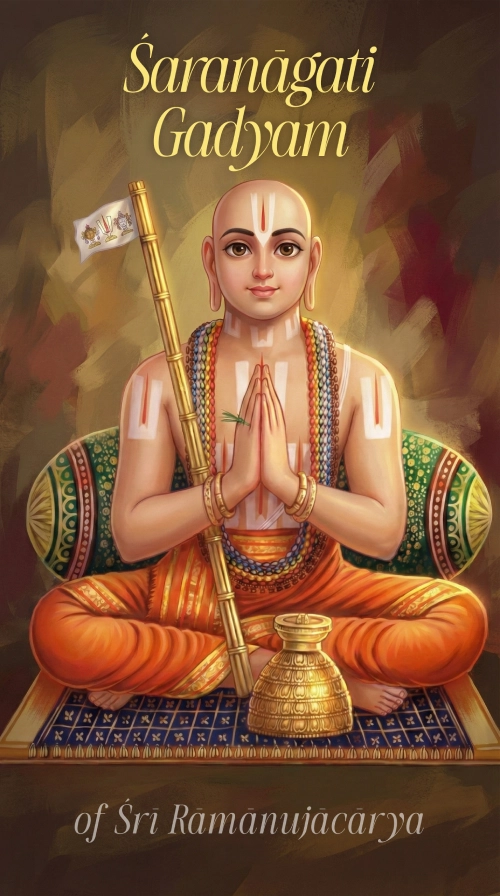
The Śaraṇāgati Gadyam is a profound Sanskrit prayer composed by Śrī Rāmānuja, the great Śrī Vaiṣṇava philosopher and theologian. As one of the three sacred prose texts (Gadyatrayam), it represents the pinnacle of devotional surrender (prapatti). This text captures Rāmānuja's direct dialogue with the Divine Couple, Śrīman Nārāyaṇa and Śrī Mahālakṣmī, at Śrīraṅgam, where he performs complete self-surrender (Śaraṇāgati).
The significance lies in its exposition of the path of total surrender as the most accessible means of salvation, especially for those unable to practice rigorous yoga or meditation. It beautifully articulates the divine attributes of both the Lord and Śrī (Lakṣmī) as the compassionate intercessor, while establishing the theological foundation that surrender itself is both the means (upāya) and the goal (upeya) of spiritual life. This prayer remains central to Śrī Vaiṣṇava practice, and is relished by the devotees as a remembrance of the divine grace.
Listen on YouTube
॥ श्रीः ॥
श्रीभगवद्रामानुजीयं
॥ शरणागतिगद्यम् ॥
यो नित्यं अच्युतपदाम्बुजयुग्मरुक्म
व्यामोहतस् तदितराणि तृणाय मेने ।
अस्मद्गुरोर् भगवतोऽस्य दयैकसिन्धोः
रामानुजस्य चरणौ शरणं प्रपद्ये ॥
वन्दे वेदान्तकर्पूर
चामीकरकरण्डकम्
रामानुजार्यम् आर्याणां
चूडामणिम् अहर्निशम् ॥
śrīḥ
śrī-bhagavad-rāmānujīyaṃ
śaraṇāgati-gadyam
yo nityaṃ acyuta-padāmbuja-yugma-rukma-
vyāmohatas tad-itarāṇi tṛṇāya mene
asmad-guror bhagavato 'sya dayai-ka-sindhoḥ
rāmānujasya caraṇau śaraṇaṃ prapadye
vande vedānta-karpūra-
cāmīkara-karaṇḍakam
rāmānujāryam āryāṇāṃ
cūḍāmaṇim ahar-niśam
TRANSLATION
Salutations to Goddess Śrī. He who, being forever enchanted by the golden pair of Acyuta’s lotus-feet, regarded all other things as mere straw — to that master of ours, the divine Rāmānuja, the one and only ocean of mercy, I surrender at his feet.
I bow always, day and night, to Ācārya Rāmānuja — the crest-jewel of the noble ones, the golden casket containing the camphor of Vedānta.
श्रीरङ्गनायिकारामानुजसंवादः ॥
श्रीरामानुजः
भगवन्नारायणाभिमतअनुरूप
स्वरूपरूपगुणविभव
ऐश्वर्यशीलाद्यनवधिकातिशय
असङ्ख्येयकल्याणगुणगणाम्
पद्मवनालयां भगवतीं श्रियं देवीम्
नित्यानपायिनीं निरवद्यां
देवदेवदिव्यमहिषीम्
अखिलजगन्मातरम् अस्मन्मातरम्
अशरण्यशरण्याम् अनन्यशरणः
शरणम् अहं प्रपद्ये ॥
śrī-raṅga-nāyikā-rāmānuja-saṃvādaḥ
śrī-rāmānujaḥ
bhagavan-nārāyaṇābhimata-anurūpa
svarūpa-rūpa-guṇa-vibhava
aiśvarya-śīlādy-anavadhikātiśaya
asaṅkhyeya-kalyāṇaguṇa-gaṇām
padma-vanālayāṃ bhagavatīṃ śriyaṃ devīm
nityānapāyinīṃ niravadyāṃ
deva-deva-divya-mahiṣīm
akhila-jagan-mātaram asman-mātaram
aśaraṇya-śaraṇyām ananya-śaraṇaḥ
śaraṇam ahaṃ prapadye
TRANSLATION
With no other refuge to resort to, I seek You, O Śrī Devī, who are full of all beneficent qualities and seated in a forest of lotus flowers. You are the refuge of all the helpless; You are my Mother, indeed the Mother of the entire world; the Crowned Divine Queen of the Lord of the Devas (Devadeva Divya Mahiṣī); the pure and unsullied one (Niravadyā); never separated from the Lord (Nityānāpāyinī). Your essential nature (Svarūpa), form (Rūpa), qualities (Guṇa), manifestations (Vibhava), sovereignty (Aiśvarya), gracious conduct (Śīla), and other innumerable auspicious qualities are limitless, unsurpassed, and most wonderful—all in perfect harmony with and pleasing to Bhagavān Nārāyaṇa's own nature and qualities.
PURPORT
In this context, it is important to note that the Mantra begins by invoking Śrī (Goddess Lakṣmī). She is full of boundless maternal love and acts as the compassionate mediator (puruṣakāra) for the soul. She intercedes on our behalf to approach the Lord, the Almighty Father. Like all fathers, He can sometimes be strict and not easily approachable due to our faults, so She must be propitiated first. Therefore, the Gadya naturally begins by explaining the words 'Śrī' or 'Śrīmat'. This aligns with the teachings of our ancient spiritual masters (Ācāryas), who advised that we must first approach Śrī, seek Her affectionate permission, pray to Her for the ultimate human goal (puruṣārtha), and ask Her to make us fit to perform the act of surrender (śaraṇāgati) by reciting the sacred root mantra.
The words 'Bhagavat' and 'Nārāyaṇa' indicate that the Lord is absolutely full of auspicious qualities (guṇa) and boundless dominion (vibhūti). These words remind us that Goddess Lakṣmī is eternally and closely associated with Him, both in the twelve-syllable mantra ('Oṃ Namo Bhagavate Vāsudevāya') and the eight-syllable mantra ('Oṃ Namo Nārāyaṇāya').
The text carefully uses the words 'anurūpa' (befitting or matching in nature) and 'abhimata' (beloved or agreeable) together. This is because, in worldly situations, two people might be agreeable to each other but not a matching pair, or they might be a matching pair but not agreeable to each other. Using both words together dispels any such doubt, confirming that Śrī and the Lord are both perfectly matching and eternally dear to each other.
The word 'guṇa' (qualities), when following 'rūpa' (form), highlights the glorious attributes of Her divine physical form, such as unmatched beauty. The words 'aiśvarya' (rulership) and 'śīla' (gracious accessibility) are used to show the vast collection of qualities that demonstrate both Her supreme power and Her ease of approach. 'Anavadhikā' simply means greatness with absolutely no limit or boundary—meaning there is nothing above or beyond it.
The next four names beautifully illustrate Goddess Lakṣmī's supreme majesty (paratva) and Her easy accessibility (saulabhya):
1. 'Nityānupāyinī' shows that She is eternally present with the Lord and never separated from Him. She is always there, ready to kindly veil the faults of erring souls so that the Lord does not notice and punish them.
2. 'Niravadya' means She is completely flawless and free from any defects, ensuring She is never unapproachable or terrifying.
3. 'Mahiṣī' means the Supreme Anointed Queen. Because She is the Queen, Her wishes and requests can never be transgressed or easily ignored by the Lord.
4. 'Akhilā jaganmātaram' (Mother of the entire universe) shows that Śrī Rāmānuja lovingly includes himself among the countless children to whom She is a mother. Finally, 'aśaraṇya' refers to those who are completely helpless and have no other refuge to turn to. By using the word 'ananya' (having no other), the speaker humbly includes himself in this class of helpless souls. Thus concludes the initial prayers directed to Śrī.
पारमार्थिक भगवच्चरणारविन्दयुगऴ
ऐकान्तिकात्यन्तिक परभक्ति परज्ञान
परमभक्तिकृत परिपूर्णानवरत
नित्यविशदतम अनन्यप्रयोजन
अनवधिकातिशयप्रिय भगवदनुभवजनित
अनवधिकातिशय प्रीतिकारित
अशेषावस्थोचित अशेषशेषतैकरतिरूप
नित्यकैङ्कर्यप्राप्त्यपेक्षया
पारमार्थिकी भगवच्चरणारविन्दशरणागतिः
यथावस्थिता अविरताऽस्तु मे ॥
श्रीरङ्गनायिका
अस्तु ते । तयैव सर्वं सम्पत्स्यते ॥
॥ श्रीरङ्गनाथरामानुजसंवादः ॥
pāramārthika bhagavac-caraṇāravinda-yugaḻa
aikāntikātyantika para-bhakti para-jñāna
parama-bhakti-kṛta paripūrṇā-navarata
nitya-viśadatama ananya-prayojana
anavadhikātiśaya-priya bhagavad-anubhava-janita
anavadhikātiśaya prīti-kārita
aśeṣāvasthocita aśeṣa-śeṣataika-rati-rūpa
nitya-kaiṅkarya-prāpty-apekṣayā
pāramārthikī bhagavac-caraṇāravinda-śaraṇāgatiḥ
yathāvasthitā aviratā 'stu me
śrī-raṅga-nāyikā
astu te tayaiva sarvaṃ sampatsyate
śrī-raṅganātha-rāmānuja-saṃvādaḥ
TRANSLATION
I pray to You: May my sincere and genuine śaraṇāgati at the lotus feet of Bhagavān be perfectly performed with all its aṅgas (essential components) and continue uninterrupted until the goal of puruṣārtha is attained. This is for the purpose of securing the privilege of eternal service (nitya kaiṅkarya) to the Lord—that is, the satisfaction derived from all forms and kinds of service, always appropriate to every condition and circumstance. This service arises from boundless, intense devotion born from the experience of enjoying the Lord—an unbounded, limitless, selfless love with no other purpose than serving Him directly. This is a perfect love, fully enjoyed in all His manifestations, not just momentarily but continuously without interruption. This devotion is further nurtured by sincere, single-pointed, and ever-intense Para Bhakti (the desire for His vision), parajñāna (direct perception of God), and Parama Bhakti (the longing to have that perception continue forever)—all directed toward the lotus feet of the Lord.
[Śrī Devī graciously accepts this prayer.]
Śrī Devī says: "So shall it be. By this alone, everything will be accomplished."
PURPORT
The phrase 'Caraṇāravinda' (lotus feet) beautifully implies that the Lord is as easily accessible to a devoted servant (śeṣa) as a mother's breast-milk is available to her child.
The text uses two important terms to describe this surrender: 'aikāntika' means the surrender is performed with the one-pointed, sole objective of pleasing the Lord and nothing else, while 'ātyantika' means this devotion and experience is continuous and never-ending (nityayukta).
The stages of devotion are clearly defined:
- 'Parabhakti' is the deep, intense longing of the devotee to have a direct, unending vision of God.
- 'Parajñāna' is the actual achievement of that direct vision of God.
- 'Paramabhakti' is the burning desire to have that experience of vision continued and perpetuated for all eternity.
The next six words, beginning with 'paripūrṇa', describe the perfection of this experience. 'Paripūrṇa anubhava' means having perfect, complete knowledge of the Lord in all His five divine manifestations: Para (supreme realm), Vyūha (cosmic emanations), Vibhava (earthly incarnations), Hārda (indwelling in the heart), and Arcā (consecrated deity forms).
'Anavarata' (continuous) means it happens without any breaks, contrasting with something that happens only 'once' or 'sometimes'. The word 'nitya' (eternal) removes any idea of limitation or endlessness. Why use both words? They are needed to highlight an uninterrupted continuity—unlike daily rituals (such as bathing or agnihotra) which are considered 'nitya' (daily/regular) but are only performed at specific intervals.
'Viśadātma' assures us that this experience of God is completely direct and clear. 'Ananya prayojana' means having absolutely no other selfish motive or object in view. To explain why a devotee would want nothing else, the words 'anavadhi atiśaya priya' (limitless, pre-eminent affection) are used. Even if there are no other goals, one's love could theoretically have a limit. These words prove that the devotion born from experiencing the Lord is utterly limitless in its depth.
'Atiśaya' means pre-eminence or ecstasy—an overwhelming feeling of joy caused by experiencing the Lord. 'Aśeṣa avasthā' means serving Him in all possible situations and states, whether He is seated in a grand hall (maṇṭapa) or resting in His private chambers (antaḥpura). 'Śeṣatva' refers to rendering loving service, such as holding the royal umbrella, waving the fan (cāmara), sounding the divine trumpets, serving as His sandals, or offering betel leaves.
Here a doubt may arise: We know that divine beings like Ananta (the serpent bed) and Garuḍa (the eagle mount) already have their assigned tasks of service. How can all these services be open to a human devotee? To clear this doubt, Śrī Rāmānuja uses the term 'rati-rūpa' (finding immense joy in the act of service itself). True service is whatever pleases the Lord. Therefore, when a devotee sees another devotee performing a service that pleases the Lord, they feel the exact same profound satisfaction as if they had performed it themselves. This shared joy in witnessing the Lord's pleasure is, in itself, a form of service. This echoes the great Ācārya Āḷavandār, who declared he serves 'only to gladden Thee, not for my own pleasure.'
The deep implication of surrendering to Nārāyaṇa (indicated by the dative case 'Nārāyaṇāya') is then explained:
- 'Pāramārthike' indicates that this surrender is not born from ignorance (tamo-guṇa), but from a pure desire to do what pleases the Lord. This distinguishes true surrender (śaraṇāgati) from other self-reliant paths.
- 'Yathāvasthita' indicates it is free from passionate worldly desires (rajo-guṇa) and is directed only to the supremely worthy Lord.
- 'Avirata' means this surrender is uninterrupted until the ultimate goal is reached. It is a direct, enduring means to salvation, unlike other indirect paths that eventually fade away. The section concludes with Goddess Lakṣmī's loving blessings: 'Astu te' (Let it be so for you). This shows the absolute certainty of Her grace, just as She (as Sītā in the Rāmāyaṇa) offered friendship even to the demon Rāvaṇa. Her final blessing, 'sarvaṃ saṃpatsyate', uses the word 'sarva' (all) to guarantee that not only the surrendered soul, but also everyone connected to them, will be wonderfully saved.
श्रीरामानुजः
अखिलहेयप्रत्यनीककल्याणैकतान !
स्वैतरसमस्तवस्तुविलक्षण
अनन्तज्ञानानन्दैकस्वरूप !
स्वाभीमतानुरूप एकरूप अचिन्त्य
दिव्याद्भुत नित्यनिरवद्य निरतिशय
औज्ज्वल्य सौन्दर्य सौगन्ध्य
सौकुमार्य लावण्य यौवनाद्य्
अनन्तगुणनिधिदिव्यरूप !
śrī-rāmānujaḥ
akhila-heya-pratyanīka-kalyāṇaikatāna !
sva-itara-samasta-vastu-vilakṣaṇa
ananta-jñānānandaika-svarūpa !
svābhīmatānurūpa ekarūpa acintya
divyādbhuta nitya-niravadya niratiśaya
aujjvalya saundarya saugandhya
saukumārya lāvaṇya yauvanādy-
ananta-guṇa-nidhi-divya-rūpa !
TRANSLATION
[Then follows invocations to the Lord with a description of all His qualities, His divine Form, and His weapons, etc.]
[With no other person to surrender myself to, I take shelter at Your lotus feet, O Śrīman Nārāyaṇa, the refuge of all the helpless!] You are the enemy of all evil and the abode of all auspicious qualities, the perfect embodiment (distinct from all other forms) of immeasurable knowledge and bliss. You bear a divine form that is agreeable to You, worthy of You, unchanging, beyond the reach of thought, divine in essence, and wonderful to behold. You are eternally existing, pure and unsullied, pre-eminently excellent, of brilliant loveliness, sweet-smelling, charming with the prime of youthfulness—indeed, a form full of such qualities and a complete treasure of infinite excellences.
PURPORT
He is described with terms like 'Akhila', which means He is completely free from the pains, penalties, and constant changes that affect both living (sentient) and non-living (non-sentient) things in this material world. The word 'Pratyanīka' shows that He doesn't just lack evil qualities, but He actively destroys the evil present in others. 'Ānanda' means He is perfectly blissful in Himself, while 'anukūla' means He is constantly doing good for others.
He is 'Kalyāṇa-aikatāna', which means He is the sole, concentrated abode of all virtues and auspiciousness. 'Kalyāṇa' also emphasizes that He is good not only to Himself but brings goodness to everyone else. The word 'Eka' removes any possibility of there being even a single trace of anything inauspicious or lifeless within Him.
Next, Śrī Rāmānuja beautifully describes the Lord's 'divya maṅgala vigraha'—His divine, auspicious physical form. The terms 'abhimata' and 'anurūpa' are used again to show His form is both deeply beloved and perfectly befitting His majestic nature. 'Ekarūpa' highlights two unique aspects: (1) His supreme purity and fullness of good qualities making Him worthy of worship, and (2) His status as the ultimate goal to be attained (upeya). His form is 'Acintya', meaning its glory is so vast it goes completely beyond the reach of human imagination or thought. It is 'Divya' (divine), meaning it is made of a pure, spiritual substance entirely different from the ordinary matter of this world. It is also structurally distinct and perfect. 'Adbhuta' means His form is astonishing, revealing new dimensions of beauty every single minute. It is 'Nitya', meaning it is everlasting and never decays. 'Niravadya' means it is completely flawless, making it wonderfully easy to meditate upon—unlike the abstract essence of God, His beautiful physical form is easy for the mind to grasp and hold onto. This form possesses 'saundarya' (exquisite loveliness) and 'lāvaṇya' (an irresistible, charming glow over His whole structure). Words like 'ādi' (etcetera) point to countless other physical perfections, such as the perfect roundness of His limbs and the majestic length of His arms.
स्वाभाविकानवधिकातिशय
ज्ञानबलऐश्वर्यवीर्यशक्तितेजस्
सौशील्य वात्सल्य मार्दव आर्जव
सौहार्द साम्य कारुण्य माधुर्य
गाम्भीर्य औदार्य चातुर्य
स्थैर्यधैर्यशौर्यपराक्रम
सत्यकामसत्यसङ्कल्पकृतित्व
कृतज्ञताद्यसङ्ख्येय
कल्याणगुणगणौघमहार्णव !
svābhāvikānavadhikātiśaya
jñāna-bala-aiśvarya-vīrya-śakti-tejas
sauśīlya vātsalya mārdava ārjava
sauhārda sāmya kāruṇya mādhurya
gāmbhīrya audārya cāturya
sthairya-dhairya-śaurya-parākrama
satya-kāma-satya-saṅkalpa-kṛtitva
kṛtajñatādy-asaṅkhyeya
kalyāṇa-guṇa-gaṇaugha-mahārṇava !
TRANSLATION
You are the great ocean into which flow rivers of limitless excellent virtues, all natural to You and beneficial for the protection of devotees. These include: complete knowledge (jñāna), mighty sovereignty (bala), supreme lordship (aiśvarya), unfailing strength (vīrya), power to act without external assistance (śakti), radiant splendor (tejas), gracious conduct (sauśīlya), tender affection like a cow toward her calf (vātsalya), compassionate softness (mārdava), straightforwardness (ārjava), genuine friendship (sauhārda), impartiality (sāmya), mercy (kāruṇya), sweetness (mādhurya), profundity (gāmbhīrya), magnanimity (audārya), skillfulness (cāturya), steadfastness (sthairya), courage (dhairya), valor (śaurya), prowess (parākrama), fulfillment of all desires (satyakāma), realization of all resolves (satyasaṅkalpa), accomplishment of all undertakings (kṛtitva), and grateful remembrance of even the smallest act of worship offered to You (kṛtajñatā)—and countless other auspicious qualities.
PURPORT
The text categorizes these qualities beautifully. The first twelve qualities are highly specific and immensely useful for granting salvation to His devoted souls:
1. 'Śīla' / 'Sauśīlya': This is the gracious quality of a supreme superior moving freely and lovingly with inferiors without any selfish motive. Because of this, the Lord never makes His devotees feel afraid of His immense power, nor does He make them hesitate to approach Him.
2. 'Vātsalya': This is deep, motherly affection where the Lord actively finds good even in the devotee's flaws, just like a mother cow lovingly licks and fondles her newborn, dirty calf. It represents extreme, flawless patience.
3. 'Mārdava': The softness of heart that makes the Lord feel a profound sense of loss if He is separated from His devotees, constantly looking out for their presence.
4. 'Ārjava': Complete straightforwardness and perfect alignment of His mind, speech, and body. Because of His artless honesty, Lord Rāma openly narrated His whole story even to the demoness Śūrpaṇakhā.
5. 'Sauhārda': True good-heartedness; He is constantly intent on doing good for His devotees without ever caring for or expecting any return.
6. 'Sāmya': Perfect equality. He never discriminates based on a person's birth, conduct, or character. He makes Himself easily available to everyone and accepts their humble offerings without judging their material value.
7. 'Kāruṇya': Boundless compassion; removing the calamities and grievances of others without expecting anything back.
8. 'Mādhurya': Sweetness. His kindness is so profound that it is visible even when He is inflicting punishment. For example, even as Lord Kṛṣṇa rushed at Bhīṣma with a weapon, Bhīṣma lovingly cried out, 'Come, come, O lotus-eyed One!'
9. 'Gāmbhīrya': Immeasurable depth and majesty. The massive favors He grants His devotees are so huge, yet He never feels He has given them much, despite how insignificant the devotee's own merits might be.
10. 'Audārya': Supreme generosity. He grants massive favors without ever feeling He has over-favored anyone. He gives not like giving to a stranger, but as if giving a rightful inheritance to His own son. (Like when Kṛṣṇa felt forever indebted to Draupadī when she cried for His help).
11. 'Cāturya': Divine cleverness and skill in instantly affording relief to His devotees while expertly overlooking their faults, just like a loving father. (For example, Rāma intelligently performed the coronation of Vibhīṣaṇa right there on the battlefield).
12. 'Sthairya': Unshakable, firm determination to never, ever abandon His devotees.
After these twelve qualities that protect the devotee, there are three qualities He uses to punish those who try to harm His devotees:
1. 'Dhairya': Unshaken courage to stand against any foes who try to stop Him from protecting His beloveds.
2. 'Śaurya': Immense valor and prowess to march directly into the enemy's camp as casually as if He were walking into His own home.
3. 'Parākrama': Unstoppable power to completely vanquish and shatter the enemies once He enters their camp (like when Rāma single-handedly destroyed Rāvaṇa's entire backup army).
Then, two qualities relating to His divine enjoyment are mentioned:
1. 'Satyakāma': Having true, eternal desires, which denotes that He possesses the flawless eternal spiritual realm (Nitya-vibhūti).
2. 'Satyasaṅkalpa': Having a true, unfailing will, which denotes that He possesses all the material universes to engage in His divine sport (Līlā-vibhūti).
Next are two qualities referring to His special protective activities:
1. 'Kṛtitva': Taking active satisfaction in answering prayers; it means He Himself steps in and does the work that the weak devotee is unable to do.
2. 'Kṛtajñatā': Immense divine gratitude. He always remembers even the tiniest good act a devotee has done, completely forgets their countless faults, and ignores how massively He is overpaying them in return. As He says, 'I will remember him at the time of death, even if he cannot remember Me.' The word 'gaṇa' (collection) is used to show that inside each of these glorious qualities are countless other sub-qualities. This massive flood of qualities is called 'ogha', and the vast ocean they form is the 'mahārṇava'. Ultimately, virtues have no permanent value unless they find their eternal home in the Supreme Lord (Bhagavān).
स्वोचितविविधविचित्रानन्ताश्चर्य !
नित्य निरवद्यनिरतिशयसुगन्ध
निरतिशयसुखस्पर्शनिरतिशयौज्ज्वल्य
किरीटमकुटचूडावतंस
मकरकुण्डलग्रैवेयकहार
केयूरकटकश्रीवत्सकौस्तुभ
मुक्तादामोदरबन्धन
पीताम्बरकाञ्चीगुण
नूपुराद्यपरिमितदिव्यभूषण !
svocita-vividha-vicitrānantāścarya !
nitya niravadya-niratiśaya-sugandha
niratiśaya-sukha-sparśa-niratiśayaujjvalya
kirīṭa-makuṭa-cūḍāvataṃsa
makara-kuṇḍala-graiveyaka-hāra
keyūra-kaṭaka-śrīvatsa-kaustubha
muktādāmodara-bandhana
pītāmbara-kāñcīguṇa
nūpurādy-aparimita-divya-bhūṣaṇa !
TRANSLATION
O Nārāyaṇa! You are adorned with all kinds of ornaments—worthy of You, most wonderful to behold, everlasting, faultless, sweet-smelling, soft to touch, and wonderfully splendorous. These include: the crown bearing the central diadem of lustrous gems, other head ornaments, ear ornaments, necklaces and neck ornaments, garlands, shoulder-bracelets and arm-bracelets, Śrīvatsa and Kaustubha, pearl garlands, waist-belts, silk garments, golden waist-bands, leg ornaments, and countless other precious adornments.
PURPORT
The word 'vividha' refers to the many different kinds of ornaments He wears, such as bracelets (kaṭaka) and crowns (makuṭa). 'Vicitra' highlights the marvelous, breathtaking varieties within each kind of ornament.
They are 'anantāścarya', meaning their excellence and wonder are completely beyond any limit. The term 'niravadya' is used to emphasize that these ornaments are flawless, making them perfectly suited for a devotee's deep meditation. When a devotee begins to contemplate the Lord's divine form, the brilliant vision of His ornaments naturally appears first before their mental eyes.
The unique quality of 'niratiśaya sugandhatvam' (unsurpassed, infinite sweet fragrance) distinguishes the Lord's ornaments from any ordinary, worldly jewelry. As the sacred scriptures (Śruti) declare, 'He is all sweet-smelling and the essence of all joy (rasa).' The word 'makuṭa' refers to the radiant central jewel embedded in the head coronet, or it can mean the magnificent crown itself. 'Kirīṭa-rūpa' specifically refers to this grand head ornament. The word 'divya' (divine) applies to all these descriptions, reminding us that nothing about Him is ordinary; everything is of the highest, purely spiritual nature.
स्वानुरूप अचिन्त्यशक्ति
शङ्खचक्रगदाअसिशार्ङ्गाद्य्
असङ्ख्येयनित्यनिरवद्य
निरतिशयकल्याणदिव्यायुध !
svānurūpa acintya-śakti
śaṅkha-cakra-gadā-asi-śārṅgādy-
asaṅkhyeya-nitya-niravadya
niratiśaya-kalyāṇa-divyāyudha !
TRANSLATION
O Nārāyaṇa! You bear various weapons of unparalleled power, all worthy of You and perfectly suited to Your nature—the conch (śaṅkha), the discus (cakra), the mace (gadā), the sword (khaḍga), the bow (dhanus), and countless other auspicious divine weapons that surpass all others in power and force.
PURPORT
These weapons possess 'acintya-śakti', which is an inconceivable, mind-boggling power where just one single weapon can perform the specific duties of all the other weapons combined. A beautiful example is given from the Rāmāyaṇa regarding Lord Rāma's arrow: 'The heavy labor usually requiring a crowbar, a chisel, and a spade was effortlessly performed by just one arrow of Rāma.' This refers to the moment Rāma shot a single arrow to prove His immense strength to Sugrīva, and that one arrow effortlessly pierced through seven massive trees, split a hill, and penetrated all the way down to the netherworld (Pātāla-loka). As explained before, 'niravadya' means these weapons are utterly flawless. Finally, 'niratiśaya-kalyāṇa' denotes the absolutely unsurpassed, excellent splendor of the Lord's complete vision, gloriously shining with both His dazzling ornaments and His mighty weapons.
स्वाभिमतनित्यनिरवद्यानुरूप
स्वरूपरूपगुणविभवऐश्वर्य
शीलाद्यनवधिकातिशया
सङ्ख्येयकल्याणगुणगणश्रीवल्लभ !
एवम्भूतभूमिनीऴानायक !
svābhimata-nitya-niravadyānurūpa
svarūpa-rūpa-guṇa-vibhava-aiśvarya
śīlādy-anavadhikātiśayā-
saṅkhyeya-kalyāṇa-guṇa-gaṇa-śrī-vallabha !
evam-bhūta-bhūmi-nīḻā-nāyaka !
TRANSLATION
You are also the Consort of Śrī, whose form harmonizes perfectly with Yours and who possesses highly beneficent qualities such as glory and sovereignty, along with innumerable excellent attributes. You are also the Consort of Bhū Devī and Nīlā Devī, who are endowed with similar auspicious qualities.
PURPORT
He is also the Lord of Bhū-devī (the Goddess of the Earth) and Nīlā-devī, who both possess splendid, auspicious qualities very similar to those mentioned for Śrī. This similarity is indicated by the word 'evambhūta' (being of such a nature). The two Goddesses, Bhū and Nīlā, are mentioned separately because they do not occupy the exact same supreme status as Śrī. Instead, they are lovingly devoted to Her as Her subordinates (śeṣabhūtas). As beautifully stated in the 'Śrī-guṇa-ratnakośa', Goddess Lakṣmī affectionately pleases Her Lord through Bhū and Nīlā, whom She considers to be like Her own extensions—Her own breast, hands, feet, and loving gaze.
स्वच्छन्दानुवर्तिस्वरूपस्थितिप्रवृत्ति
भेदाशेषशेषतैकरतिरूप
नित्यनिरवद्यनिरतिशय
ज्ञानक्रियैश्चर्याद्यनन्त
कल्याणगुणगण
शेषशेषाशनगरुडप्रमुख
नानाविधानन्त्परिजन
परिचारिकापरिचरित चरणयुगऴ !
svacchandānuvarti-svarūpa-sthiti-pravṛtti
bhedāśeṣa-śeṣataika-rati-rūpa
nitya-niravadya-niratiśaya
jñāna-kriyaiścaryādy-ananta
kalyāṇa-guṇa-gaṇa
śeṣa-śeṣāśana-garuḍa-pramukha
nānā-vidhānant-parijana
paricārikā-paricarita caraṇayugaḻa !
TRANSLATION
You possess innumerable followers and servants, both male and female, who minister to Your needs and comforts while waiting at Your feet. Their form, existence, and actions are all due to Your will. Among them are Ādiśeṣa, Viśvaksenā, and Garuḍa, who are endowed with a host of auspicious qualities—imperishable, pure, possessing limitless wisdom and energy for action, and endowed with the power to direct and maintain.
PURPORT
The word 'svarūpa' (inherent nature) is used to distinguish the unique, pure forms of these attendants from all other kinds of beings. 'Sthiti' (existence/position) explains that things truly exist only as long as they remain firmly fixed in their proper, natural places—which for a soul, is in service to the Lord.
This section highlights the massive difference between the 'nitya-siddhas' (the eternally liberated souls in the spiritual realm) and the 'saṃsārins' (the bound souls wandering in the material world). The eternally liberated souls have a pure, intuitive perception; they instantly understand and know the innermost wishes of the Lord. In contrast, bound souls are ignorant of His desires and only act out their lives. Thus, the existence and actions of bound souls are entirely different from the glorious nityas. The phrase 'svacchanda anuvṛtti' beautifully shows that the nityas joyfully and voluntarily act by intuitively grasping the Lord's will.
The term 'nitya-niravadya' (eternally flawless) specifically distinguishes these eternally free souls (nityas) from the liberated souls (muktas) who were once bound by karma but are now free. 'Kriyā' refers to their joyful, constant service to the Lord. 'Aiśvarya' means they have perfect control and direction over the activities of their spiritual bodies and senses to execute this service.
The text specifically mentions 'Śeṣāsana', which refers to Viśvaksena, the Lord's chief commander. He is granted the high honor of eating the sacred remnants of the Lord's food (as beautifully noted in Āḷavandār's 'Stotra-ratna': 'the eater of the food left over after Thy eating'). The word 'nānāvidha' refers to the incredibly diverse and different kinds of loving services rendered to the Lord: holding the royal umbrella, waving the fan (cāmara), serving as His sandals or His seat, or offering the betel spittoon. For each and every one of these loving services, there are countless, innumerable devoted attendants joyfully employed. The term 'paricārikā' honors the female attendants, keeping in mind devoted maidens like Vimala, who lovingly wave the fans for the Lord.
परमयोगिवाङ्मनसाऽपरिच्छेद्य
स्वरूपस्वभावस्वाभिमत
विविधविचित्रानन्तभोग्य
भोगोपकरणभोगस्थान
समृद्धानन्ताश्चर्या
नन्तमहाविभवानन्त्परिमाण
नित्यनिरवद्यनिरतिशयश्रीवैकुण्ठनाथ !
parama-yogi-vāṅmanasā 'paricchedya
svarūpa-svabhāva-svābhimata
vividha-vicitrānanta-bhogya
bhogopakaraṇa-bhoga-sthāna
samṛddhānantāścaryā-
nanta-mahā-vibhavānant-parimāṇa
nitya-niravadya-niratiśaya-śrī-vaikuṇṭha-nātha !
TRANSLATION
You are also the Lord of Vaikuṇṭha, the eternal, faultless, immeasurable realm that lies beyond the reach of speech and mind even for the holy yogins—a divine abode most dear to You, containing within itself all kinds and varieties of enjoyments, the means conducive to such enjoyments, and places perfectly suited for such experiences. It is replete with all forms of divine manifestations (vibhava). Such is Your Vaikuṇṭha, O Lord!
PURPORT
The phrase 'parama-yogī-vāṅ-manasa-aparicchedya-svarūpa-svabhāvā' can either describe the Supreme Lord Himself or the realm of Vaikuṇṭha. It means possessing a nature and form so unimaginably grand that it cannot be measured, grasped, or even described by the speech and minds of the greatest, most advanced yogis. If applied to the Lord, 'svarūpa' points to His natural supreme rulership, while 'svabhāva' points to His other glorious qualities. If applied to Vaikuṇṭha, 'svarūpa' describes its magnificent, spiritual structure.
'Saulabhya' points to the Lord's easy accessibility, and supreme enjoyability is His natural attribute. 'Vividha' points to the endless, wonderful varieties of the exact same things, while 'ananta' highlights that these varieties are completely innumerable. The wonders there are limitless. 'Vibhava' refers to the staggering abundance of enjoyable spiritual wealth—specifically external enjoyables like magnificent divine chariots, extending beyond just personal items like garlands and sandals. Everything in Vaikuṇṭha is 'nitya' (eternal) and 'niravadya' (completely flawless, without a single blemish). The word 'niratiśaya' confirms that there is absolutely 'nothing higher than this'—it is the unsurpassable, ultimate zenith of perfection.
स्वसङ्कल्पानुविधायि स्वरूपस्थितिप्रवृत्ति
स्वशेषतैकस्वभाव प्रकृति पुरुष
कालात्मक विविध विचित्रानन्त
भोग्य भोक्तृवर्ग भोगोपकरण
भोगस्थानरूप
निखिलजगदुदय विभव लयलील !
svasaṅkalpānuvidhāyi svarūpa-sthiti-pravṛtti
svaśeṣataika-svabhāva prakṛti puruṣa
kālātmaka vividha vicitrānanta
bhogya bhoktṛ-varga bhogopakaraṇa
bhoga-sthāna-rūpa
nikhila-jagad-udaya vibhava laya-līla !
TRANSLATION
Your divine sport (līlā) consists of the creation, sustenance, and dissolution of the worlds. These worlds contain instruments of enjoyment (bhogyopākaraṇa) and various kinds of enjoyable objects (bhogya). The fundamental principles—Prakṛti (primordial matter), Puruṣa (individual souls), and Kāla (time)—are by their very nature eternally subservient to You, O Lord. Their form (svarūpa), their existence (sthiti), and their activities (pravṛtti) are all in accordance with Your will alone, and they always follow only Your wishes and commands.
PURPORT
The phrase 'sva-saṅkalpa' (by His own will) is used to convey that the Lord doesn't just casually direct the universe; He actively, continuously sustains and protects it using merely His divine will. 'Śeṣatvam' emphasizes that every single thing in the entire universe exists purely to serve Him.
Usually, in philosophical lists, 'kāla' (Time) is mentioned after 'prakṛti' (Matter), as both are non-sentient (acetana). However, here Time is mentioned before Matter because Time acts as the crucial active agent (kāraṇa) that brings the soul (puruṣa) and matter (prakṛti) together, and also separates them. As the Viṣṇu Purāṇa explains: 'Distinct from Viṣṇu, there are two entities called matter (pradhāna) and soul (puruṣa). The active principle that brings them together and separates them is Time; and that Time is also His body.' The universe is 'vividha', meaning it is wonderfully variegated with different experiences of sound, touch, and so on. 'Vicitra' implies its marvelous, unique distinctions. Finally, the word 'nikhila' (entirety) is used to clearly elevate and differentiate the Supreme Lord Īśvara from subordinate, created gods like the four-faced Brahmā.
सत्यकाम! सत्यसङ्कल्प !
परब्रह्मभूत ! पुरुषोत्तम महाविभूते !
श्रीमन्! नारायण! वैकुण्ठनाथ !
अपारकारुण्य सौशील्य वात्सल्य
औदार्य ऐश्वर्य सौन्दर्य महोदधे !
अनालोचितविशेष अशेषलोकशरण्य !
प्रणतार्तिहर ! आश्रितवात्सल्यैकजलधे!
अनवरतविदित निखिलभूतजातयाथात्म्य!
अशेषचराचरभूत निखिलनियमननिरत!
अशेषचिदचिद्वस्तुशेषिभूत!
निखिलजगदाधार! अखिलजगद्स्वामिन्!
अस्मन्मास्वामिन्! सत्यकाम! सत्यसङ्कल्प!
सकलेतरविलक्षण! अर्थिकल्पक!
आपत्सख! श्रीमन्! नारायण! अशरण्यशरण्य!
satyakāma! satyasaṅkalpa !
para-brahma-bhūta ! puruṣottama mahā-vibhūte !
śrīman! nārāyaṇa! vaikuṇṭha-nātha !
apāra-kāruṇya sauśīlya vātsalya
audārya aiśvarya saundarya mahodadhe !
anālocita-viśeṣa aśeṣa-loka-śaraṇya !
praṇatārtihara ! āśrita-vātsalyaika-jaladhe!
anavarata-vidita nikhila-bhūta-jāta-yāthātmya!
aśeṣa-carācara-bhūta nikhila-niyamana-nirata!
aśeṣa-cid-acid-vastu-śeṣi-bhūta!
nikhila-jagad-ādhāra! akhila-jagad-svāmin!
asman-mā-svāmin! satyakāma! satyasaṅkalpa!
sakaletara-vilakṣaṇa! arthi-kalpaka!
āpat-sakha! śrīman! nārāyaṇa! aśaraṇya-śaraṇya!
TRANSLATION
You are the Supreme Brahman (Para Brahma), the greatest of all beings, possessing immense power and wealth. Your will is always fulfilled, and Your commands are carried out by all. You are the Consort of Śrī! O Nārāyaṇa, Lord of Vaikuṇṭha! You are an ocean filled with auspicious qualities such as boundless compassion, easy accessibility, affectionate kindness, generosity, sovereignty, and supreme beauty. You are the refuge of the entire world without any distinction of race, color, or caste. You remove the suffering of those who take shelter in You. You are an ocean of motherly affection toward Your devotees. You are omniscient, knowing at all times the true nature of all groups of beings. You skillfully control all movable and immovable things in the worlds. You are their Lord, the sustainer of all the worlds, their Master, and my Master. Your desires are always fulfilled, and Your commands are scrupulously executed. Distinct from all others, You are the wish-fulfilling tree (the granter of all prayers), the friend in distress, Śrīman Nārāyaṇa, the refuge of the helpless, the one and only refuge (with no other to turn to for help).
PURPORT
1. 'Satyakāma' denotes that the Lord possesses the eternal, flawless spiritual realm (Nitya-vibhūti).
2. 'Satyasaṅkalpa' denotes that He possesses the entire material universe (Līlā-vibhūti) for His sport, and that He is its intelligent, creative cause (nimitta-kāraṇa).
3. 'Para-brahma-bhūta' is used to show that He is also the material cause (upādāna-kāraṇa) of the universe.
4. 'Puruṣottama' is used to clearly prove that even though He is the material cause of everything, He remains completely untouched and unaffected by any of the impurities or infirmities of material things.
5. 'Mahā-vibhūti' dispels any doubt about how He can be the material cause yet distinct from matter. It reminds us of the scriptures stating that all universes act as His physical body, completely under His control.
6. 'Śrīman' denotes that both the Lord and Goddess Śrī are the joint, unified Masters of all.
7. 'Nārāyaṇa' conveys this same protective truth in more detail. The root meaning of Nārāyaṇa ('nārāt jātāni...') explains that He is the source and ultimate resting place for all eternal entities. It reaffirms that He is free from the flaws of His creation.
8. 'Vaikuṇṭha-nātha' explicitly proves the existence of His eternal spiritual realm. The deep meaning of 'Vaikuṇṭha' is: 'kuntha' means obstruction to knowledge caused by karma, and 'vi' means without. Therefore, souls whose pure knowledge is no longer obstructed by karma are called Vaikuṇṭha, and the magnificent, unhindered place where they reside is also called Vaikuṇṭha.
Up to this point, the text has deeply described the nature of the Supreme Lord and the attributes that make Him both the means to salvation (upāya) and the ultimate goal (upeya).
Next, the text focuses specifically on the qualities that make Him the perfect 'upāya' (means of surrender). It starts with 'apāra' (boundless), showing the sheer, unimaginable extent of His mercy; this mercy operates even on a person who completely does not deserve it. 'Kāruṇya' is His deep compassion. 'Aiśvarya' (rulership) shows that even when a bound soul acts so terribly as to obstruct their own salvation, the Lord's immense power still protects and gently redirects them.
'Saundarya' (divine beauty) shows how He magnetizes and completely attracts bound souls to come under His protection. As the scriptures say, 'He steals the sight and the hearts of men,' leading devotees to cry out, 'Victory to You!'
Having established His many virtues, Śrī Rāmānuja shows that the real purpose of these qualities is to invite us to surrender (śaraṇāgati). He uses 'anālocita-viśeṣa', which guarantees that the Lord makes absolutely no distinction based on a person's caste, conduct, or character. 'Loka' includes all worlds and every living being inside them.
He is 'praṇatārti-hara'—the one who completely removes the calamities of those who bow to Him. This is also the specific name of Lord Varadarāja of Kāñcī. Śrī Rāmānuja likely mentions this in deep gratitude, remembering how Lord Varadarāja and His consort took the form of a tribal hunter and huntress to personally guide and save him when he was lost in a dark forest after being plotted against by his former teacher.
His quality of 'āśritavātsalya' (motherly affection for those who take refuge) is vital for His protective activities. Rāmānuja highlights this specific quality because he deeply believed it is the most radiantly noticeable attribute of the Lord.
The phrase 'anavarata' addresses a common doubt: 'Lord, since You are omniscient, You already know my helplessness. Why must I pray?' The answer is that it is the Lord's sweet will that the soul makes at least some small, willing effort to invoke His grace.
The passage beginning with 'aśeṣa' expands on this: even if the soul cannot actively cooperate, it must at least not actively obstruct the Lord's grace. Ultimately, even the ability to stop resisting is granted by His will. The words 'aśeṣa cit-acit' answer the question of why God saves us: 'Even my prayer asking to be saved is driven by Your will; You are the one who sustains us and allows us to grow.'
'Akhila-jagat-svāmin' confirms He is the absolute Lord of the universe, owning not just the physical things but all their qualities as well. 'Asmad-svāmin' makes this deeply personal: it highlights the immense favor He does by granting the soul the birthright to serve Him. Whatever happens, it is entirely His doing.
'Satyakāma' shows that protecting the weak is the natural duty of a totally Perfect Being. 'Satyasaṅkalpa' shows He performs this monumental task of protection effortlessly.
'Sakaletara-vilakṣaṇa' is an emotional appeal: 'If You do not undertake this task of saving me, how are You any different from ordinary people?' He is the 'arthi-kalpaka'—the divine wish-fulfilling tree to whom prayers are made and who generously grants them all. As Kṛṣṇa says, He considers those who accept His favors to be immensely generous to Him. If He doesn't save the helpless, His beautiful reputation would be ruined!
'Āpat-sakhā' (friend in times of danger) reminds the Lord that the dire, miserable state of a soul (like the elephant Gajendra) is precisely what summons His protection.
The appeal reaches its climax: 'Śrīman' means 'Even if I am completely unqualified, please save me at least for the sake of Goddess Śrī!' 'Nārāyaṇa' means 'Even if She neglects me, protect me at least for Your own glorious sake!' Finally, 'Aśaraṇya-śaraṇya' means 'Even though I have no connection or merit, I must be protected because I am completely helpless without any other refuge, and You are the sole protector of the helpless!'
अनन्यशरणः त्वत्पादारविन्दयुगऴं
शरणम् अहं प्रपद्ये ॥
अत्र द्वयम् अनुसन्धेयम् ।
पितरं मातरं दारान्
पुत्रान् बन्धून् सखीन् गुरून् ।
रत्नानि धनधान्यानि
क्षेत्राणि च गृहाणि च ॥
सर्वधर्मांश् च सन्त्यज्य
सर्वकामांश् च साक्षरान् ।
लोकविक्रान्तचरणौ
शरणं तेऽव्रजां विभो! ॥
त्वम् एव माता च पिता त्वम् एव
त्वम् एव बन्धुश् च गुरुस् त्वम् एव ।
त्वम् एव विद्या द्रविणं त्वम् एव
त्वम् एव सर्वं मम देवदेव ॥
पिताऽसि लोकस्य चराचरस्य
त्वम् अस्य पूज्यश् च गुरुर् गरीयान् ।
न त्वत्समोऽस्त्यभ्यधिकः कुतोऽन्यो
लोकत्रयेऽप्यप्रतिमप्रभाव ! ॥
तस्मात् प्रणम्य प्रणिधाय कायं
प्रसादये त्वाम् अहम् ईशम् ईड्यम् ।
पितेव पुत्रस्य सखेव सख्युः
प्रियः प्रियायार्हसि देव सोढुम् ॥
ananya-śaraṇaḥ tvat-pādāravinda-yugaḻaṃ
śaraṇam ahaṃ prapadye
atra dvayam anusandheyam
pitaraṃ mātaraṃ dārān
putrān bandhūn sakhīn gurūn
ratnāni dhana-dhānyāni
kṣetrāṇi ca gṛhāṇi ca
sarva-dharmāṃś ca santyajya
sarva-kāmāṃś ca sākṣarān
loka-vikrānta-caraṇau
śaraṇaṃ te 'vrajāṃ vibho!
tvam eva mātā ca pitā tvam eva
tvam eva bandhuś ca gurus tvam eva
tvam eva vidyā draviṇaṃ tvam eva
tvam eva sarvaṃ mama deva-deva
pitā 'si lokasya carācarasya
tvam asya pūjyaś ca gurur garīyān
na tvat-samo 'sty-abhyadhikaḥ kuto 'nyo
loka-traye 'py-apratima-prabhāva !
tasmāt praṇamya praṇidhāya kāyaṃ
prasādaye tvām aham īśam īḍyam
piteva putrasya sakheva sakhyuḥ
priyaḥ priyāyārhasi deva soḍhum
TRANSLATION
I seek Your protection and surrender myself to Your lotus feet. (śaraṇāgati)
Here is the Dvaya Mantra: (So far, the Dvaya Mantra has been expounded). The explanation of this sentence with the mantra.
(a) (I prostrate before You)—Renouncing my father, mother, wife, children, relatives, friends, even my teacher, precious gems, wealth and possessions, my land, my house, etc., all desires and actions relating to them, as well as kaivalya (liberation through isolation), I prostrate at Your feet which strode across the three worlds.
(b) O Lord! I surrender myself to You. You alone are my mother, my father, You are my relations; even my teacher—You alone are. So also my learning, my wealth. Indeed, You are my everything.
(c) O God of gods, You are the Father of the worlds, both moving and unmoving, worshipped by the world. You are greater than the greatest. There is no one greater than You in all these three worlds. O You of matchless glory!
(d) Therefore, prostrating before You with my body bent in adoration, I pray to You, the adorable Master. You are like a father to a son, like a friend to a friend, affectionate as to a dear person. You alone can save me.
PURPORT
The phrase 'Dambhaḥ pādāravinda-yugalam' points out that because the Lord possesses all the magnificent virtues and qualities mentioned previously, He is the only right person to be approached. The word 'aravinda' (lotus) highlights that praying at His feet is not a harsh task, but an immensely pleasant and cooling experience. 'Yugalam' (pair) beautifully mirrors the dual form ('caraṇau' - two feet) mentioned in the sacred Dvaya Mantra.
He uses the word 'Aham' (I), expressing deep humility: 'I, who am a massive sinner, who have committed an entire ocean of sins.' Then follows 'Prapadye' ('I completely surrender'). With this, the deep exposition of the first half of the Dvaya Mantra is complete.
Next, Śrī Rāmānuja fully unfolds the deep meaning of being helpless ('ananya-śaraṇa') and taking refuge ('śaraṇaṃ aham prapadye'), supporting it with beautiful verses from the Purāṇas.
In the quoted verse, things like family, teachers, and wealth are worldly means (upāyas). The text shows that in this world, even a wife is considered both a means of support and a source of joy. The verse then lists things considered valuable on earth, like jewels. The following verse shifts to the next world, listing the spiritual means to be used there and the respective gains. The word 'akṣara' is used to denote 'kaivalya' (where the soul simply enjoys its own self in isolation, falling short of God-realization).
The words 'loka-vikrānta' (He who measured the worlds) and 'vibho' (All-pervading Lord) highlight His incredible almightiness combined with His wonderful, easy accessibility.
The profound meaning of the word 'śaraṇaṃ' (refuge) is then expounded. The verses beautifully prove that the Supreme Lord is our truest Father and our deepest relation when it comes to protection. To emphasize that He alone does what a worldly father tries to do, the words 'tvam eva' (You alone) are lovingly repeated. The verse 'pitā 'si' expands this to mean: 'Not only are You my Father, but You are the Father of the entire universe.' When it comes to protecting souls and being easily accessible, absolutely no one can equal Him, let alone excel Him. 'Apramīya-prabhāva' highlights this unimaginable, immeasurable almightiness.
Finally, 'prapatti' (the very act conveyed by the word 'prapadye') is defined. 'Īśam īḍyam' means there is absolutely no Lord above Him, and He alone is worthy of worship. As the peace chants declare, 'None lords over Him; His glory is the highest.' Ordinary parents forgive us simply because of biological ties. But the Supreme Lord forgives us because of His deep, eternal, and countless connections with us; He feels inherently bound to forgive us. What exactly is 'prapatti'? Prapatti is the supreme, unshakable faith in the Lord that perfectly culminates in a heartfelt solicitation for His protection; or, it can be understood as the actual prayer of surrender that is born out of that supreme, unshakable faith.
मनोवाक्कायैर् अनादिकालप्रवृत्त
अनन्त अकृत्यकरण कृत्याकरण
भगवदपचार भागवतापचार
असह्यापचाररूप नानाविध अनन्तापचारान्
आरब्धकार्यान्, अनारब्धकार्यान्,
कृतान्, क्रियमाणान्, करिष्यमाणांश् च
सर्वान् अशेषतः क्षमस्व ।
अनादिकालप्रवृत्तविपरीतज्ञानं,
आत्मविषयं कृत्स्नजगद्विषयं च,
विपरीतवृत्तं च अशेषविषयं,
अद्यापि वर्तमानं वर्तिष्यमाणं च सर्वं क्षमस्व ॥
mano-vāk-kāyair anādi-kāla-pravṛtta
ananta akṛtya-karaṇa kṛtyā-karaṇa
bhagavad-apacāra bhāgavatāpacāra
asahyāpacāra-rūpa nānā-vidha anantāpacārān
ārabdha-kāryān, anārabdha-kāryān,
kṛtān, kriyamāṇān, kariṣyamāṇāṃś ca
sarvān aśeṣataḥ kṣamasva
anādi-kāla-pravṛtta-viparīta-jñānaṃ,
ātma-viṣayaṃ kṛtsna-jagad-viṣayaṃ ca,
viparīta-vṛttaṃ ca aśeṣa-viṣayaṃ,
adyāpi vartamānaṃ vartiṣyamāṇaṃ ca sarvaṃ kṣamasva
TRANSLATION
Please grant me complete forgiveness for all my sins without exception—sins of various kinds, whether committed in the past, being committed in the present, or to be committed in the future—endless and beginningless. These include the commission of forbidden acts and the omission of enjoined duties, all committed through mind, speech, or body, whether directed toward You or Your devotees. Please forgive these unforgivable sins (so numerous in count), whether connected with actions that were initiated or not initiated. Forgive me, O Lord, for my defective knowledge and perverted actions.
PURPORT
In doing so, he uniquely begins by explaining the meaning of the word 'namaḥ' ('I salute' or 'not mine'). Even though 'Śrīmate Nārāyaṇāya' comes first in the actual sequence of the mantra, 'namaḥ' is taken up first. This is because we must first completely drive out the evil (our false ego) before we can truly attain the good. 'Śrīmate Nārāyaṇāya' represents the attainment of the ultimate good, while 'namaḥ' represents the destruction of all evil and ego.
Rāmānuja then intensely prays for total purification from his sins. He uses the phrase 'anādi-kāla-pravṛtta' (collected over a long period of endless, beginningless time) to explain why the offenses are 'ananta' (infinite). The first 'ananta' describes the vast amount of 'apacāra' (offenses in general, which include both doing things that are strictly forbidden and failing to do things that are prescribed). The second 'ananta' specifically qualifies these endless offenses.
After referring to offenses in a general sense, Śrī Rāmānuja powerfully breaks them down into specific, dangerous categories:
1. 'Bhagavad-apacāra': These are offenses directly against the Supreme Lord Himself, similar to the terrible insults hurled by the demon-king Śiśupāla.
2. 'Bhāgavata-apacāra': These are offenses committed against the Lord's dear devotees (which often involve fights over money or disrespect). Offenses against the Lord's devotees are incredibly severe; in fact, the Lord considers an offense against His devotees to be a direct offense against Himself.
3. 'Asahya-apacāra': These are unbearable, unforgivable offenses. This includes offenses against one's own spiritual master (ācārya), or harming devotees under the false belief that they are not truly His devotees. It also includes the grave sin of believing that the consecrated idol forms of the Lord in the temples are just ordinary play-dolls or mere stone.
The word 'nānā-vidha' denotes that there are countless subtle sub-divisions within each of these terrifying offenses. 'Sarva' is used to ensure every single possible offense is included in this plea for forgiveness.
Unforgiven karmas have three devastating effects: they make a person unfit to perform sacred Vedic duties, they force the person to painfully suffer the consequences of their sins, and worst of all, they create dark psychological tendencies that push the person to commit even more sins in the future. To ensure none of these effects remain, Rāmānuja uses the all-encompassing word 'aśeṣataḥ' (completely, leaving no remainder).
Next, Rāmānuja prays that the Lord should even forgive acts that look like good, meritorious deeds on the outside, but are actually sinful on the inside due to false understanding.
He specifically points out 'viparīta-jñāna' (perverted or false knowledge) relating to the soul (ātman). This false knowledge involves thinking that the soul and the world are independent entities completely free from God's control, or thinking they are controlled by lesser gods instead of Nārāyaṇa. It also includes the arrogant delusion that things which actually belong to God are under one's own personal control and meant for one's own enjoyment.
If a person performs a so-called 'meritorious' act, but does it while believing their soul is independent of God, that act is actually tainted by perversity. Furthermore, if a person performs a religious act purely out of a selfish desire for personal gain for themselves or their family—even if the act is technically the worship of Bhagavān or other gods—it is classified as 'viparīta-vṛtta' (perverted action). The word 'aśeṣa' includes all such tainted deeds. Finally, the phrase 'adyāpi vartamānam' (even existing today) is an honest confession: Even though a person has been clearly instructed by their spiritual master (ācārya) and has gained comprehensive intellectual knowledge, the deep-rooted, inherited tendencies of countless past lives are incredibly hard to shake off. Because of these stubborn habits, false knowledge and false actions still occur. Hence, the prayer humbly asks for forgiveness for what continues 'even today' (adyāpi).
मदीयानादिकर्मप्रवाहप्रवृत्तां,
भगवत्स्वरूपतिरोधानकरीं,
विपरीतज्ञानजननीं,
स्वविषयायाश् च भोग्यबुद्धेर् जननीं,
देहेन्द्रियत्वेन भोग्यत्वेन
सूक्ष्मरूपेण च अवस्थितां,
दैवीं गुणमयीं मायां,
ऽऽदासभूतः शरणागतोऽस्मि तवास्मि दासः,ऽऽ
इति वक्तारं मां तारय ।
madīyānādi-karma-pravāha-pravṛttāṃ,
bhagavat-svarūpa-tirodhāna-karīṃ,
viparīta-jñāna-jananīṃ,
sva-viṣayāyāś ca bhogya-buddher jananīṃ,
dehendriyatvena bhogyatvena
sūkṣma-rūpeṇa ca avasthitāṃ,
daivīṃ guṇamayīṃ māyāṃ,
''dāsa-bhūtaḥ śaraṇāgato 'smi tavāsmi dāsaḥ,''
iti vaktāraṃ māṃ tāraya
TRANSLATION
I am Your servant. I have surrendered myself to You. Help me, Your servant, O Lord, to cross over Your Mūlaprakṛti of three guṇas, which flows like a current from beginningless and endless karma. This Mūlaprakṛti conceals from my vision Your true nature and form, produces in me perverted knowledge about You, and creates in me a false sense of satisfaction in the enjoyment of material things existing in the world in all forms—subtle and gross—as body, senses, and objects of enjoyment.
PURPORT
Karma is called 'anādi' (beginningless) based on the famous 'seed and tree' logic (bīja-aṅkura-nyāya)—just as it is impossible to say whether the seed or the tree came first, the cycle of karma has no beginning.
The word 'tirodhāna-karīṃ' (that which creates a veil of illusion) reminds us of the profound verse in the Bhagavad Gītā where the Lord says His divine illusion made of the three modes of nature (guṇas) is incredibly difficult to overcome. This illusion causes 'viparīta-jñāna'—the false, perverted knowledge that mistakenly believes the physical, decaying body (deha) is the eternal soul (ātman).
The phrase 'dehendriya' (body and senses) explains that material nature (prakṛti) presents itself to the bound soul as both 'bhogya' (the objects to be enjoyed) and 'bhogopakaraṇa' (the very tools and senses used to enjoy them). However, the word 'daivīṃ' reveals the ultimate truth: all of this material nature actually exists for the Lord's divine, recreative sport.
The word 'dāsabhūtam' (being a servant) is an adjective describing the soul.
The essence of the entire Dvaya Mantra is beautifully captured here: the profound meaning of the first half of the mantra is contained in the feeling 'I have completely surrendered to You' (śaraṇāgato 'smi), and the profound meaning of the second half is encapsulated in the feeling 'I am eternally Your servant' (tavāsmi dāsaḥ). (Furthermore, great masters like Śrī Vedānta Deśika note that acknowledging oneself as a servant fundamentally reflects the deep meaning of surrendering to Nārāyaṇa). The text assures us of the immense power of this surrender by referencing the word 'vaktāram' (the speaker). Simply uttering the holy words 'You are my refuge' (bhava śaraṇaṃ) with sincerity guarantees a soul's salvation, as supported by the quote, 'They who merely utter the words You are my refuge...'
तेषां ज्ञानी नित्ययुक्तः
एकभक्तिर् विशिष्यते ।
प्रियो हि ज्ञानिनोऽत्यर्थम्
अहं स च मम प्रियः ॥
उदाराः सर्व एवैते
ज्ञानी त्वात्मैव मे मतम् ।
आस्थितः स हि युक्तात्मा
माम् एवानुत्तमां गतिम् ॥
बहूनां जन्मनाम् अन्ते
ज्ञानवान् मां प्रपद्यते ।
वासुदेवः सर्वम् इति
स महात्मा सुदुर्लभः ॥
इति श्लोकत्रयोदितज्ञानिनं मां कुरुष्व ।
पुरुषः स परः पार्थ
भक्त्या लभ्यस् त्वनन्यया ।
भक्त्या त्वनन्यया शक्यः ।
मद्भक्तिं लभते पराम् ।
इति स्थानत्रयोदितपरभक्तियुक्तं मां कुरुष्व ।
परभक्तिपरज्ञानपरमभक्ति
एकस्वभावं मां कुरुष्व ।
परभक्ति परज्ञान परमभक्तिकृत
परिपूर्णानवरत नित्यविशदतम
अनन्यप्रयोजन अनवधिकातिशयप्रिय
भगवदनुभवोऽहं,
तथाविध भगवदनुभवजनित
अनवधिकातिशय प्रीतिकारित
अशेषावस्थोचित अशेषशेषतैकरतिरूप
नित्यकिङ्करो भवानि ।
teṣāṃ jñānī nitya-yuktaḥ
eka-bhaktir viśiṣyate
priyo hi jñānino 'tyartham
ahaṃ sa ca mama priyaḥ
udārāḥ sarva evaite
jñānī tv-ātmaiva me matam
āsthitaḥ sa hi yuktātmā
mām evānuttamāṃ gatim
bahūnāṃ janmanām ante
jñānavān māṃ prapadyate
vāsudevaḥ sarvam iti
sa mahātmā su-durlabhaḥ
iti śloka-trayodita-jñāninaṃ māṃ kuruṣva
puruṣaḥ sa paraḥ pārtha
bhaktyā labhyas tv-ananyayā
bhaktyā tv-ananyayā śakyaḥ
mad-bhaktiṃ labhate parām
iti sthāna-trayodita-para-bhakti-yuktaṃ māṃ kuruṣva
para-bhakti-para-jñāna-parama-bhakti-
eka-svabhāvaṃ māṃ kuruṣva
para-bhakti para-jñāna parama-bhakti-kṛta
paripūrṇā-navarata nitya-viśadatama
ananya-prayojana anavadhikātiśaya-priya
bhagavad-anubhavo 'haṃ,
tathā-vidha bhagavad-anubhava-janita
anavadhikātiśaya prīti-kārita
aśeṣāvasthocita aśeṣa-śeṣataika-rati-rūpa
nitya-kiṅkaro bhavāni
TRANSLATION
Please, O Lord, favor me and make me a jñānī like the one described in the following three verses:
Verses:
(a) Of them (the four classes of devotees), the one who is steadfast and concentrates his devotion on Me alone is superior to the others—for to him I am exceedingly dear, and he is also dear to Me.
(b) Indeed, I consider all these (the four classes) to be generous; but among them, the jñānī (the wise one) is My very Self. He, being steadfast in his mind, rests on Me as the Supreme Goal.
(c) At the end of many births, a person who has realized that Vāsudeva is everything comes to Me. Such a mahātmā is rare indeed to find.
Also make me endowed with parabhakti described in the following three passages in Bhagavad Gītā:
(i) O Arjuna! That Supreme Person is attainable only by bhakti that is undistracted.
(ii) He is to be attained only by bhakti which seeks no other benefit than that of attaining Him.
(iii) He obtains that supreme devotion to Me.
Make me also endowed with constant parabhakti, parajñāna, and paramabhakti.
I pray that I may become Your servant in ever-constant service to You—having acquired the experience of the Lord that is full, clear, and constant, highly desired, having no other object in view, and produced by parabhakti, parajñāna, and paramabhakti; a service which is the result of a great urge to perform services of all forms suited to the conditions and circumstances of the moment, which are produced by the unlimited love and devotion to You arising out of the experience as stated above.
PURPORT
Here, a very important philosophical question arises: For a 'prapanna' (a person who has completely surrendered themselves as a helpless soul to the Supreme Lord), are 'parabhakti' (intense longing), 'parajñāna' (direct vision), and 'paramabhakti' (eternal devotion) necessary steps they must climb to achieve salvation? This is a vital question because the accepted doctrine clearly states that surrender (prapatti) alone is completely sufficient to secure liberation. If surrender alone is enough, why then does Śrī Rāmānuja pray for parabhakti and the others?
The beautiful answer is this: For a surrendered soul, 'prapatti' totally takes the place of parabhakti as the means to salvation. In the earlier passage 'māṃ tāraya' (save me), Śrī Rāmānuja already made the complete surrender, confirming his status as a prapanna. Because he has already surrendered, he does not pray for these states as tools to get salvation.
Instead, he prays for 'parajñāna' and 'paramabhakti' so he can blissfully experience them as joyful fruits (upeyas) during his remaining lifetime on earth. For someone practicing the difficult path of Bhakti Yoga, these states are strict 'upāyas' (means or stepping stones) required to reach salvation while they are still in the body. But for a surrendered prapanna, they are not means to an end; they are glorious, joyous experiences obtainable right before the final moment of liberation (mokṣa).
Of these, 'parajñāna' (direct vision) is prayed for first in the passage beginning 'teṣāṃ'. Then, in the next passage beginning 'puruṣaḥ sa paraḥ', he specifically prays for 'paramabhakti' (continuous eternal devotion).
The words 'sthāna-traya' (three places) indicate that the scriptural quotes supporting these concepts are drawn from three different, disconnected places in the Bhagavad Gītā.
In the subsequent sentence, he again refers to parabhakti, parajñāna, and paramabhakti, but here they refer to the perfected qualities attained by a fully released soul who has reached the ultimate stage of mokṣa. This ultimate state is why it is qualified by the term 'eka-svabhāvām'—a pure, one-pointed natural state of perfection that is simply impossible to fully attain while still bound in this material world (saṃsāra). Finally, Śrī Rāmānuja prays for the profound feeling of satisfaction that arises directly from consciously experiencing the Lord, and for the natural result of that satisfaction: engaging in various loving services to the Lord. He prays to experience the Lord entirely as His humble servant, described by the complex compound word 'śeṣatāika-rati-rūpa' (finding one's absolute joy solely in the state of being His servant).
श्रीरङ्गनाथः
एवम्भूत मत्कैङ्कर्यप्राप्त्युपायतया
अवकॢप्तसमस्तवस्तुविहीनोऽपि,
अनन्त तद्विरोधिपापाक्रान्तोऽपि,
अनन्त मदपचारयुक्तोऽपि,
अनन्त मदीयापचारयुक्तोऽपि,
अनन्त असह्यापचारयुक्तोऽपि,
एतत्कार्यकारणभूत अनादि
विपरीताहङ्कारविमूढात्मस्वभावोऽपि,
एतदुभयकार्यकारणभूत अनादि
विपरीतवासनासम्बद्धोऽपि,
एतदनुगुण प्रकृतिविशेषसम्बद्धोऽपि,
एतन्मूल आध्यात्मिक आधिभौतिक आधिदैविक
सुखदुःख तधेतु तदितरौपेक्षणीय
विषयानुभव ज्ञानसङ्कोचरूप
मच्चरणारविन्दयुगऴ एकान्तिकात्यन्तिक
परभक्ति परज्ञान परमभक्तिविघ्नप्रतिहतोऽपि,
येनकेनापि प्रकारेण द्वयवक्ता त्वम्,
केवलं मदीययैव दयया, निश्शेषविनष्ट
सहेतुक मच्चरणारविन्दयुगऴ
एकान्तिकात्यन्तिक परभक्ति परज्ञान
परमभक्तिविघ्नः,
मत्प्रसादलब्ध मच्चरणारविन्दयुगऴ
एकान्तिकात्यन्तिक परभक्ति परज्ञान परमभक्तिः,
मत्प्रसादाद् एव साक्षात्कृत यथावस्थित
मत्स्वरूपरूपगुणविभूतिलीलोपकरणविस्तारः,
अपरोक्षसिद्ध मन्नियाम्यता
मद्दास्यैकरसात्मस्वभावात्मस्वरूपः,
मदेकानुभवः, मद्दास्यैकप्रियः,
परिपूर्णानवरत नित्यविशदतम
अनन्यप्रयोजन अनवधिकातिशयप्रिय
मदनुभवस् त्वं तथाविध मदनुभवजनित
अनवधिकातिशय प्रीतिकारित
अशेषावस्थोचित अशेषशेषतैकरतिरूप
नित्यकिङ्करो भव ।
एवम्भूतोऽसि ।
śrī-raṅganāthaḥ
evam-bhūta mat-kaiṅkary-aprāpty-upāyatayā
avakḷpta-samasta-vastu-vihīno 'pi,
ananta tad-virodhi-pāpākrānto 'pi,
ananta mad-apacāra-yukto 'pi,
ananta madīyāpacāra-yukto 'pi,
ananta asahyāpacāra-yukto 'pi,
etat-kārya-kāraṇa-bhūta anādi
viparītāhaṅkāra-vimūḍhātma-svabhāvo 'pi,
etad-ubhay-akārya-kāraṇa-bhūta anādi
viparīta-vāsanā-sambaddho 'pi,
etadanuguṇa prakṛti-viśeṣa-sambaddho 'pi,
etan-mūla ādhyātmika ādhibhautika ādhidaivika
sukha-duḥkha tad-hetu tad-itara-upekṣaṇīya
viṣayānubhava jñāna-saṅkoca-rūpa
mac-caraṇāravinda-yugaḻa ekāntikātyantika
para-bhakti para-jñāna parama-bhakti-vighna-pratihato 'pi,
yena-kenāpi prakāreṇa dvaya-vaktā tvam,
kevalaṃ madīyayaiva dayayā, niśśeṣa-vinaṣṭa
sa-hetuka mac-caraṇāravinda-yugaḻa
ekāntikātyantika para-bhakti para-jñāna
parama-bhakti-vighnaḥ,
mat-prasāda-labdha mac-caraṇāravinda-yugaḻa
ekāntikātyantika para-bhakti para-jñāna parama-bhaktiḥ,
mat-prasādād eva sākṣātkṛta yathāvasthita
mat-svarūpa-rūpa-guṇa-vibhūti-līlopakaraṇa-vistāraḥ,
aparokṣa-siddha man-niyāmyatā
mad-dāsyaika-rasātma-svabhāvātma-svarūpaḥ,
mad-ekānubhavaḥ, mad-dāsyaika-priyaḥ,
paripūrṇā-navarata nitya-viśadatama
ananya-prayojana anavadhikātiśaya-priya
madanubhavas tvaṃ tathā-vidha madanubhava-janita
anavadhikātiśaya prīti-kārita
aśeṣāvasthocita aśeṣa-śeṣataika-rati-rūpa
nitya-kiṅkaro bhava
evam-bhūto 'si
TRANSLATION
[Then the Lord answers the prayer and says to the devotee:]
“You may not possess all the necessary qualifications for attaining the state of being in My service. You may be burdened with sins that obstruct your path to My service. You may have committed grave offenses against Me or against My devotees (Bhāgavatas), or committed extremely serious and unforgivable wrongs against Me. Your disposition may be clouded by ahaṅkāra (ego), which conceals Me from your vision—this ahaṅkāra being both the cause and result of these sins. You may be affected by beginningless and distorted impressions and tendencies (vāsanās) inherited from previous births, which are both the cause and result of your sins and ahaṅkāra. You may be bound to Prakṛti (material nature), which is the root cause of all these afflictions. You may be hindered by obstacles to Para Bhakti (supreme devotion), Para Jñāna (supreme knowledge), and Parama Bhakti (highest devotion)—a devotion that is constant and single-pointedly directed toward My lotus feet. These obstructions consist of limited knowledge arising from the experience of external material objects that are sources of pleasure, pain, or neither; caused by bodily senses and external objects (whether earthly or divine), all due to your connection with Prakṛti.
However, you have somehow uttered the words of the Dvaya Mantra. By My grace alone, you will be completely freed from all obstructions to Para Bhakti, Para Jñāna, and Parama Bhakti, along with their root causes. By My grace, you will also obtain Para Bhakti, Para Jñāna, and Parama Bhakti. You will be blessed with the direct vision of Me—My form, My attributes, My divine manifestations (vibhūtis), and also of Mūlaprakṛti, which is My playground. You will directly and clearly realize your own true nature—that of being eternally in service to Me and under My control. Then, finding your joy in Me alone, desiring only to serve Me, and experiencing such bliss—complete, clear, eternal, with no goal other than Me, and supremely delightful—you will be My servant forever, as described above. Know that you have become My servant as stated.”
PURPORT
The word 'avaklpta' means actions strictly commanded or injuncted by the scriptures (śāstras). 'Samasta-vastu-vihīnaḥ' deeply acknowledges the devotee's absolute helplessness—it means the devotee is entirely unqualified because they have failed to perform the rigorous paths of Karma Yoga, Jñāna Yoga, and Bhakti Yoga, and they lack even the basic subsidiary qualities mentioned in the Gītā (like 'amānitvam' - complete absence of pride).
The word 'vihīna' confirms that the devotee has already completely given up relying on all these dharmas, exactly as instructed by the word 'tyāga' (abandonment) in the Carama Śloka. The prefix 'pari' in 'parityāga' means 'completely' or 'totally'. It shows that a helpless surrendered soul (prapanna) is genuinely unable to perform the three yogas due to the crushing weight of their sinful karmas. They are forced to completely give them up because they realize their utter inability to ever perform them, even in the future. These terrible sinful karmas are the enemies of salvation, and they are so deeply ingrained that the devotee has lost absolutely all hope of saving themselves through their own efforts. All of this profound helplessness is conveyed just by the prefix 'pari'.
The phrase 'etat kārya-kāraṇa-bhūta' brings back the 'seed and tree' analogy, showing that sin causes ignorance, and ignorance causes more sin—each acts as both the cause and the effect in a vicious cycle.
The adjective 'viparīta' is carefully placed next to 'ahaṅkāra' (ego). This is to clarify that not all types of ego are bad; only the 'viparīta' (perverted) ego is objectionable—like falsely believing that the physical body is the soul. A pure ego, such as proudly thinking 'I am a spiritual being' or 'Brahman is the divine indweller inside me,' is perfectly acceptable and is even supported by the scriptures (śruti).
'Vimūḍhātma-svabhāva' highlights the tragedy of the bound soul: the true, beautiful nature of the soul is to be a loving servant, but this truth is completely hidden from them by ignorance. 'Ubhaya kārya-kāraṇa' uses 'ubhaya' (both) to refer to the deadly combination of sin and ignorance. 'Sukha-duḥkha-tad-hetu' refers to all the undesirable material things and experiences that are ultimately unfit to be enjoyed because they only lead to cycles of temporary pleasure and inevitable pain.
'Jñāna-saṃkoca' refers to the painful shrinking or limitation of the soul's knowledge, specifically the ignorance regarding the true nature of the Supreme Lord and the individual soul. This ignorance, combined with the dangerous addiction to enjoying material objects, creates the major obstacles (vighna) mentioned later.
The Lord then makes a breathtaking promise using the words 'ena kenāpi prakāreṇa'—He will save the devotee no matter what their condition is, whether they are in a desperate, urgent hurry to attain liberation (ārta) or are willing to patiently wait until the natural end of their life.
The word 'Kevalaṃ' (only) is incredibly powerful: it means salvation is granted solely by the Lord's absolute grace and mercy, regardless of whether the devotee feels sufficient anxiety or perfect repentance. The word 'eva' in 'madīyayā eva' emphasizes that His grace is the only thing responsible for the devotee's salvation, and 'madīyā' confirms that the Lord needs absolutely no outside help or secondary agency to shower His grace.
'Vistāra' is used to promise that when the devotee finally gets the direct, face-to-face vision of God, it will not be a limited glimpse of just a few qualities, but a vast, expansive experience of all His infinite, glorious attributes.
Thus far, the deep implications of the word 'Nārāyaṇa' as the ultimate Savior have been expounded.
Next follows the breathtaking description of the liberated soul's status in mokṣa—a glorious status that is actually their true, natural birthright. This begins with the word 'aparokṣa' (direct vision).
'Mad-niyāmyatva' confirms that the liberated soul is fully controlled and supported by the Lord. As the scriptures say, 'O Gārgī, the sun, the moon, and all things are supported and controlled by Him.' This completely destroys the false idea that the soul is ever an independent entity.
'Madeka-anubhava' means experiencing the Lord entirely. Generally, a person behaves according to how they view their own status. When a pure devotee fully realizes their true status as a servant of the Lord, they joyfully engage themselves entirely in His worship, and through that very service, they fully enjoy Him. 'Eka' emphasizes that this service and experience are directed entirely and solely to Him, and absolutely nothing else.
'Mad-dāsyaika-priya' reveals that serving Him is supremely pleasurable precisely because the Lord is so infinitely high and magnificent that He fully deserves every ounce of worship one can possibly offer. Again, 'Eka' emphasizes that the liberated devotee will never, ever desire anything else but to serve Him. Finally, the Lord says 'Evam-bhūto 'si' (You have become this). This directly answers a burning question in Śrī Rāmānuja's mind: 'When will this glorious state of service begin?' By using the past tense, the Lord powerfully assures him: 'You have already become one with this state, and you can experience it at any time you desire.' This is the ultimate, supreme boon and spiritual gain.
आध्यात्मिक आधिभौतिक आधिदैविक
दुःखविघ्नगन्धरहितस् त्वं
द्वयम् अर्थानुसन्धानेन सह
सदैवं वक्ता यावच्छरीरपातं
अत्रैव श्रीरङ्गे सुखम् आस्व ॥
शरीरपातसमये तु केवलं मदीययैव दयया
अतिप्रबुद्धः, माम् एवावलोकयन्,
अप्रच्युत पूर्वसंस्कारमनोरथः,
जीर्णम् इव वस्त्रं सुखेन इमां प्रकृतिं
स्थूलसूअक्ष्मरूपां विसृज्य,
तदानीम् एव मत्प्रसादलब्ध मच्चरणारविन्दयुगऴ
एकान्तिकात्यन्तिक परभक्ति परज्ञान
परमभक्तिकृत परिपूर्णानवरत
नित्य विशदतम अनन्यप्रयोजन
अनवधिकातिशयप्रिय मदनुभवस् त्वं
तथाविध मदनुभवजनित
अनवधिकातिशय प्रीतिकारित
अशेषावस्थोचित अशेषशेषतैकरतिरूप
नित्यकिङ्करो भविष्यसि ॥
ādhyātmika ādhibhautika ādhidaivika
duḥkha-vighna-gandha-rahitas tvaṃ
dvayam arthānusandhānena saha
sadaivaṃ vaktā yāvac-charīra-pātaṃ
atraiva śrī-raṅge sukham āsva
śarīra-pāta-samaye tu kevalaṃ madīyayaiva dayayā
atiprabuddhaḥ, mām evāvalokayan,
apracyuta pūrva-saṃskāra-manorathaḥ,
jīrṇam iva vastraṃ sukhena imāṃ prakṛtiṃ
sthūla-sūakṣma-rūpāṃ visṛjya,
tadānīm eva mat-prasāda-labdha mac-caraṇāravinda-yugaḻa
ekāntikātyantika para-bhakti para-jñāna
parama-bhakti-kṛta paripūrṇā-navarata
nitya viśadatama ananya-prayojana
anavadhikātiśaya-priya mad-anubhavas tvaṃ
tathā-vidha mad-anubhava-janita
anavadhikātiśaya prīti-kārita
aśeṣāvasthocita aśeṣa-śeṣataika-rati-rūpa
nitya-kiṅkaro bhaviṣyasi
TRANSLATION
Thus relieved and not troubled in the least by the obstructions that cause worldly (ādhyātmika), material (ādhibhautika), or divine (ādhidaivika) griefs and sorrows, always uttering the Dvaya Mantra with full understanding of its meaning and significance, you shall reside in Śrīraṅga until the body falls (death).
At the time of death, by My Grace alone, you will attain supreme awakening. Looking upon Me alone, with your previous impressions and desires undiminished, you will easily cast off this body—both gross (sthūla) and subtle (sūkṣma)—like worn-out clothes. At that very moment, through My Grace, you will attain Para Bhakti (supreme devotion), Para Jñāna (supreme knowledge), and Parama Bhakti (highest devotion) directed exclusively and eternally toward My lotus feet. This will result in the experience of Me that is complete, uninterrupted, eternal, ever-clear, having no other purpose, and of unsurpassed and incomparable excellence. From such experience of Me will arise love of unsurpassed and incomparable excellence, which will manifest as eternal service (nitya kaiṅkarya) characterized by complete servitude (śeṣatva) appropriate to all states and filled with supreme delight.
PURPORT
The words 'duḥkha' (sorrow) and 'vighna' (obstacles) are used to mean the same thing—anything that blocks spiritual joy. The Lord prescribes that the devotee should deeply investigate the profound meanings of the Dvaya Mantra and constantly recite it. This specific practice is recommended to prevent the mind from developing any new attachments to material things. If there is even a single minute of vacant, idle time, it leaves room for the three kinds of worldly afflictions to rush in and disturb the mind.
It is incredibly important to note that this meditation is not given as a strict 'means' (upāya) to achieve mokṣa; for a surrendered soul, the mere, simple utterance of the Dvaya Mantra has already done the job. Therefore, this meditation is not a compulsory, stressful duty that must be performed to earn salvation, but rather a sweet, highly recommended way to spend one's remaining time fruitfully and safely.
The Lord suggests living in 'Śrīraṅgam', which does not merely mean the physical city of Śrīraṅgam, but represents any holy place favored by the Lord and filled with godly people. And how long should this be done? Until the physical body naturally falls away.
The word 'kevalam' powerfully reassures the devotee: even if the soul is unable to do any of these practices, they will still be saved. The phrase 'dayā eva'—where 'eva' indicates absolute completeness—proves the total, unfailing effectiveness of the Lord's pure mercy.
'Ati-prabuddha' implies an incredible spiritual awakening. The knowledge we gain during our earthly lifetime is so limited it can be compared to mere darkness. True, dazzling spiritual knowledge only dawns when the finite soul finally rests in the Supreme Lord at the end of life.
There is a major difference at the time of death between paths. Devotees practicing the difficult path of Bhakti Yoga are strictly required to maintain a 'last reminiscence' (antima smaraṇam)—they must consciously remember the Lord at the moment of death to achieve salvation. However, for a fully surrendered soul (prapanna), the rule is beautifully different. At the time of death, the prapanna might be completely unconscious, like a lifeless log of wood or a piece of stone. Yet, the Supreme Lord Himself will remember the devotee! The Lord will favor them with high spiritual knowledge as their soul peacefully rests in Him. The soul then begins its grand journey to the spiritual world, guided directly by the divine light shown by the Lord Himself.
The word 'mām' (Me) refers to the Supreme Lord in all His glory—with His natural personality, His resplendent physical form, His infinite attributes, and His vast dominions. The word 'eva' guarantees that at that final, glorious moment, the departing soul is not disturbed by any other worldly thoughts.
'Avalokayan' means having a direct, face-to-face vision of the Lord. 'Apracyuta' describes a person whose memory is totally undiminished. It means the profound spiritual teachings received from their Ācārya, and their burning desire to attain the Lord, remain perfectly intact and unfading in their mind. 'Tadānīm eva' means all of this happens instantly, without any delay, the very second the physical bonds of material nature (prakṛti) are finally released.
मा तेऽभूद् अत्र संशयः ।
अनृतं नोक्त्पूर्वं मे
न च वक्ष्ये कदाचन ।
रामो द्विर् नाभिभाषते ॥
सकृद् एव प्रपन्नाय
तवास्मीति च याचते ।
अभयं सर्वभूतेभ्यो
ददाम्येतद्व्रतं मम ॥
सर्वधर्मान् परित्यज्य
माम् एकं शरणं व्रज ।
अहं त्वा सर्वपापेभ्यो
मोक्षयिष्यामि मा शुचः ॥
इति मयैव ह्युक्तम् ।
अतस् त्वं तव तत्त्वतो
मद्ज्ञानदर्शनप्राप्तिषु
निःसंशयः सुखम् आस्व ॥
अन्त्यकाले स्मृतिर् यातु
तव कैङ्कर्यकारिता ।
ताम् एनां भगवन्न् अद्य
क्रियमाणां कुरुष्व मे ॥
इति श्री भगवद्रामानुजविरचिते
गद्यत्रयप्रबन्धे शरणागति गद्यम् ॥
सर्वं श्रीकृष्णार्पणम् अस्तु
mā te 'bhūd atra saṃśayaḥ
anṛtaṃ nokt-pūrvaṃ me
na ca vakṣye kadācana
rāmo dvir nābhibhāṣate
sakṛd eva prapannāya
tavāsmīti ca yācate
abhayaṃ sarva-bhūtebhyo
dadāmy-etad-vrataṃ mama
sarva-dharmān parityajya
mām ekaṃ śaraṇaṃ vraja
ahaṃ tvā sarva-pāpebhyo
mokṣayiṣyāmi mā śucaḥ
iti mayaiva hy-uktam
atas tvaṃ tava tattvato
mad-jñāna-darśana-prāptiṣu
niḥsaṃśayaḥ sukham āsva
antya-kāle smṛtir yātu
tava kaiṅkarya-kāritā
tām enāṃ bhagavann adya
kriyamāṇāṃ kuruṣva me
iti śrī bhagavad-rāmānuja-viracite
gadyatraya-prabandhe śaraṇāgati gadyam
sarvaṃ śrī-kṛṣṇārpaṇam astu
TRANSLATION
[Assurance by the Lord]
Do not have any doubt about this. “I have never spoken a falsehood, nor will I ever speak one.”
“Rāma never speaks twice (His word is final).”
“I have already declared this.”
“To one who even once surrenders to Me saying 'I am Yours,' I grant fearlessness and protection from all beings. This is My vow.”
“Abandon all dharmas and take refuge in Me alone. I will liberate you from all sins. Do not grieve.” Therefore, you may rest without any doubt or fear regarding the attainment of true knowledge about Me, direct realization of Me, and union with Me.
PURPORT
To cement this trust, the text references 'Anṛtam', pointing to the famous quote by Lord Rāma in the Rāmāyaṇa where He declares He never, ever tells a lie. The second quote is from Lord Kṛṣṇa in the Mahābhārata, serving to perfectly confirm the grand assurance He has just given. The phrase 'Satya eva' shows that this divine assurance is guaranteed for the entire world.
Because of this flawless promise ('Ataś tvam'), the devotee realizes a profound truth: the ultimate salvation that takes countless lifetimes of intense effort to attain through Bhakti Yoga can be instantly and absolutely guaranteed through pure surrender (prapatti). Realizing this, the Lord instructs the devotee to rest with a completely assured and peaceful mind.
'Sukham āsvā'—'Rest happily.'
Here, a final philosophical question is raised: Is the 'knowledge' (jñāna) referred to in this passage something new that the devotee has to strive to acquire in the future?
The answer is a resounding No. The true, liberating knowledge has already been perfectly gained through the loving teachings of the spiritual masters (Ācāryas). Because that knowledge is flawlessly true and has been truly attained, the devotee can be absolutely certain that the next stages—the direct, glorious vision of God and absolute, eternal attainment—are an absolute certainty. Therefore, the devotee has nothing left to worry about and can truly 'rest assured.'
(It is worth noting that the brilliant scholar Nigamānta Mahādeśika explains this slightly differently: he suggests that the 'jñāna' referred to here means that the pure knowledge already acquired from the Ācāryas will remain forever firm and completely unimpaired.)
Thus ends the brilliant and deeply illuminating commentary by Śrutaprakāśikā Ācārya on the majestic Śaraṇāgati Gadya. Thus ends the translation of the original text of the Śaraṇāgati Gadya.